
How to Maximize NOI on a South Florida Rental Property

Two owners can hold identical South Florida properties, charge the same rent, and finish the year with materially different net operating income. Nothing about the buildings explains the gap. The difference sits in vacancy days, whether the air handler was serviced or replaced under emergency pricing, how the renewal was priced, what got included in the last turnover scope, and whether the roof replacement was scheduled or discovered.
That is the practical definition of NOI: it is an output of how the property was operated, not a number an owner sets. Most conversations about improving NOI start and end with rent, which is the single lever an owner controls least and the market controls most. The levers that actually move the number are operational, they compound quietly, and they are available every month rather than once at renewal.
This article works those levers in order of controllability for owners holding more than one South Florida rental. It is not a guide for a single-unit owner handling their own maintenance calls, and it does not apply to short-term rental operations, where the revenue model, expense structure, and regulatory exposure are different problems entirely.
What NOI Is, Plainly
Net operating income is operating income minus operating expenses. It stops before debt service and before capital items.
Operating income includes collected rent and other recurring revenue the property produces — pet rent, parking, storage, or recoverable charges where the lease and applicable law permit them. The operative word is collected. Scheduled rent on a vacant unit is not income.
Operating expenses include property taxes, insurance, property management, repairs and maintenance, landscaping, pest control, association dues where applicable, owner-paid utilities, leasing and turnover costs, and administrative expenses.
What NOI excludes matters just as much:
- Debt service. Principal and interest are financing decisions, not operating performance. This is why NOI is the number lenders and buyers use to compare properties independent of how each owner financed them.
- Capital expenditures. A roof replacement or HVAC system replacement is generally a capital item rather than an operating expense. The distinction between a repair and an improvement carries tax consequences and should be confirmed with a CPA for the specific work and the specific owner.
- Depreciation and income taxes. Accounting and tax treatment sit outside operations.
That structure produces an uncomfortable and useful conclusion. Because capital items sit below the NOI line but emergency repairs sit above it, an owner who never plans replacements does not avoid the cost. They convert planned capital spending into unplanned operating expense at the worst available price, and NOI absorbs the difference.
Why NOI Is the Number That Compounds Into Equity
For income-producing property, value is commonly expressed as NOI divided by a capitalization rate. At a given cap rate, every dollar of durable NOI improvement translates into a multiple of that dollar in value.
The arithmetic is simple. At a 6% cap rate, one dollar of annual NOI supports roughly $16.67 of value. At a 5.5% cap rate, roughly $18.18. This is why operational discipline is not a cash-flow question alone. Eliminating recurring, avoidable annual expense or recovering avoidable vacancy days does two things at once: it improves this year’s distributions and it raises the number a buyer, appraiser, or lender applies a multiple to.
Cap rates are set by the market and by the specific asset, submarket, and condition. No owner controls them. The point is not to predict a cap rate. The point is that the only side of that equation an owner can control is NOI, and improvements there carry through to equity as long as they are durable rather than one-time.
The reverse is equally true. A pattern of vacancy days, emergency-priced repairs, and deferred capital work does not simply reduce annual income. It reduces the income figure a buyer will underwrite, and it invites the buyer to underwrite conservatively. Beam’s article on how strong property management affects resale value covers the exit event in detail.
The Levers, In Order of Controllability
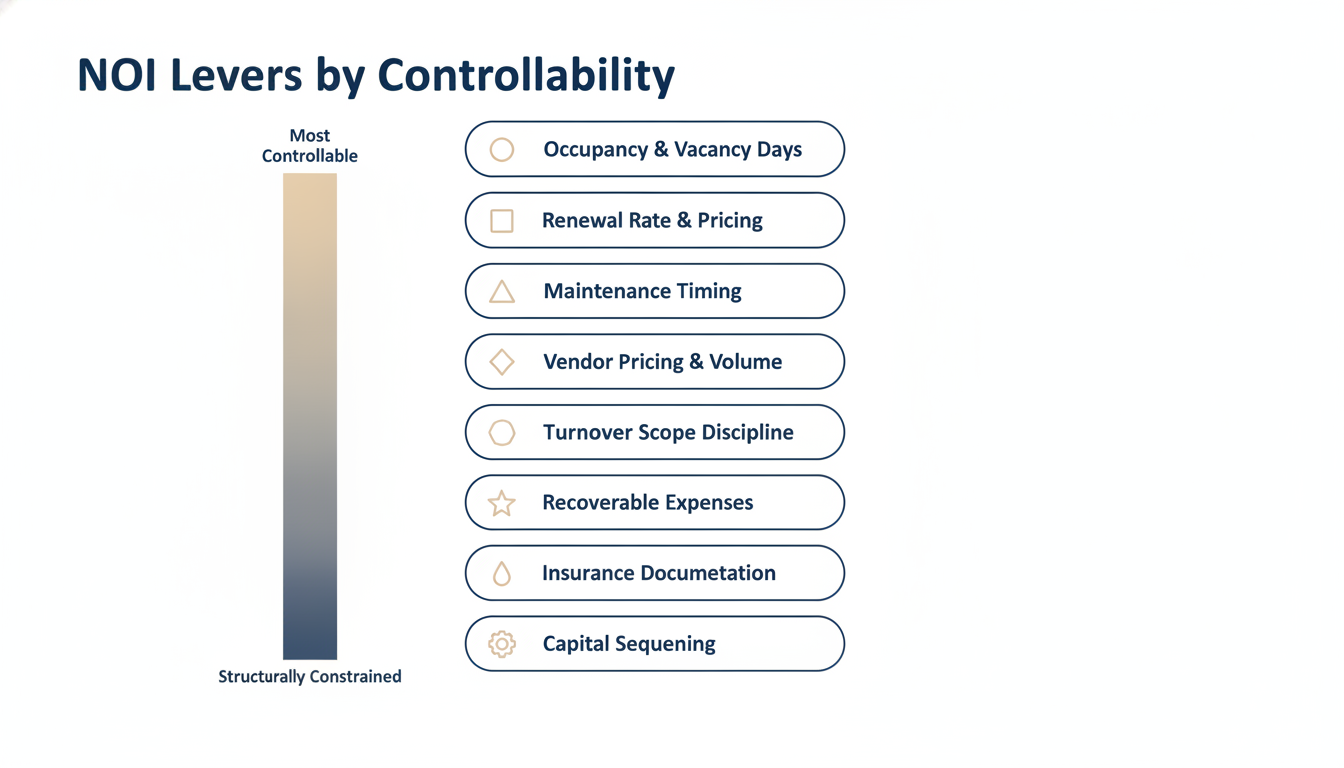
1. Occupancy and Vacancy Days
Vacancy is the largest controllable line item in most residential portfolios, and it is the only one where the loss is permanently unrecoverable. A deferred expense can be paid later. A vacant day cannot be re-rented later.
Vacancy days are produced by operational sequence, not by the market alone:
- How early notice-to-vacate is received and how early marketing begins
- Whether turnover scope is defined before move-out or discovered after
- Whether vendors are on a standing bench or sourced on demand
- Whether the unit is genuinely rent-ready when showings start
- How quickly applications are screened and decisions returned
Each of those is a process, and each one adds days when it is missing. The mechanics of compressing them are covered in reducing vacancy between tenants in South Florida, and the arithmetic of what a single vacancy costs across a year and a portfolio is covered in how a 30-day vacancy affects your annual NOI.
2. Renewal Rate and Market-Based Renewal Pricing
Renewals are the highest-return operational activity in residential property management, because a renewal avoids the entire turnover and vacancy cost structure while preserving income continuity.
But renewal rate and renewal pricing are two separate decisions, and owners commonly collapse them. Two failure patterns:
- Automatic flat increases applied without reference to current market conditions or the quality of the tenancy. These can push out a reliable, low-maintenance tenant whose replacement costs far more than the increase was worth.
- No increase at all, held year after year to “avoid vacancy.” A unit priced below market for several consecutive renewals accumulates a gap that eventually has to be closed, usually through a turnover, and the foregone income in the meantime is never recovered.
The disciplined version is a documented renewal process: begin well before expiration, evaluate current market conditions for that specific unit type and submarket, weigh payment and care history, model the cost of the likely alternative, and make a priced decision with a rationale attached. That last part matters for a trustee or executor, who may need to show beneficiaries that renewal pricing was a considered judgment rather than inattention.
3. Maintenance Timing and the Planned-Versus-Emergency Differential
The same repair carries a different price depending on when it is performed. Scheduled work is competitively bid, scoped in advance, performed during normal hours, and completed before secondary damage develops. Emergency work is dispatched at whatever rate is available, at whatever hour, with whatever scope the failure has already created.
South Florida amplifies the differential. Cooling systems run nearly year-round. Humidity means a slow leak becomes a moisture and material problem quickly. Storm season compresses contractor availability precisely when demand spikes. A sealant repair scheduled in April and the same failure discovered in September are not the same job.
Planned maintenance also protects the expenses around the repair: fewer tenant disruptions, less collateral damage, better renewal outcomes, and a cleaner claim and insurance record. The operating rhythm is laid out in the annual maintenance schedule for South Florida rental properties, and the strategic case is in preventative maintenance as an asset protection strategy.
4. Vendor Pricing and Portfolio Volume
An owner with three properties calling a contractor once a year is a retail customer. A management operation directing recurring, predictable volume across many properties is a different kind of counterparty.
The NOI effect shows up in more places than the hourly rate:
- Standing pricing on routine and recurring work rather than ad hoc quotes
- Response priority during storm season and peak cooling demand, which reduces vacancy days and secondary damage
- Consistent scope definition, so the same job is not re-specified and re-priced each time
- Verified licensing and insurance, which reduces liability exposure
- Fewer repeat visits because the work was scoped and verified correctly
None of that requires a large portfolio on the owner’s part. It requires being inside an operation that already has the volume. That is one of the structural arguments for portfolio management services for multi-property investors.
5. Turnover Scope Discipline and Over-Improvement
Turnover is where NOI is most often spent without a return, because scope drifts. A unit needs paint, a cleaning, and two repairs, and it receives new flooring, upgraded fixtures, and a countertop replacement that the achievable rent does not support.
Scope discipline means asking one question of every line: does this item support achievable rent, reduce a future failure, or protect the asset? If the answer is no to all three, it is a preference, not an operating decision.
The inverse error is equally expensive. Under-scoping a turnover produces longer marketing time, weaker applicant quality, more first-year maintenance calls, and a shorter tenancy. The objective is correct scope, defined against a written rent-ready standard rather than negotiated in the moment. The full cost structure is broken down in the true cost of tenant turnover, and the standard itself in rent-ready systems.
6. Recoverable Expenses and Lease Structure
Some operating costs can be allocated by lease where Florida law and the specific property permit it. Utility responsibility, pest control, filter replacement, landscaping on a single-family rental, and similar recurring items are structural decisions made at lease drafting, not adjustments made mid-term.
Two disciplines matter here. First, the lease has to be clear and enforceable, which is a question for Florida counsel rather than a template. Second, assigning a task to a tenant is not the same as ensuring it happens. A lease that makes the tenant responsible for filter replacement without any verification mechanism has moved a cost off the ledger and moved a risk onto the equipment. Assigned responsibility still requires a verification step, or the savings reappear later as a capital replacement.
7. Insurance and the South Florida Premium Environment
Insurance is the expense line South Florida owners most often treat as fixed. Premium levels are driven by market and regulatory conditions well outside any single owner’s control, and rates, availability, and underwriting requirements change. Current information on the Florida market is published by the Florida Office of Insurance Regulation.
What is controllable is the file the property presents at renewal. Underwriters price uncertainty, and documentation reduces it:
- Roof age, condition evidence, and documented repairs or replacement
- Opening protection, verified and matched to openings
- Documented electrical, plumbing, and water-heater condition and updates
- Wind mitigation features documented as the carrier requires
- A clean, explained claim history rather than an unexplained pattern
- Dated inspection records showing continuous, prudent maintenance
The point is not that documentation guarantees a lower premium. It is that an owner who cannot produce current condition evidence has surrendered the only part of the equation they influence. Beam covers this in more depth in what South Florida owners should know about insurance rates. Coverage decisions should be made with a licensed Florida insurance professional.
8. Capital Sequencing
Capital items sit below the NOI line, but the timing of capital work determines how much cost lands above it. A forecast turns capital into a scheduled, competitively priced project. No forecast turns the same item into an emergency operating expense, often accompanied by vacancy days and collateral damage.
Capital sequencing requires a per-property register: system, age, condition, repair frequency, expected replacement window, and preliminary cost range. Age alone is not a replacement trigger. Age plus declining condition plus rising repair frequency is. And sequencing across a portfolio prevents the scenario where three properties need major systems in the same quarter because no one was tracking them together.
An Illustrative Worked Example

The figures below are illustrative arithmetic chosen for round numbers. They are not market data, not average rents, not a projection, and not a representation of results for any property. Their only purpose is to show how the levers interact.
Assume a hypothetical single-family rental with a scheduled rent of $3,000 per month, or $36,000 per year in gross scheduled rent.
Reactive operating model, hypothetical year:
| Line | Amount |
|---|---|
| Gross scheduled rent | $36,000 |
| Vacancy loss (45 days) | ($4,438) |
| Effective gross income | $31,562 |
| Property taxes | ($6,000) |
| Insurance | ($5,000) |
| Repairs and maintenance (emergency-weighted) | ($4,800) |
| Turnover cost (over-scoped) | ($4,000) |
| Landscaping, pest, administrative | ($1,800) |
| Management fee (8% of collected) | ($2,525) |
| Net operating income | $7,437 |
Managed operating model, same hypothetical property and same rent:
| Line | Amount |
|---|---|
| Gross scheduled rent | $36,000 |
| Vacancy loss (15 days) | ($1,479) |
| Effective gross income | $34,521 |
| Property taxes | ($6,000) |
| Insurance | ($4,600) |
| Repairs and maintenance (planned-weighted) | ($3,200) |
| Turnover cost (scope-disciplined) | ($2,400) |
| Landscaping, pest, administrative | ($1,700) |
| Management fee (8% of collected) | ($2,762) |
| Net operating income | $13,859 |
The rent never changed. The differences are 30 vacancy days, the planned-versus-emergency maintenance mix, turnover scope discipline, a documented insurance file, and vendor pricing. In this illustration NOI moves by roughly $6,400 on a property with $36,000 of scheduled rent.
Now apply the valuation arithmetic. At a hypothetical 6% cap rate, that $6,422 of NOI difference corresponds to roughly $107,000 of implied value. At 5.5%, roughly $117,000. Again — illustrative arithmetic on hypothetical inputs, not a valuation. But the structure of the point holds regardless of the numbers plugged in: durable operating improvement is an equity event, not just a cash-flow event.
Why the Management Fee Is a Small Term in the Equation
In the illustration above, the management fee moved by $237 between the two models. The vacancy line moved by nearly $3,000 and the maintenance and turnover lines by another $3,200.
That is the structural reason fee-shopping is a poor way to improve NOI. The fee is a small, visible, easily compared number. The lines it is supposed to control — vacancy days, maintenance timing, turnover scope, vendor pricing, capital sequencing — are larger, less visible, and harder to compare. An owner who selects a manager on fee alone has optimized the smallest term and left the largest ones unmanaged.
The right question is not “what is the fee?” It is “which of these eight levers does this operation actually run, and what evidence can it produce?” A manager who collects rent and dispatches repair calls is not operating any of them. Beam’s framing of that distinction is in operational oversight vs. rent collection, and the diligence questions are in how to evaluate a property management company in South Florida.
Reactive Model vs. Managed Model
| Operating dimension | Reactive model | Managed model |
|---|---|---|
| Vacancy | Marketing begins at or after move-out | Notice triggers a scheduled turnover and marketing sequence |
| Renewals | Handled near expiration, flat or skipped | Started early, priced to market, decision documented |
| Maintenance | Dispatched when reported | Scheduled by interval and condition, exceptions escalated |
| Vendors | Sourced per incident at retail pricing | Standing bench with recurring volume and priority response |
| Turnover | Scope negotiated during the vacancy | Scope defined against a written rent-ready standard |
| Insurance | Premium accepted as fixed | Condition file maintained for underwriting |
| Capital | Discovered at failure | Forecast, sequenced, competitively bid |
| Reporting | Invoices | Portfolio exceptions, condition trend, upcoming decisions |
What This Means for Trustees and Executors
A fiduciary has a different obligation than an investor. The investor wants NOI maximized. The trustee or executor has to account for income performance and show that the result reflects prudent administration rather than drift.
That makes documentation part of the work product, not a byproduct. A defensible file shows the vacancy interval and what was done to close it, how each renewal was priced and why, which maintenance was scheduled versus emergency, how vendors were selected, and which capital items were identified and either funded or deliberately deferred with a stated reason.
An estate that produced modest income with a complete record is a defensible administration. An estate that produced modest income with no explanation is not. Beam’s approach to property management for trustees and estate executors treats the record as part of the deliverable.
How Beam Operates the NOI Levers
Beam Management Group runs these levers as a standing process across an owner’s properties rather than as a set of good intentions:
- Establish a condition and system baseline per property so capital timing is known, not discovered.
- Run a scheduled maintenance calendar with documented findings and verified completion.
- Manage renewals on a defined early timeline with market-referenced pricing and recorded rationale.
- Compress vacancy by triggering turnover scope and marketing at notice, not at move-out.
- Hold turnover scope to a written rent-ready standard rather than to preference.
- Maintain a vetted vendor bench with recurring volume, verified credentials, and priority response.
- Keep the insurance condition file current ahead of renewal and underwriting review.
- Forecast and sequence capital across the portfolio so replacements are planned rather than emergency-priced.
- Report portfolio exceptions and upcoming decisions so capital is directed where it protects the most NOI.
Each item on that list corresponds to a line on the income statement. That is the whole argument.
Find the NOI Levers in Your Portfolio
If your portfolio is producing less than the rents suggest it should, the gap is almost never in the rent. It is in vacancy days, emergency-priced repairs, undisciplined turnover scope, and capital that was discovered instead of planned. Beam can run those operations across every property so you can spend your attention on acquisition, refinance, and disposition decisions rather than on vendor dispatch.
If you are a trustee, executor, or inheritor accountable for how these assets perform, the same operating discipline produces something equally valuable: a documented record showing that income performance was managed deliberately and that decisions affecting the estate were considered and recorded.
Beam is built for multi-property owners, inheritors, trustees, and executors who measure results in net operating income and total cost of ownership. Contact Beam Management Group to review where NOI is actually being lost across your properties and which levers will move it first.
FAQ
What is NOI on a rental property?
Net operating income is operating income minus operating expenses, calculated before debt service, capital expenditures, depreciation, and income taxes. Operating income means collected rent and other recurring property revenue. Operating expenses include taxes, insurance, management, maintenance, leasing and turnover costs, owner-paid utilities, association dues where applicable, and administrative costs. Because it excludes financing, NOI allows properties to be compared independent of how each owner borrowed.
Is raising rent the best way to increase NOI?
Rarely, because rent is the lever the market controls most and the owner controls least. Achievable rent is set by the submarket, unit type, and condition. The levers an owner does control — vacancy days, renewal timing and pricing, planned versus emergency maintenance, vendor pricing, turnover scope, recoverable expenses, insurance documentation, and capital sequencing — are usually available every month rather than once per lease term, and their combined effect on NOI is typically larger than a modest rent adjustment.
Does the property management fee reduce NOI?
Yes, the fee is an operating expense. The relevant question is proportionality. The fee is a small term relative to the lines it is intended to control: vacancy days, maintenance timing, turnover scope, vendor pricing, and capital sequencing. Selecting a manager on fee alone optimizes the smallest number on the statement while leaving the largest ones unmanaged. The useful comparison is which operating levers the manager actually runs and what evidence they can produce.
How does improving NOI affect property value?
For income-producing property, value is commonly expressed as NOI divided by a capitalization rate. At a given cap rate, durable NOI improvement translates into a multiple of that improvement in implied value. Owners do not control cap rates, which are set by market conditions and asset specifics, but NOI is the side of the equation operations can influence. The improvement must be durable rather than one-time to be underwritten by a buyer, appraiser, or lender.
Are capital expenditures part of NOI?
Generally no. Capital items such as a roof or HVAC system replacement typically sit below the NOI line, while repairs sit above it as operating expenses. This creates an operational consequence: an owner who does not forecast capital replacement does not avoid the cost, but converts planned capital work into unplanned, emergency-priced operating expense that reduces NOI. The specific repair-versus-improvement classification carries tax implications and should be confirmed with a CPA.
Which operating expenses can be recovered from tenants in Florida?
That depends on the lease, the property type, and applicable Florida law. Utility responsibility, pest control, filter replacement, and landscaping on single-family rentals are commonly addressed at lease drafting. Two cautions apply: the lease language should be reviewed by Florida counsel rather than adapted from a template, and assigning a task to a tenant without a verification mechanism moves a cost off the ledger while moving risk onto the equipment.
Can insurance expense really be managed in South Florida?
Premium levels are driven by market and regulatory conditions no single owner controls. What is controllable is the documentation the property presents at renewal and underwriting review: roof age and condition evidence, verified opening protection, documented system updates, wind mitigation features, an explained claim history, and dated inspection records. Documentation does not guarantee a lower premium, but an owner without current condition evidence has given up the only part of the process they influence. Coverage decisions should involve a licensed Florida insurance professional.
How should a trustee document NOI performance for beneficiaries?
Keep a per-property record showing vacancy intervals and the actions taken to close them, how each renewal was priced and why, which maintenance was scheduled versus emergency, how vendors were selected and verified, and which capital items were identified and either funded or deliberately deferred with a stated reason. The objective is to demonstrate that income performance reflected considered decisions. Estate accounting requirements vary, so trustees should confirm expectations with Florida counsel and the estate’s CPA.