
Roof and Exterior Maintenance in a Tropical Climate
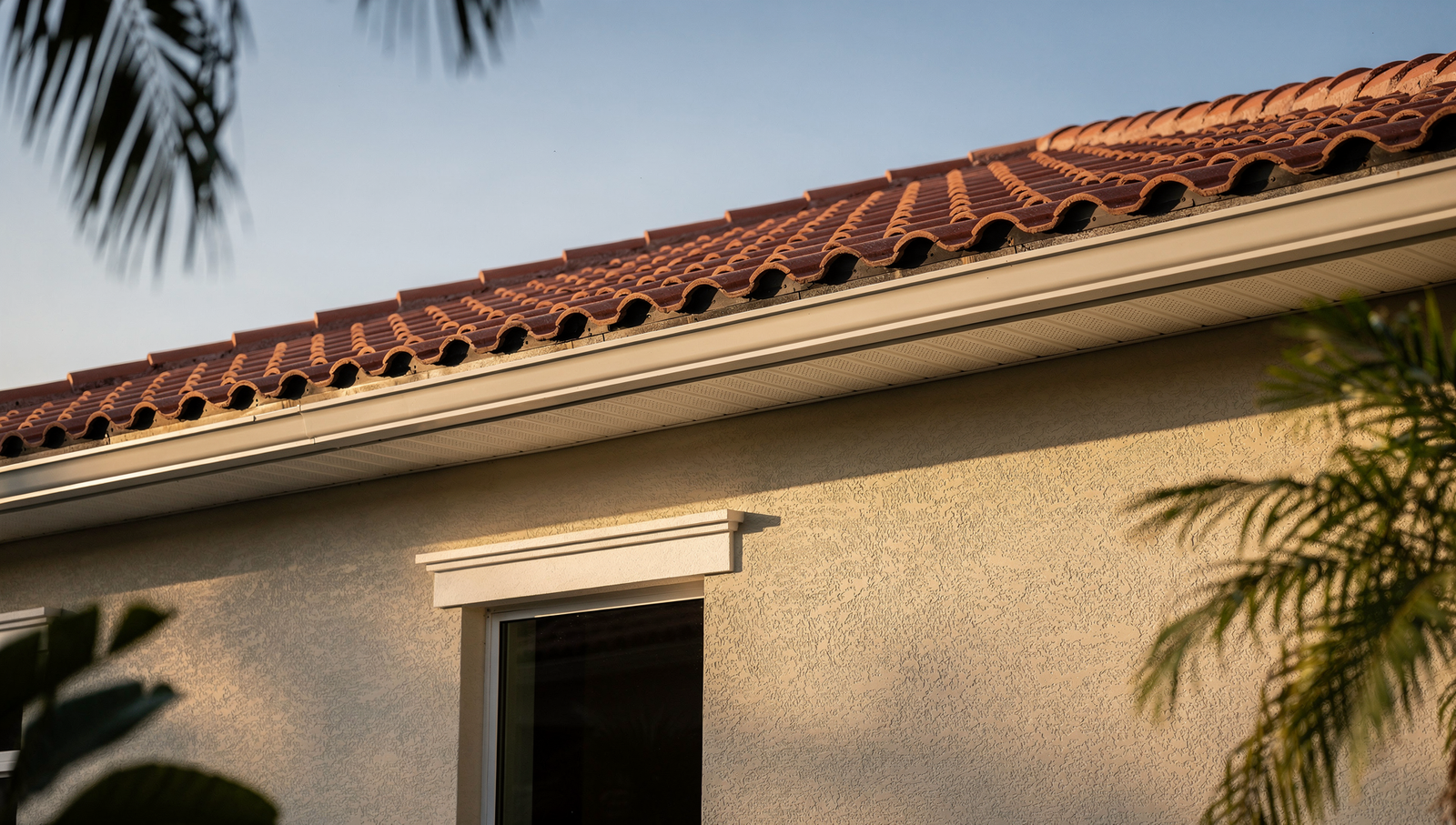
The most expensive envelope conversation an owner has is usually with an underwriter, not a roofer. A renewal questionnaire asks for the roof’s age and the date of its last full replacement. The owner does not know. The carrier orders an inspection, the inspection reports a roof at the end of its documented life with no maintenance record behind it, and the property is non-renewed or quoted at a number that changes the asset’s economics. Nothing failed. No water came through a ceiling. The building simply could not produce evidence of its own condition.
That is the operating reality of the building envelope in South Florida. It is not a storm-season item. It is a continuously loaded, continuously degrading asset that carries the property’s insurability, its refinance profile, its interior condition, and a large share of its capital budget. Salt air, ultraviolet exposure, daily thermal cycling, and sustained humidity work on it every day of the year, including the calm ones.
Storm-specific preparation and post-event response are covered separately in the hurricane season prep checklist for South Florida rentals, how to protect a rental property before a hurricane, and the post-hurricane property inspection protocol. The calendar that positions recurring work across the operating year sits in the annual maintenance schedule for South Florida rental properties. This article is about the other 350 days: how the shell of a building wears out here, where failures actually begin, and how a multi-property owner manages that decline as a scheduled financial event instead of an emergency.
What the Climate Actually Does to a Building Shell
Four loads act on a South Florida exterior more or less continuously, and they compound rather than alternate.
Salt aerosol. Airborne chloride does not stop at the beach. It travels inland on prevailing wind and settles on every exposed metal surface. In the envelope, that means roof fasteners, drip edge and flashing, gutter hangers, soffit screws, hurricane clips and straps where exposed, railing anchors, and light-gauge trim. Corrosion at a fastener is not a cosmetic issue. A fastener is a load path. When it loses section, the component it holds is no longer attached the way the assembly was designed and permitted.
Ultraviolet exposure. UV is what ends most sealants, coatings, membrane surfacing, and asphalt-based products. It breaks down the polymers that keep a material flexible and adhered. Sealant that has gone chalky, brittle, or crazed is not “old-looking.” It has stopped functioning as a joint, and the joint is where water enters.
Thermal cycling. A dark roof surface in direct South Florida sun runs far hotter than ambient air, then drops sharply during an afternoon storm and overnight. The U.S. Department of Energy’s Guidelines for Selecting Cool Roofs notes that reducing roof operating temperature can extend roof service life, which is the same point in reverse: sustained high surface temperature and repeated expansion and contraction accelerate wear on the covering, the fasteners holding it, and every sealed joint in it. Dissimilar materials expand at different rates, and the joint between them is where the movement concentrates.
Sustained humidity. High ambient moisture keeps assemblies from drying. A wall or roof deck that gets wet in a temperate climate dries between events. Here, it may not. Slow drying is what converts a minor intrusion into rot, delamination, and biological growth. The U.S. Environmental Protection Agency is direct on the mechanism: mold control is moisture control, and moisture problems should be found and fixed promptly. An envelope defect is a moisture source with a permanent supply. Interior moisture management is addressed in mold prevention in South Florida rental properties.
The practical consequence for an owner: exterior components in this market do not reach their published service life by default. Coastal exposure, orientation, shading, and installation quality move the number, and the only way to know where a specific building sits is to look at it on a schedule and write down what you saw.
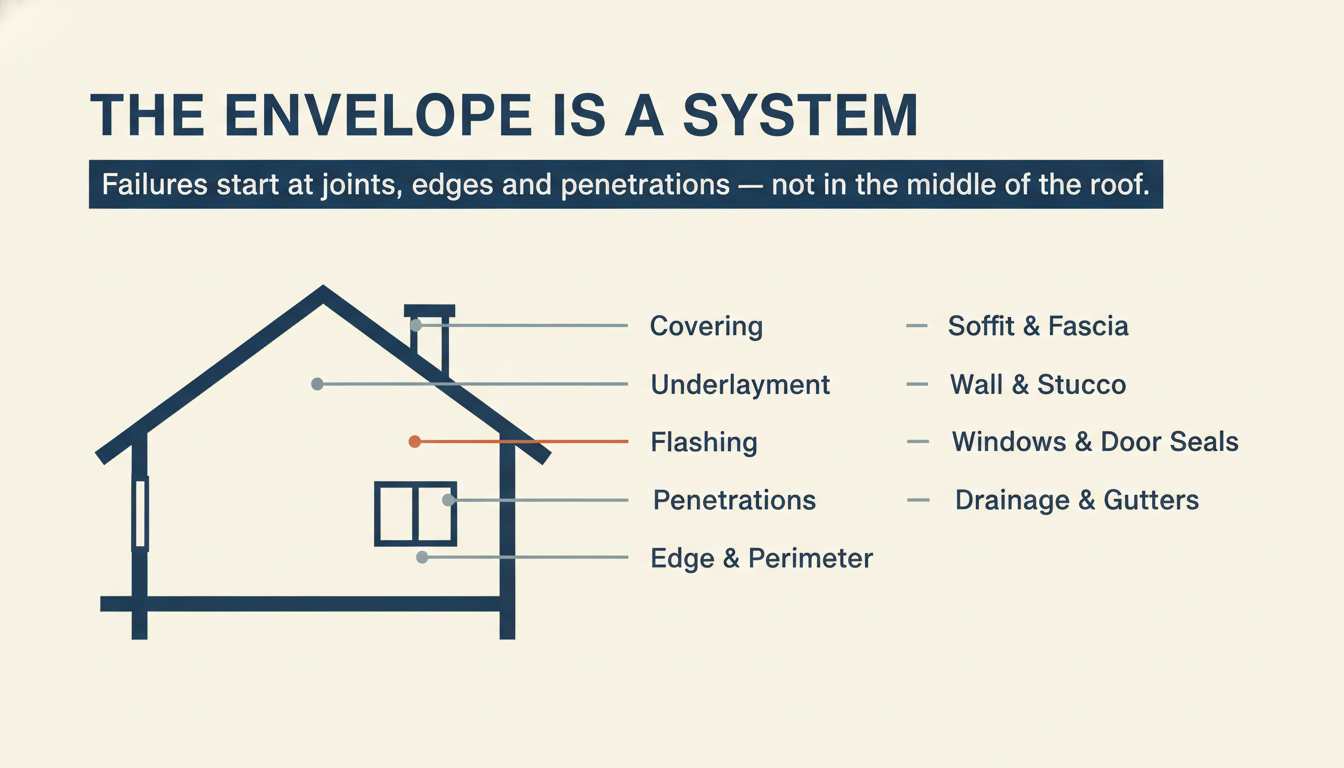
The Roof Is a System, and Failures Start at the Edges
Owners think about the roof as the covering — tile, shingle, metal, or membrane. Underwriters, adjusters, and water do not. A roof is an assembly of at least six parts, and the covering is rarely where the problem begins.
Covering. The visible layer. It sheds bulk water and takes the UV and impact load. Cracked, slipped, or missing tiles, granule loss on shingles, blistering or ponding on flat sections, and fastener backout on metal panels are all findings, not emergencies, if they are caught while they are still isolated.
Underlayment. The actual water barrier on most steep-slope roofs. It ages under heat whether or not the covering looks intact. A tile roof can present well from the street while the underlayment beneath it is at the end of its life. This is why “the tile looks fine” is not a condition assessment, and why roofs are frequently re-covered rather than repaired.
Flashing. Wall intersections, chimneys, curbs, valleys, and transitions. Flashing failures produce a disproportionate share of interior water damage because the water enters at a concealed junction and travels before it appears.
Penetrations. Plumbing vents and their boots, exhaust terminations, HVAC curbs and line-set entries, skylights, solar attachments, satellite mounts, and anything else somebody drilled through the roof. Pipe boots are a known consumable that degrade under UV well before the roof does. Every penetration added after the original installation is a joint someone else sealed, and its quality is unknown until it is inspected.
Edge and perimeter detail. Drip edge, eave and rake terminations, and the roof-to-wall transition. This is where wind pressure concentrates and where corrosion attacks the fasteners holding the assembly down. Perimeter detail is also the first area a competent inspector examines, because a compromised edge undermines everything inboard of it.
Drainage path. Where water goes after it leaves the covering, including valleys, crickets, scuppers, and the gutter system.
The operating rule that follows: a roof should be assessed as an assembly by a licensed roofing contractor, with findings recorded per component. “Roof OK” is not a record. “Underlayment estimated at year 18 of expected life, three pipe boots cracked, valley flashing corroded at northeast corner, drip edge fasteners showing rust bleed” is a record — and it is the difference between planning a replacement and reacting to a ceiling stain.
Soffits, Fascia, and the Ventilation Path
Soffit and fascia get treated as trim. They are structural and functional components of the envelope, and in this climate they fail quietly.
Fascia carries the gutter and terminates the rafter tails. When it holds moisture — usually because a gutter overflowed against it repeatedly, or a coating failed and was not renewed — it rots from behind. The paint can look acceptable while the substrate is gone. Soffit panels close the underside of the overhang and, when vented, admit the intake air that ventilates the attic assembly. Damaged, detached, or improperly blocked soffit changes attic airflow, and attic conditions in a humid climate drive both energy performance and moisture behavior at the roof deck.
Soffits are also the most common wildlife and insect entry point on a South Florida rental, and an open soffit panel is frequently the first visible symptom of a fascia problem behind it.
Inspection items worth recording: fascia coating condition and any soft spots, gutter attachment integrity, soffit panel security and vent blockage, staining at the underside of the overhang, and any daylight visible from the attic at the eave.
Sealants, Openings, and Coatings Have Life Cycles
The parts of the envelope with the shortest service lives are the cheapest to maintain and the most expensive to ignore.
Sealant joints. Around window and door frames, at control joints in stucco, at dissimilar-material transitions, and at penetrations through walls. Sealant is a wear item with a defined life that UV shortens. It should be inspected on a cycle and replaced on condition — chalking, loss of adhesion at one face, cracking, or hardening are all end-of-life indicators. A failed perimeter joint at a window is one of the most common non-roof water intrusion paths in South Florida residential construction, and it presents as interior staining that owners frequently misdiagnose as a roof leak.
Windows and doors. Beyond the perimeter seal: weatherstripping compression, sill drainage paths that are supposed to weep and instead are painted or blocked, threshold seals, glazing seal condition, and hardware corrosion on coastal properties. Sliding door tracks that no longer drain are a routine source of water at the interior floor line.
Stucco. The dominant wall assembly in this market and one that hides its problems well. Hairline shrinkage cracking is common and usually cosmetic. Pattern cracking, cracking that follows framing lines or radiates from openings, bulging, hollow-sounding areas, efflorescence, and staining below a joint are not. Stucco is a reservoir cladding: it absorbs water and relies on the drainage plane, flashing, and weep detail behind it. When those are compromised, the wall stays wet and the damage occurs where it cannot be seen. Assessment and repair are licensed contractor work, and a repair that only addresses the visible crack without the cause repeats within two seasons.
Exterior coatings. Paint and elastomeric coatings are the sacrificial UV and moisture barrier over the wall assembly. They are also the single maintenance item most often deferred by absentee owners, because a faded building still rents. Coating intervals should be set by the manufacturer’s specification for the product actually applied, the substrate, and the exposure — not by a rule of thumb. What matters operationally is that the interval is documented, the last date is known, and the decision to defer is made deliberately rather than by inattention. Recoating a sound wall is maintenance. Recoating a wall after the substrate has taken on water is repair, at a different order of cost.
Drainage Is an Envelope Component, Not Landscaping
Gutters, downspouts, and grading get filed under yard care. They belong in the envelope program, because their entire function is controlling where roof water goes.
South Florida rainfall arrives in high-intensity bursts. A gutter that is undersized, sagging, disconnected, or packed with organic debris does not simply overflow harmlessly. It sheets water down the fascia, saturates the soffit, drives moisture against the wall assembly and the window head, and discharges concentrated volume at the foundation. Downspouts that terminate at the base of the wall move a roof-sized catchment area directly into the soil beside the building, week after week.
Items that belong on the recorded inspection: gutter cleanliness and slope, hanger and fastener condition with attention to corrosion, seam integrity, downspout attachment and discharge distance from the structure, splash blocks or extensions in place, evidence of overflow staining on fascia or wall, and grading that carries water away rather than holding it against the slab. Ponding near a foundation after a routine storm is a finding that should generate a work order, not a shrug.
Roof Age, Condition, and Insurability
This is the part of envelope management that has moved from maintenance into underwriting, and it is currently one of the most consequential issues in South Florida residential ownership.
Florida law addresses roof age directly in homeowners’ insurance. Under section 627.7011(5), Florida Statutes, an insurer may not refuse to issue or renew a homeowners’ policy on a residential structure with a roof less than 15 years old solely because of the roof’s age. For a roof at least 15 years old, the insurer must allow the owner to obtain an inspection by an authorized inspector, at the owner’s expense, before requiring replacement as a condition of issuing or renewing — and may not refuse solely because of roof age if that inspection indicates the roof has five or more years of useful life remaining. The statute also defines how roof age is calculated: from the last date on which 100% of the roof’s surface area was built or replaced under the building code in effect at that time.
Three operating implications for a portfolio owner, and one important caveat.
First, roof age is a specific, documented date, not an estimate. If you cannot produce the permit and the completion date for the last full replacement, you are negotiating from a weaker position at every renewal. On inherited property, establishing that date through permit records should be an early task.
Second, an inspection is a lever, and its outcome depends on condition you controlled or failed to control over the preceding decade. Maintained flashing, intact boots, sound edge detail, and a documented service history support a favorable useful-life finding. Deferred maintenance does the opposite.
Third, the statutory language above applies to homeowners’ policies. Investment property is frequently written on dwelling fire, landlord, or commercial residential forms, and coverage available to a portfolio owner may sit outside that specific provision. Carrier appetite, inspection requirements, and roof condition standards vary by insurer and by form. Confirm your own position with your licensed agent and review your policy; broader market context is discussed in what South Florida owners should know about insurance rates. Current filings, company information, and consumer resources are published by the Florida Office of Insurance Regulation.
The strategic point holds across forms. In this market, roof condition is not only a maintenance variable. It is an insurability variable, and insurability is a financing variable.
Replacement as a Scheduled Capital Event
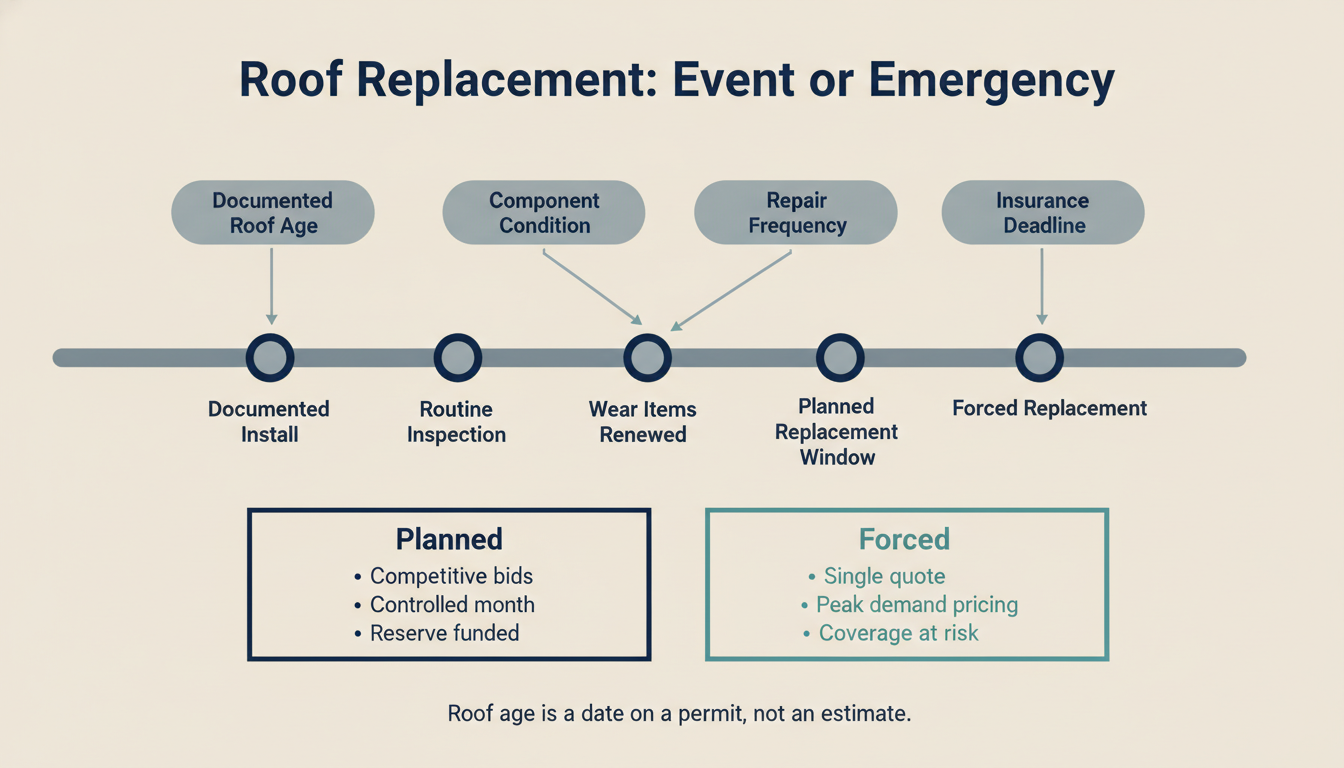
A roof replacement is one of the largest single expenditures in a residential rental’s life. Whether it is a planned capital event or a crisis is determined years earlier, by whether anyone was tracking condition.
| Reactive Model | Managed Model |
|---|---|
| Roof age unknown or “sometime before we bought it” | Permit date and full-replacement date on file per property |
| Condition assessed when a ceiling stains | Scheduled licensed inspection with per-component findings |
| Sealants and boots replaced after intrusion | Wear items renewed on documented cycle |
| Replacement triggered by leak, storm, or carrier demand | Replacement window forecast from age, condition, and exposure |
| One bid, urgent timeline, peak demand pricing | Competitive scoping in a controlled month |
| Interior repairs, tenant disruption, possible relocation | Work sequenced around occupancy or turnover |
| Insurance renewal handled defensively | Condition evidence presented proactively at renewal |
| Capital shock absorbed in a single quarter | Reserve funded against a known schedule |
Inputs that belong in the forecast for every property:
Documented age against expected service life for the specific system installed, adjusted for coastal exposure and observed condition rather than assumed.
Component condition trend, because underlayment, flashing, and edge detail age on their own curves and often determine the replacement date before the covering does.
Repair frequency. Three repairs in two seasons on the same roof is a replacement signal regardless of age.
Insurance and financing posture. If a roof is approaching the age at which carriers in your segment demand inspection or replacement, the replacement decision has a deadline set by the underwriting calendar, not by the roof.
Occupancy and turnover schedule, since sequencing major exterior work into a planned vacancy reduces disruption cost and supports a stronger re-lease position. The same sequencing discipline appears in rent-ready systems.
Portfolio concentration. Owners who acquired several properties in the same period frequently own several roofs of the same vintage. Discovering that in year 19 across four buildings is a liquidity event. Discovering it in year 12 is a capital plan. Visibility across addresses is one of the practical functions of portfolio management services for multi-property investors.
What a Documented Envelope History Is Actually Worth
Condition records are usually filed as maintenance paperwork. They function as financial instruments at four specific moments.
At insurance renewal or placement. A dated inspection history, permit records, and evidence of maintained flashing and sealants change the conversation from an underwriter’s assumption to your documentation.
At a claim. Carriers distinguish between sudden damage and long-term deterioration. An owner who can show scheduled inspections, prompt repairs, and renewed wear items is arguing from a maintained-condition record. An owner with nothing is arguing against a wear-and-tear characterization with no evidence.
At refinance or a new loan. Lenders and appraisers price uncertainty. A roof with an unknown age and no condition record is uncertainty, and it shows up in required reserves, repair escrows, or terms. This intersects with the diligence posture discussed in DSCR financing.
At sale. A buyer’s inspector will find the deferred items regardless. The only question is whether you priced them or the buyer does, with a contingency and a negotiating advantage. That mechanism is examined in how strong property management affects resale value, and the broader preservation argument in property value protection strategies for passive investors.
For a trustee or executor, there is a fifth: the record is evidence of prudent administration. Beneficiaries and courts evaluate process. A roof that failed is a fact. A roof that failed while under a documented inspection and capital-planning program is a defensible fact. Beam’s approach to property management for trustees and estate executors treats envelope documentation as part of the estate record for that reason.
What an Absentee Owner Structurally Cannot Assess
Remote ownership fails hardest on the envelope, because almost nothing that matters is visible from the ground, from the street, or from a photograph taken at an unknown date.
An owner reviewing paperwork from another state cannot confirm:
- Whether the underlayment beneath an intact-looking tile roof is near the end of its life
- Whether pipe boots and penetration seals have cracked since the last visit
- Whether edge and perimeter fasteners are corroding
- Whether flashing at a wall intersection is still sealed or merely still present
- Whether soffit panels are secure and eave venting is unobstructed
- Whether fascia is sound behind acceptable-looking paint
- Whether window perimeter sealant has lost adhesion on one face
- Whether stucco cracking is cosmetic shrinkage or a pattern indicating a moisture or movement problem
- Whether gutters actually drain during a heavy rain, or overflow against the wall
- Whether water stands near the foundation after a routine storm
- Whether a repair invoice describes work that addressed a cause or only a symptom
- The actual date of the last full roof replacement, absent permit research
None of that is knowable from a rent statement or a vendor invoice. It requires a person on site, on a schedule, working to a defined standard, photographing components and recording findings against the prior visit. That verification gap is the core requirement described in what absentee owners need from a property manager, and the distinction drawn in operational oversight vs. rent collection.
It is also why the envelope is where deferred maintenance concentrates in remotely held portfolios. Interior problems generate tenant complaints. The exterior generates nothing until it generates everything at once. The economics of that pattern are the subject of preventative maintenance as an asset protection strategy and the broader framework in residential asset protection.
How Beam Manages the Envelope Across a Portfolio
- Establish a baseline per property: roof type, documented replacement date from permit records, coating history, opening and sealant condition, drainage configuration, and coastal exposure.
- Schedule licensed inspections and record findings by component rather than by building, so trends are visible year over year.
- Photograph the same components from the same vantage points each cycle, dated, to make change observable.
- Track wear items — boots, sealant joints, coatings, gutter hardware — on their own renewal cycles instead of waiting for intrusion.
- Route repeat repairs at the same location into a cause diagnosis by a licensed contractor rather than a third patch.
- Maintain permit and warranty documentation in a form that answers an underwriter, lender, adjuster, or buyer without a search.
- Forecast roof and coating replacement windows per property, then flag portfolio-level vintage concentration before it becomes simultaneous.
- Present capital recommendations with condition evidence, competitive scoping, and the cost of waiting, then sequence approved work into controlled months.
The result is not a building that never needs a roof. It is a portfolio where every roof has a known age, a known condition, a known replacement window, and a file that holds up when someone with financial authority asks for it.
Schedule a Roof and Envelope Condition Review
If you own multiple South Florida rentals and could not state, today, the replacement date of each roof and the last time each building’s sealants and coatings were renewed, that gap is already priced into your insurance position and will be priced again at your next refinance or sale. Beam coordinates the inspection schedule, licensed contractors, condition documentation, and capital forecasting across every property, so envelope spend arrives on a calendar you set.
If you have inherited South Florida rental property, the buildings likely came with no envelope history at all. Establishing documented roof age from permit records, a baseline condition assessment per property, and a forecast replacement window is one of the fastest ways to understand what you actually hold, protect the interiors while decisions are being made, and demonstrate to beneficiaries or a court that the largest capital item in the estate is being managed deliberately.
Beam Management Group works with multi-property investors, inheritors, trustees, and executors who need local operational oversight and verified condition records — not an inspection checklist to run themselves, and not a rent-collection service. Contact Beam Management Group to review the roofs and exteriors across your properties and build a maintenance and capital plan around their documented condition.
FAQ
How often should the roof and exterior be inspected on a South Florida rental property?
Set a recurring schedule rather than an event-driven one. A common approach for a managed portfolio is a documented exterior condition review at least annually by qualified personnel, with a licensed roofing contractor assessing the roof assembly on an interval appropriate to its age and condition, plus a targeted review after any significant weather event. Frequency should increase as a roof ages and for properties with direct coastal exposure.
Why does salt air matter if the property is not on the beach?
Airborne chloride travels inland on prevailing wind and settles on exposed metal. In a building envelope, that means roof fasteners, flashing, drip edge, gutter hangers, and exposed connectors. Corrosion at a fastener is a load-path issue, not a cosmetic one, because the component it secures is no longer attached as designed. Coastal properties warrant closer inspection intervals, but inland properties are not exempt.
Where do most roof leaks actually start?
Rarely in the middle of the covering. Most water intrusion originates at flashing, penetrations such as plumbing vent boots and equipment curbs, valleys, and the roof-to-wall or perimeter edge detail. That is also why a roof that looks intact from the ground can be well into failure, and why assessment should be performed by a licensed roofing contractor on the assembly rather than the visible surface.
Can an insurer refuse to renew a policy because of roof age in Florida?
Section 627.7011(5), Florida Statutes, provides that an insurer may not refuse to issue or renew a homeowners’ policy on a structure with a roof less than 15 years old solely because of roof age, and that for a roof at least 15 years old the owner must be allowed an inspection by an authorized inspector before replacement is required as a condition of coverage. Investment property is often written on dwelling fire, landlord, or commercial residential forms, which may fall outside that provision. Confirm your specific position with your licensed insurance agent.
How is a roof’s age calculated for insurance purposes in Florida?
Under the same statute, roof age is calculated from the last date on which 100% of the roof’s surface area was built or replaced in accordance with the building code in effect at that time, or from the initial date of a partial replacement where subsequent partial work brought the total to 100%. This is why permit records matter and why an owner’s recollection is not sufficient documentation.
Are stucco cracks a serious problem?
It depends on the pattern. Fine shrinkage cracking is common and often cosmetic. Cracking that follows framing lines, radiates from window and door corners, appears with bulging or hollow-sounding areas, or is accompanied by efflorescence or staining can indicate moisture behind the cladding or movement in the assembly. Because stucco absorbs water and relies on concealed drainage detailing, assessment and repair should be performed by a licensed contractor, and a repair that does not address the cause will recur.
How should a roof replacement be budgeted in a rental portfolio?
As a scheduled capital event with a forecast window, not a contingency. Build the forecast from documented age, per-component condition trend, repair frequency, coastal exposure, insurance and financing deadlines, and the occupancy calendar. Owners who acquired multiple properties in the same period should specifically check for roof vintage concentration across the portfolio, because several simultaneous replacements is a liquidity problem rather than a maintenance problem.
What envelope records should a trustee or executor keep?
Keep permit records and the documented full-replacement date for each roof, every inspection with per-component findings and dated photographs, all repairs with cause and cost, wear-item renewal dates for sealants, boots, and coatings, warranty documentation, insurance inspection reports and correspondence, the forecast replacement window per property, and written reasoning for any deferral. Organized this way, the file supports estate accounting, insurance renewal, and eventual sale, and it evidences prudent administration of the largest capital item on the property.