
Why Operational Oversight Matters More Than Rent Collection
The management fee is the easiest number to compare and the least useful one to decide on. Why operational oversight matters more than rent collection comes down to what each model does to the numbers underneath that fee.
An owner evaluating two proposals at 8 percent and 10 percent is looking at a difference measured in tens of dollars per unit per month. Meanwhile the decision actually being made — who controls vacancy duration, maintenance sequencing, vendor pricing, renewal strategy, and capital timing across the portfolio — routinely moves numbers an order of magnitude larger.
This is not an argument that higher fees are better. Plenty of expensive management is mediocre. It is an argument that the fee is a rounding error relative to the operational outcomes it purchases, and that comparing fees while ignoring those outcomes is how owners end up with the lowest-cost manager and the highest cost of ownership.
What the Fee Actually Buys
Every management relationship sits somewhere on a spectrum between two models.
Rent collection is transactional and reactive. Rent is collected, owner statements are issued, repairs are addressed when reported, tenants are replaced when they leave, and renewals happen or they do not. The manager responds to events.
Operational oversight is systematic and anticipatory. Condition is inspected on a schedule, maintenance is calendared before failure, vendors are managed against standards, turnovers are compressed by sequencing, renewals are priced from market data, and capital needs are forecast rather than discovered.
Both models collect rent. Only one manages the asset. The distinction shows up not in the monthly statement but in the annual one — and most sharply at the moment of sale, refinance, or an insurance claim, when the presence or absence of an operating record becomes financially material.
The Four Places Money Actually Moves
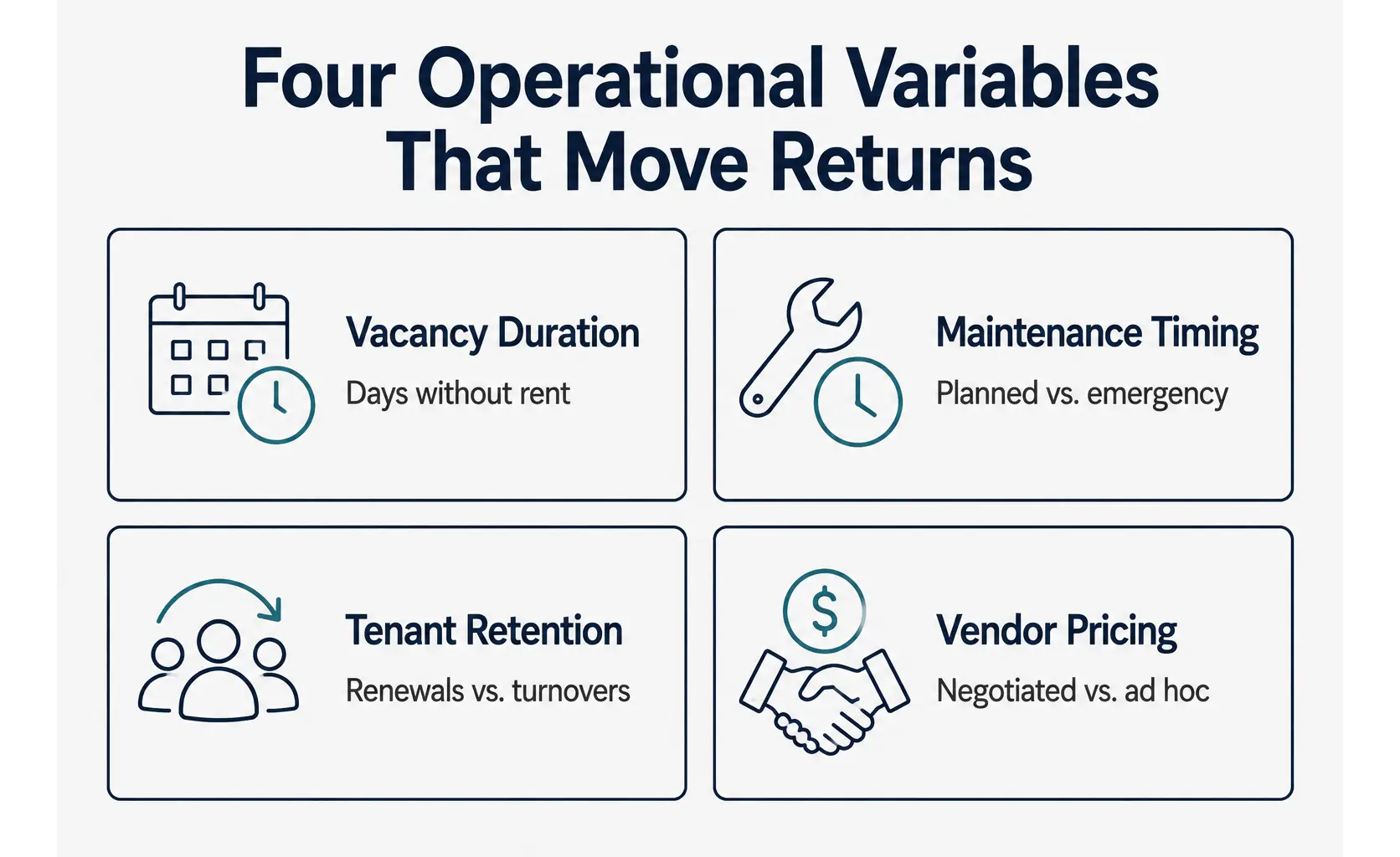
For a portfolio owner, four operational variables dominate return. None of them is the management fee.
1. Vacancy Duration
Days between tenants are the most direct, most controllable loss in the entire operation. A manager who begins turnover work on the notice date rather than the move-out date routinely cuts vacancy by half or more, as covered in reducing vacancy between tenants in South Florida. Across a portfolio with regular turnover, the difference between a 12-day and a 30-day average vacancy exceeds the entire annual management fee on multiple units.
2. Maintenance Timing
The same repair costs materially different amounts depending on when it happens. A serviced HVAC system is a routine expense. The same system failing in August is an emergency call, a rushed replacement, and a frustrated tenant approaching renewal. Reactive maintenance does not save money; it defers and inflates it, which is the core argument of preventative maintenance as asset protection.
3. Tenant Retention
Every renewal avoided is a full turnover cost not incurred: vacancy, make-ready, marketing, screening, and a reset rent trajectory. Retention is driven by maintenance responsiveness, communication consistency, and market-grounded renewal pricing — all operational variables. The full accounting appears in the true cost of tenant turnover.
4. Vendor Pricing and Quality
A manager with standing vendor relationships and volume across a portfolio gets better pricing, faster scheduling, and more consistent work than an owner or manager hiring reactively per incident. Verified work also means the same repair is not paid for twice.
Add these four together across a multi-unit portfolio and the operational spread between competent and reactive management is typically several times the difference between any two fee structures on the market.
Rent Collection Model vs. Operational Oversight Model
Rent Collection Model
- Inspections: On request or when a problem is reported
- Maintenance: Reactive; each item approved individually
- Turnover: Sequential — work begins after the unit is empty
- Renewals: Flat increase or no increase, applied without market analysis
- Vendors: Whoever is available; work not independently verified
- Reporting: Rent received, expenses paid
- Capital planning: None; replacements are discovered as failures
- Owner’s position at sale or refinance: Bank statements and invoices
Operational Oversight Model
- Inspections: Scheduled, photographed, compared against prior condition
- Maintenance: Calendared preventative work plus pre-authorized response thresholds
- Turnover: Overlapping — scope, pricing, and marketing begin at notice
- Renewals: Priced from current comparables, communicated with context
- Vendors: Standing bench, scheduled and verified before payment
- Reporting: Categorized financials, maintenance history, renewal calendar
- Capital planning: System age and condition tracked, replacements forecast
- Owner’s position at sale or refinance: A documented operating history
Total Cost of Ownership: The Right Comparison

The useful way to evaluate a management proposal is to stop comparing fees and start comparing the full annual cost of operating the property.
For each option, an owner should be able to estimate:
- Management fee — the only number most owners compare
- Expected vacancy days per turnover, multiplied by daily rent
- Expected annual maintenance spend, split between planned and emergency work
- Expected renewal rate, which determines how often turnover costs recur
- Expected make-ready cost per turnover, driven largely by in-tenancy maintenance quality
- Capital surprise exposure — the probability of a major system failing without warning
A manager charging two points more, who cuts average vacancy in half, lifts the renewal rate, and prevents one emergency system replacement, is not more expensive. They are meaningfully cheaper, and the gap widens with every additional unit.
Conversely, the cheapest fee attached to reactive operations tends to produce a portfolio with above-market turnover, unpredictable maintenance spend, thin documentation, and a rent roll that drifts below market — all of which reduce both current income and eventual sale value.
Why Operational Oversight Matters More Than Rent Collection in South Florida
Three regional factors amplify the gap between the two models.
The climate punishes deferral faster. Humidity, heat, salt air, and heavy seasonal rain accelerate deterioration. A minor moisture issue here does not stay minor for a full quarter, and HVAC equipment carries a load that inland markets do not impose.
Storm exposure makes documentation financially material. Pre-storm preparation and post-storm condition records affect claim outcomes directly. Owners already absorbing the current market conditions described in what South Florida owners should know about insurance rates have a direct incentive to work with a manager who maintains that record as a matter of routine.
Vendor capacity tightens without warning. After any significant weather event, contractor availability — not budget — becomes the constraint. Established relationships determine who gets scheduled and who waits.
What This Means for a Growing Portfolio
At one property, an owner can absorb reactive management through personal attention. At three, four, or six properties, the same approach compounds: multiple unpredictable maintenance streams, staggered turnovers handled sequentially, renewals happening without pricing analysis, and no consolidated view of condition or capital needs.
This is the operational ceiling most investors hit — not a financing constraint or a deal-flow constraint. It is the point where the portfolio’s operations require a system rather than a person, and where the manager’s role shifts from collecting rent to protecting return. Investors thinking about the next phase of growth, whether through DSCR financing or continued acquisition, need operations that scale without their personal involvement.
The same logic underlies residential asset protection: value is preserved through documented, systematic operations, not through the lowest available fee.
Master Operational Oversight with Beam
Beam Residential operates as a portfolio operations partner: scheduled inspections, calendared preventative maintenance, compressed turnovers, market-based renewal pricing, verified vendor work, and reporting an owner can act on.
If your portfolio is growing but your time isn’t, the question is not which manager charges the least. It is which one produces the lowest total cost of ownership across every unit you hold.
Contact Beam Residential to compare your current operating results against what a systems-driven approach should produce.
FAQ
What is a typical property management fee, and does it matter?
Residential management fees generally fall within a single-digit percentage of collected rent, with additional leasing or renewal fees varying by firm. The fee matters far less than what it purchases, because vacancy duration, maintenance timing, renewal rates, and vendor pricing move considerably more money across a portfolio than the fee difference between two proposals.
What is the difference between rent collection and operational oversight?
Rent collection is reactive: rent is collected, repairs are addressed when reported, and tenants are replaced when they leave. Operational oversight is anticipatory: condition is inspected on a schedule, maintenance is calendared before failure, turnovers are compressed by sequencing, renewals are priced from market data, and capital needs are forecast.
How do I evaluate a property manager beyond the fee?
Ask about inspection frequency and whether reports include dated photographs, the spending threshold they can act on without approval, who verifies vendor work before payment, their maintenance response standard, their hurricane protocol, how renewals are priced, and what documentation you would have if you sold or refinanced in three years.
Does better management actually increase net operating income?
It can, through mechanisms that are individually measurable: fewer vacancy days per turnover, higher renewal rates that avoid turnover costs entirely, planned rather than emergency maintenance spend, better vendor pricing, and renewal rents that track the market instead of drifting below it.
Is professional management worth it for a small portfolio?
It depends on the owner’s proximity, availability, and vendor relationships. The threshold is usually reached when the owner can no longer personally handle same-week vendor coordination, in-person showings, and market-based renewal decisions across every unit — which for most owners happens between two and four properties, and immediately if they live out of state.
How does management quality affect resale value?
Buyers and lenders price uncertainty. A property with documented maintenance history, clean categorized financials, market-rate leases, and no unknown deferred maintenance underwrites more easily and negotiates better than one requiring the buyer to assume the worst about condition and records.
What should I do if my current manager only collects rent?
Start with documentation: request the last twelve months of maintenance history, the most recent inspection report with photographs, and the renewal analysis for each unit. If those do not exist, that is the answer — and it is the same gap that shows up later during a sale, a refinance, or an insurance claim.
Authority Outbound Links
- National Association of Residential Property Managers — professional standards → https://www.narpm.org/
- National Apartment Association — operations and resident retention resources → https://www.naahq.org/