
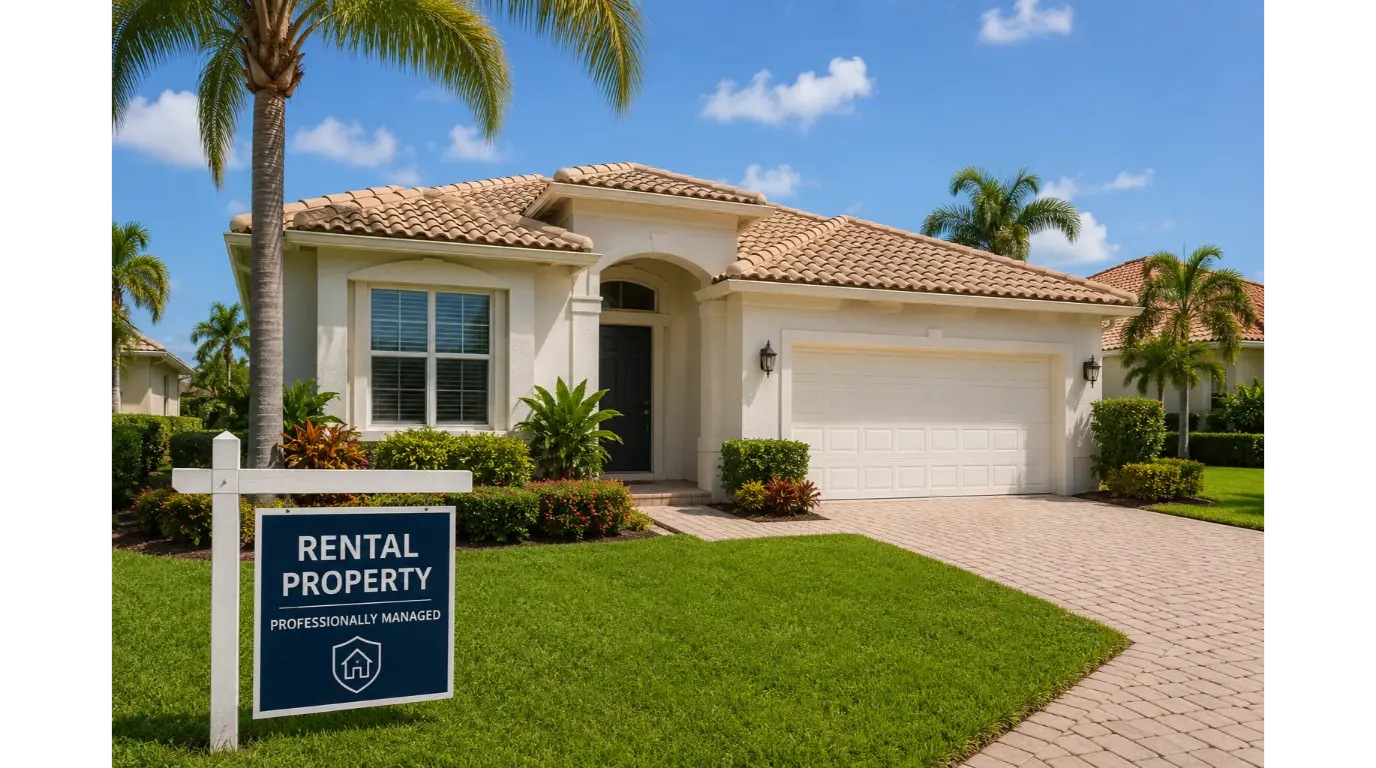
Residential asset protection: How South Florida investors preserve property value and cash flow
Owning a rental property in South Florida is not passive income by default. It becomes passive income when the right operational systems are in place. Without them, what you have is an asset that is slowly losing value — through deferred maintenance, high turnover, tenant damage, and operational gaps that compound quietly over time.
Residential asset protection is the framework that prevents that from happening.
It is not a financial product. It is not insurance. It is the operational discipline of managing a property so that its physical condition, revenue performance, and market value are actively preserved — not left to chance.
What residential asset protection actually means
The term “asset protection” has a legal meaning in estate planning. Here, it means something more operational.
Residential asset protection is the systematic management of a rental property to:
- Maintain and improve its physical condition over time
- Minimize vacancy and revenue disruption
- Attract and retain high-quality tenants
- Prevent small maintenance issues from becoming expensive failures
- Ensure the property is always positioned at or above market rent
In South Florida, where heat, humidity, storm exposure, and a competitive rental market all apply pressure simultaneously, asset protection is not optional for serious investors. It is the difference between a property that appreciates and one that quietly deteriorates.
Why most rental properties lose value silently
The most common threat to a rental property’s value is not a hurricane or a bad tenant. It is the slow accumulation of deferred decisions.
Deferred Maintenance
A water heater showing early signs of failure. A roof that could use an inspection before hurricane season. An HVAC filter that has not been changed in months. Individually, each item is minor. Collectively, they represent a property in decline.
When maintenance is reactive rather than preventative, repair costs increase by an average of 3 to 5 times compared to proactive intervention. A $200 HVAC service call today prevents a $4,000 system replacement next summer.
Tenant Turnover
Each vacancy in South Florida costs an investor an average of $3,000 to $5,000 when accounting for lost rent, cleaning, repairs, and re-leasing costs. Properties with high turnover are not just losing money during the vacancy period — they are absorbing repeated transition costs that erode annual returns.
High-quality tenants who renew leases are the single most reliable indicator of a well-protected asset.
Operational Gaps
Inconsistent inspections. Slow vendor response. No documentation of property condition. No system for tracking maintenance history. These gaps create exposure — to legal liability, to code violations, to disputes at move-out — that competent licensed property management in Florida eliminates.
The four pillars of residential asset protection
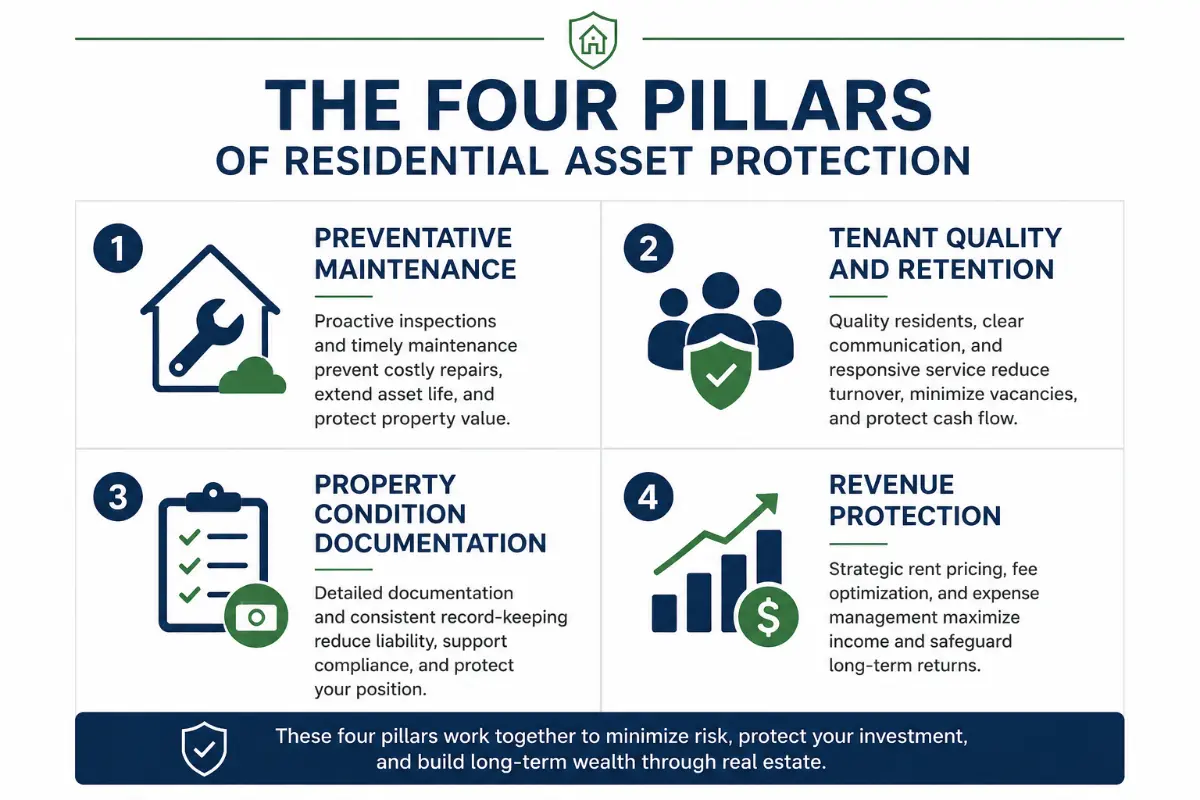
Effective asset protection for a residential rental property rests on four operational disciplines.
1. Preventative Maintenance Systems
A protected property operates on a defined maintenance calendar, not a reactive call log. This means scheduled inspections, seasonal system checks, vendor relationships that ensure priority response, and a documented property condition history.
In South Florida, preventative maintenance must account for the regional environment: hurricane-season preparation, humidity-related issues like mold and wood rot, HVAC performance under near-constant demand, and the accelerated wear that tropical conditions place on roofs, windows, and exterior surfaces.
2. Tenant Quality and Retention
Asset protection begins at tenant selection. A thorough screening process — income verification, rental history, background check, reference review — filters for tenants who treat a property with care and fulfill their lease obligations.
Equally important is what happens after move-in. Responsive management, clear communication, and prompt handling of maintenance requests are what convert a one-year tenant into a three-year tenant. Each renewal is a measurable financial benefit to the investor looking at building a rental portfolio in South Florida.
3. Property Condition Documentation
At every transition point — move-in, inspection, move-out — the condition of the property should be fully documented with time-stamped records. This protects the investor legally, enables accurate security deposit handling, and creates a baseline for tracking property condition over time.
Properties without documentation have no defense in disputes. Documentation is operational infrastructure.
4. Revenue Protection
Asset protection is not only about the physical property. It is also about ensuring that rent is collected consistently, that lease terms are enforced, and that market rate is reviewed at each renewal to ensure the property is not underperforming relative to the local rental market.
In Fort Lauderdale and surrounding Broward County markets, rental demand remains strong. A well-managed property operating below market rent is leaving money on the table every month.
Want to see how Beam approaches asset protection for South Florida investors?
Residential asset protection vs. standard property management
Most property management services focus on two things: finding tenants and collecting rent. These are necessary functions, but they are not asset protection.
The distinction is significant for investors.
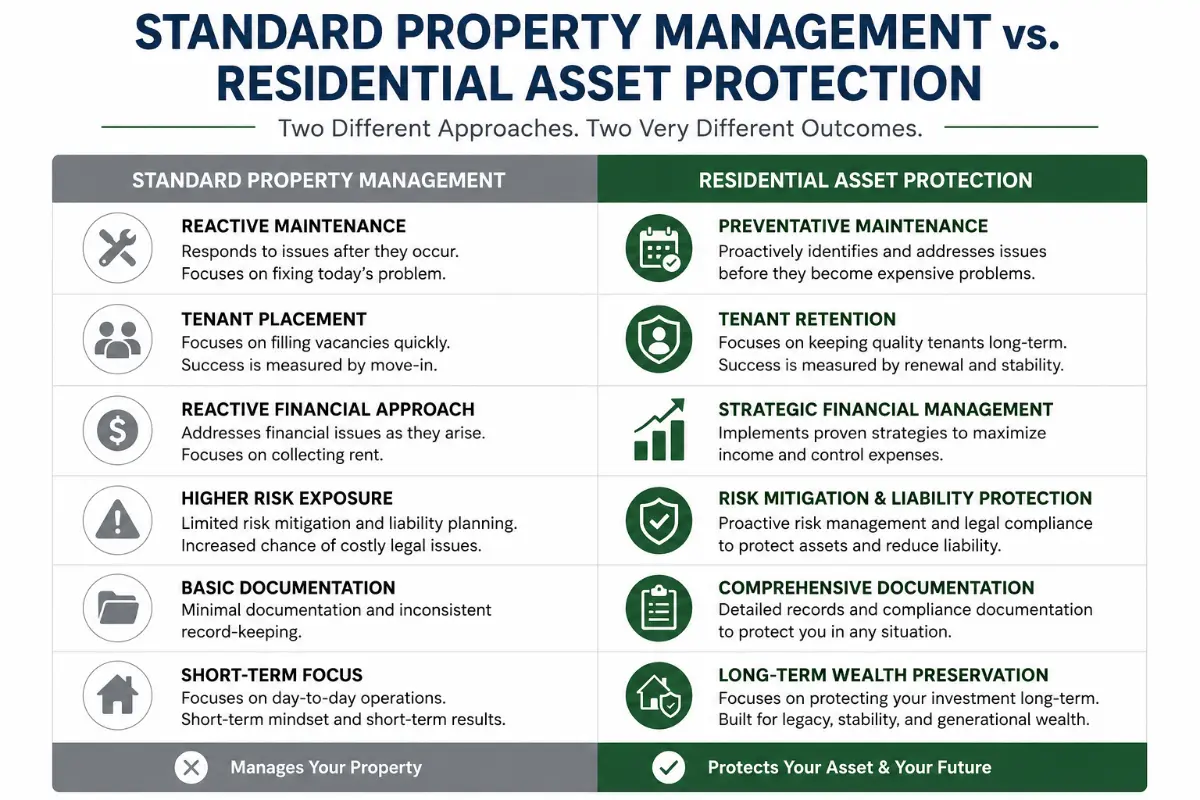
| Standard Property Management | Residential Asset Protection |
|---|---|
| Reactive maintenance | Preventative maintenance calendar |
| Tenant placement | Tenant quality screening and retention |
| Rent collection | Revenue optimization and lease enforcement |
| Basic oversight | Documented condition tracking |
| Vendor coordination | Vetted vendor relationships with priority response |
| Annual renewals | Market rate review at every renewal |
An investor who treats property management as a commodity — comparing only price and basic services — is likely not receiving asset protection. They are receiving administration.
Why South Florida investors face higher operational risk
South Florida presents specific operational challenges that make asset protection more important here than in most markets.
- Hurricane exposure: Broward and Miami-Dade counties sit in a high-risk hurricane corridor. A property that has not been properly prepared — roof inspections, storm shutter documentation, gutter maintenance, tree trimming — carries measurable risk to its physical structure and insurance standing.
- Tropical climate wear: Heat and humidity accelerate the deterioration of HVAC systems, roofing materials, wood surfaces, and exterior paint. A maintenance schedule built for the South Florida environment extends the useful life of every major system.
- Insurance rate environment: Florida’s property insurance environment has contracted significantly. Properties with documented maintenance histories, updated roofs, and wind mitigation features command better rates and retain coverage options that neglected properties lose.
- Competitive rental market: With strong rental demand and a high cost of living, South Florida tenants have expectations. Properties that are not well-maintained, professionally managed, and competitively positioned lose tenants to better-managed alternatives affecting Broward County property values.
What investors should expect from an asset protection partnership
If you are working with a property management company and the conversation centers primarily on fees and lease-up timelines, asset protection is not being delivered.
An operational oversight services partner focused on asset protection will:
- Provide a documented preventative maintenance calendar specific to your property
- Conduct regular inspections and share written condition reports
- Review market rent at every renewal and recommend adjustments
- Respond to maintenance requests within defined timeframes
- Maintain vendor relationships that ensure quality work at fair pricing
- Advise on capital improvements that protect or increase property value
- Prepare your property for hurricane season as a standard operational function
The standard of service is different because the objective is different. The goal is not simply to have a tenant in place. The goal is to have the right tenant in place, in a well-maintained property, generating strong returns — this year and ten years from now.
Protecting your investment starts with the right operational framework
A rental property is one of the most significant assets an investor holds. Its performance over time is not determined by the market alone — it is determined by how it is managed, maintained, and operated.
Residential asset protection is the discipline that keeps the gap between potential return and actual return as narrow as possible.
For South Florida investors, that discipline needs to account for the specific demands of this market: the climate, the insurance environment, the tenant expectations, and the operational complexity that comes with managing property at a distance.
The investors who compound returns reliably over time are not the ones who found the cheapest management fee. They are the ones who invested in operational systems that protected what they built.
If you own rental property in South Florida and want to know whether your investment is being actively protected — or just administered — we’re glad to have that conversation.
FAQ
Q: What is residential asset protection in property management?
A: Residential asset protection is the operational management of a rental property with the specific goal of preserving and improving its physical condition, revenue performance, and long-term market value. It includes preventative maintenance, tenant quality control, property condition documentation, and revenue optimization — going beyond basic rent collection and tenant placement.
Q: How is asset protection different from standard property management?
A: Standard property management typically focuses on tenant placement and rent collection. Asset protection adds preventative maintenance systems, documented inspections, tenant retention strategies, market rent reviews, and proactive oversight designed to protect the property’s value over time — not just administer its day-to-day operations.
Q: Why is asset protection especially important in South Florida?
A: South Florida’s combination of hurricane risk, tropical climate wear on building systems, a contracting insurance market, and high tenant expectations creates elevated operational risk for rental property owners. Preventative maintenance, proper documentation, and proactive management directly affect insurance eligibility, property condition, and tenant retention in this market.
Q: Does asset protection help with insurance rates in Florida?
A: Yes. Properties with documented maintenance histories, updated roofs, wind mitigation features, and routine inspection records are better positioned to retain coverage options and qualify for favorable rates in Florida’s competitive insurance market. Neglected properties lose leverage with insurers.
Q: How do I know if my property is being managed with asset protection in mind?
A: Ask your property manager for a preventative maintenance calendar, recent inspection reports, and documentation of market rent reviews. If these systems are not in place, operational oversight is reactive rather than protective. A true asset protection partner will provide written records and proactive recommendations — not just responses to problems.
Q: What does residential asset protection cost?
A: Asset protection is not a separate service with a separate fee — it is the standard of management delivered by an operationally sophisticated property manager. The cost is embedded in professional management. The return is measured in reduced repair costs, lower vacancy, longer tenancies, and preserved property value over time.
Ready to take your portfolio to the next level?
👉 Contact us today to discuss your residential asset protection.