
Tax Considerations for Multi-Property Owners in South Florida

Important: Beam Management Group is not a tax advisor, a CPA firm, or a law firm. Nothing in this article is tax advice, legal advice, or accounting advice. It is general operational information about record-keeping. Tax rules change, and how they apply depends entirely on your individual facts and circumstances. Consult a qualified CPA and Florida counsel before making any tax, entity, titling, or estate decision.
A single line on a bank statement reads: contractor, five figures. That entry, by itself, cannot tell anyone whether the work was a repair that belongs in one place on a return or capital work that belongs somewhere else entirely. The bank does not know. The card statement does not know. The only thing that can answer the question is a document describing what was actually done to the building, at which property, on what date.
That is the practical point of this article. On a rental portfolio, the tax outcome is largely determined by the quality of the operating records, and those records are created during the year by whoever is running the properties. By the time the file reaches a CPA, the facts are already fixed. The CPA can only work with what the operation produced.
This is written for owners of multiple South Florida residential rentals and for trustees, executors, and inheritors administering them. It is not written for single-unit DIY landlords or short-term rental operators, whose situations differ materially and are outside the scope of what follows.
The Record Is the Position
Every classification on a rental return rests on a factual assertion about what happened at a specific property. Whether that assertion can be supported later is an operations question, not an accounting question.
Consider two owners who spend the same money in the same year on the same building. Owner A has, for each expenditure, an itemized invoice naming the property, describing the scope of work, and dated on completion, filed against that property. Owner B has a credit card statement and a general recollection.
Their economics are identical. Their positions are not. Owner A’s CPA classifies from evidence. Owner B’s CPA classifies from a conversation, and then bills for the hours spent having it. If either return is ever examined, Owner A produces a file and Owner B produces an explanation.
Nothing about this is unique to South Florida. What is unique to South Florida is volume. Portfolios here generate a high frequency of building-envelope, moisture, and mechanical work, much of it urgent, much of it authorized by phone. Undocumented urgency is how records degrade.
Repairs and Improvements Look Identical on a Bank Statement
At a general conceptual level, tax treatment distinguishes between amounts that keep a property in ordinarily efficient operating condition and amounts that improve it. The IRS addresses this through its tangible property guidance, and the specific tests, elections, and safe harbors involved are detailed, fact-dependent, and subject to change.
This article deliberately does not state the tests. Read the IRS tangible property regulations guidance and Publication 527, Residential Rental Property, and then have your CPA apply them to your facts. Any article that tells you where the line sits is doing you a disservice.
What is squarely an operating responsibility is producing the facts the analysis requires. In practice, that means the invoice has to say more than “roof work” or “plumbing.”
What a useful work record contains:
- The property address, and the unit where applicable
- A written description of the scope of work performed
- What condition or failure prompted the work
- What was repaired versus what was replaced, and the extent of any replacement
- The date the work was completed
- The vendor, with license information where applicable
- Permit number and inspection closeout where a permit was required
- Photographs before and after, dated
- The total cost, itemized between labor and materials where the vendor provides it
A vendor writing “replaced two damaged sections of soffit” and a vendor writing “exterior work” have performed the same job and created two entirely different records. The first supports a classification. The second requires someone to reconstruct the facts a year later from memory.
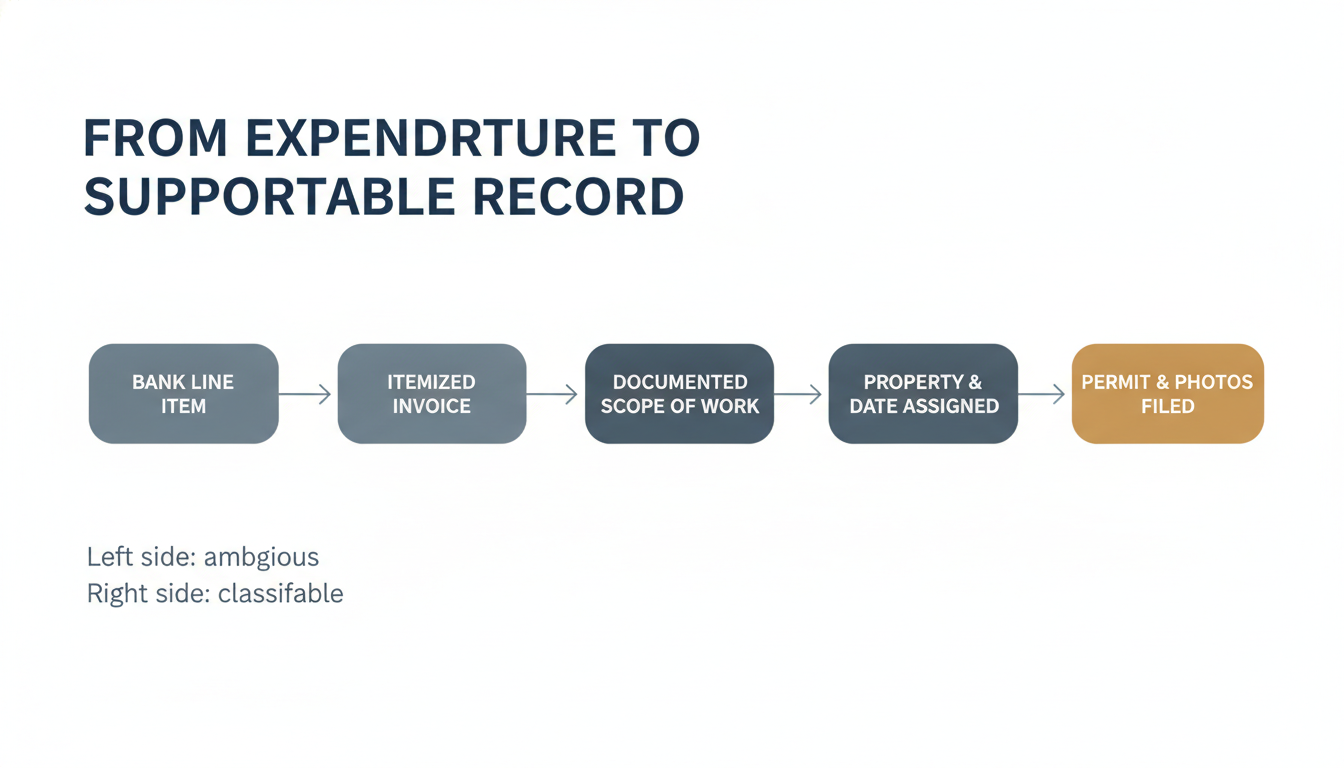
The operational fix is upstream: vendors are instructed to itemize by property and describe scope before the work is authorized, not asked to reissue invoices in February. This is the same discipline that produces a defensible annual maintenance schedule for South Florida rental properties — the record exists because the process requires it, not because someone remembered to collect it.
Capital Work Needs a Chain of Documentation
When work is treated as capital, the supporting record has to answer more than what was done. Generally speaking, a CPA needs to establish an amount, an asset, and a date the asset was placed in service.
Operationally, three items carry that weight:
The invoice with a documented scope. Total cost, itemized, tied to a specific property. Where several properties were serviced under one contract, the allocation should be documented at the time, not estimated later.
The placed-in-service date. The date the improvement was completed and available for its intended use, supported by completion documentation, final inspection, or a dated condition record. For a portfolio doing multiple capital projects a year, this is one of the most commonly missing data points, and it is unrecoverable once the vendor’s records go stale.
The supporting file. Proposal, permit, inspection closeout, warranty, and photographs. This file also protects the property in an insurance or resale context, which is why building it once serves several purposes at the same time.
Owners of larger portfolios sometimes ask about cost segregation. That is a CPA conversation, and in many cases an engineering-and-CPA conversation. What operations contributes is the underlying detail — itemized invoices, component-level scope, and accurate dates — that makes such a study possible at all. Aggregate invoices marked “renovation” limit the options available to your advisors before they are ever consulted.
Aggregate Bookkeeping Is a Portfolio-Level Liability
The most common structural problem in multi-property record-keeping is not missing documents. It is correct documents recorded in a single undifferentiated pool.
One operating account, one card, one lump of income, one lump of expenses. It works until something requires per-property detail, and then everything requires per-property detail at once.
| Requirement | Per-property records | Aggregate records |
|---|---|---|
| Annual return preparation | Categorized detail delivered as-is | Allocation exercise, billed hourly |
| Property-level performance | Visible monthly | Estimated at year-end |
| Basis and capital history | Maintained per asset | Reconstructed from statements |
| Sale, exchange, or refinance | Property file already exists | Emergency assembly under deadline |
| Removing one property from the portfolio | Isolate and hand off | Unwind from the pool |
| Examination response | Retrieve and produce | Rebuild, then explain |
| Beneficiary or co-owner reporting | Standing report | Special project |
Reconstruction is expensive twice: once in professional fees, and again in the quality of what reconstruction produces. Allocations made eleven months after the fact are estimates. Estimates are weaker positions than records, and no CPA can make them stronger.
The remedy is unglamorous. Income and expense are coded to a property at the moment of entry. Every invoice carries a property. Every payment is matched to an invoice. Every month closes with a statement per property that ties to the bank. This is the reporting spine behind portfolio management services for multi-property investors, and it is one of the clearest distinctions between operational oversight and rent collection. A rent collector reports a deposit. An operator reports a property.
Professional Fees and Management Fees Are Operating Line Items Too
Portfolio owners incur costs that never touch a building: management fees, leasing fees, legal fees, accounting and tax preparation fees, bookkeeping, filing costs, and fees paid to fiduciary or trust professionals.
These are ordinary operating expenditures, and they are documented the same way as everything else. Engagement letters and management agreements on file. Invoices that describe the service, the period covered, and the property or portfolio. Fees allocated across properties on a stated, consistent basis rather than a shifting one. Legal fees separated by matter, since not every matter is treated the same way and your CPA needs the description to determine treatment.
Fiduciaries should be especially careful here. Trustees and executors are accountable for the reasonableness of administrative expenses to beneficiaries, and possibly to a court, independent of any tax question. An invoice that says “professional services” satisfies neither audience.
Entity, Titling, and Inherited Property
For inherited South Florida rentals, the most consequential operational issues are usually not accounting entries. They are mismatches among three documents that are supposed to describe the same arrangement.
The ownership entity. Whatever holds title after the estate or trust administration: the trust itself, an estate, an LLC, individual beneficiaries, or tenants in common.
The insurance named insured. The party named on the policy for each property.
The lease parties. The named landlord on every executed lease and renewal.
When these three disagree, ordinary events become complicated. A claim is submitted by an entity that is not the named insured. An eviction is filed by a party that does not appear on the lease. Rent is deposited into an account belonging to a different entity than the one holding title, which then has to be untangled for accounting and reporting. None of this is exotic; it is routine in inherited portfolios where leases were signed by a decedent years earlier and never updated.
The correction is a coordinated one involving Florida counsel, the CPA, and the insurance agent, with operations executing: title and entity confirmed, policies re-issued to the correct named insured, leases assigned or re-executed as counsel directs, and banking aligned to the entity. Beam’s work with trustees and estate executors generally begins here, because nothing downstream is reliable until these three agree.
Entity selection itself — whether to hold property in an LLC, how many, and how they are treated — is a decision for your CPA and Florida counsel together. It has tax, liability, financing, and insurance consequences that cannot be separated from one another.
Stepped-Up Basis: Why the Condition Record Matters Operationally
In general terms, property acquired from a decedent may receive an adjusted income tax basis determined as of the date of death. How that applies to any specific estate, trust, or property depends on the facts, the governing instruments, and the law in effect, and it is a question for a CPA and Florida counsel. Do not act on a general description, including this one.
The operational implication, however, is straightforward and time-sensitive: the facts that support a valuation and condition position exist only near the date of death, and they degrade quickly.
What an operator can capture, promptly:
- A dated photographic condition record of each property, interior and exterior
- A written condition assessment noting system ages and known deficiencies
- Current leases, rent roll, and occupancy status as of the date
- Existing maintenance and capital history, gathered before vendors purge records
- A qualified appraisal where counsel or the CPA directs one
Establishing this baseline is administratively cheap in the first weeks and effectively impossible eighteen months later, after tenants have turned over, work has been performed, and the property no longer resembles what it was. Fiduciaries additionally need it to demonstrate prudent administration and to answer beneficiaries. Have your counsel and CPA specify what they want captured, and capture it while it still exists.
Florida-Specific Notes
Florida changes the composition of a portfolio’s tax profile, and owners relocating capital from other states sometimes misread what that means.
No state personal income tax. Florida does not impose a personal income tax. That does not reduce federal obligations, and it does not eliminate state and local property-related obligations.
Real property tax applies. Real property is assessed and taxed locally. Assessments, exemptions, valuation notices, and appeal procedures are handled by the county property appraiser and tax collector where each property sits — different offices, different calendars, different portals, across Miami-Dade, Broward, and Palm Beach. For a multi-county portfolio, tracking notices per property is an operating task, and missed notices are missed opportunities.
Tangible personal property. Florida has a tangible personal property regime applicable to certain business personal property. Whether and how it reaches a given residential rental arrangement depends on the facts. Confirm applicability and any filing requirement with your CPA and the county property appraiser.
Homestead exemption and portability generally do not apply to non-homestead rental property. These are homestead-based benefits, and rental property held for investment is generally not homestead. Inheritors who assume a decedent’s homestead treatment simply continues on a property now being rented are frequently wrong, and the assessment consequences can be significant. Confirm the status of every inherited property with the county property appraiser.
For general property tax information, the Florida Department of Revenue property tax information for taxpayers page and its tangible personal property page are the correct starting points. Property-specific answers come from your county property appraiser and your CPA.
What a Clean Year-End Package Contains
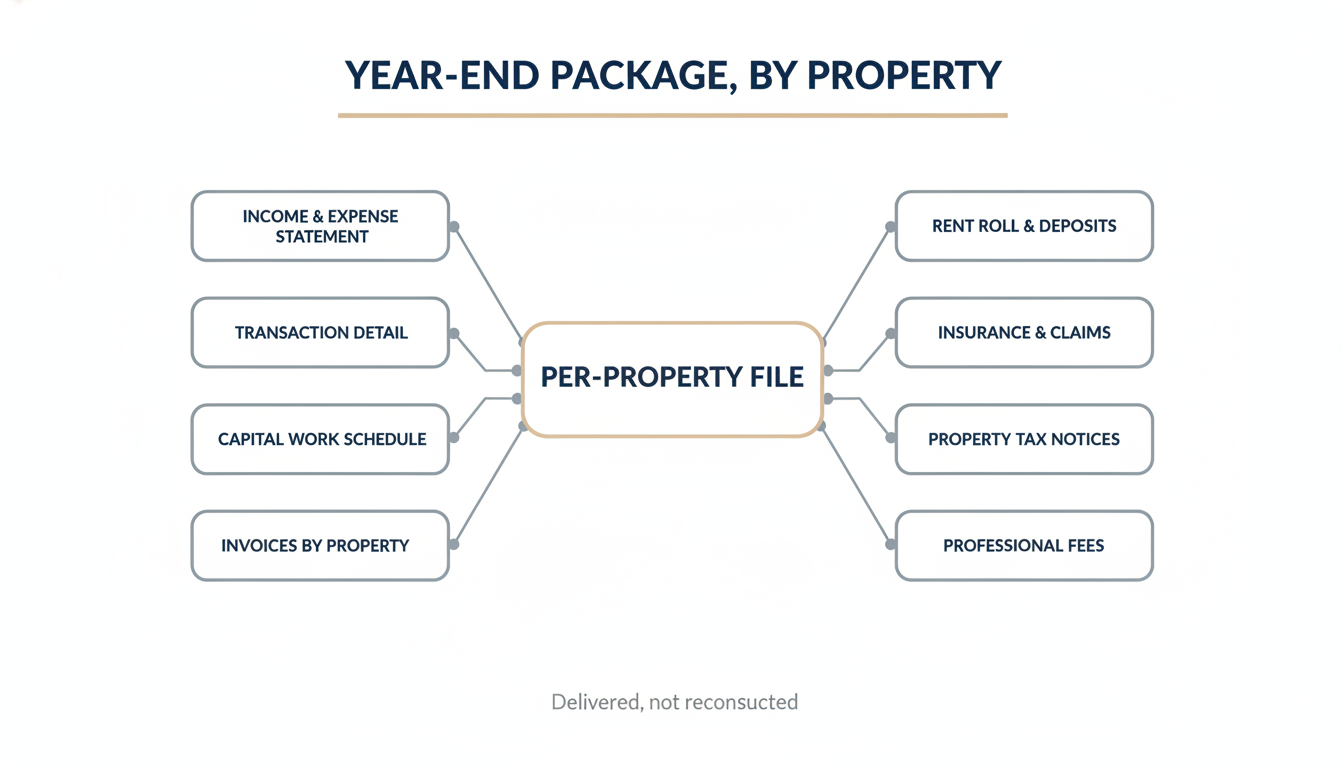
The objective is a package your CPA can work from without a discovery phase. Organized by property, it generally includes:
- An income and expense statement for each property, categorized consistently and reconciled to the bank.
- A general ledger or transaction detail supporting each statement.
- A capital work schedule listing each project, its cost, its documented scope, and its completion date.
- Invoices for all material work, filed by property and cross-referenced to the ledger.
- A rent roll with lease terms, plus tenant ledgers and deposit accounting.
- Insurance policies, premium detail, and any claim documentation.
- Property tax notices, assessments, and payment confirmations by county.
- Professional and management fee invoices with engagement documentation.
- A written note of any unusual event — casualty, extended vacancy, major renovation, ownership or titling change, property acquired or disposed.
- For estates and trusts, the governing instrument and any date-of-death valuation or condition record.
Your CPA may want more or less. Ask in advance, once, and configure the operation to produce it on a standing basis. That single conversation reliably lowers professional fees, because CPAs bill for organizing what should have arrived organized.
Audit Readiness Is Not a Separate Project
Owners tend to think of examination readiness as a defensive posture assumed after a notice arrives. It is more accurately a byproduct. A portfolio operated with per-property coding, itemized scopes of work, matched invoices and payments, documented capital projects with dates, and monthly reconciliation is already producing the file an examiner would ask for. Nothing additional needs to be built.
The reverse is also true and less comfortable. A portfolio operated from an aggregate account with vague vendor invoices cannot become examination-ready on demand. It can only be reconstructed, at cost, into something weaker than a record.
The same file does other work. It supports the condition and capital history a buyer diligences, discussed in how strong property management affects resale value. It supports insurance claims and underwriting. It supports the reporting that absentee owners need from a property manager. It supports a trustee’s demonstration of prudent administration. Documentation is not an accounting overhead line. It is a component of residential asset protection that happens to be useful at tax time.
To restate the point this article opened with: none of the above is tax or legal advice, and Beam does not provide either. Rules change and outcomes depend on individual circumstances. Engage a qualified CPA and Florida counsel, tell them how your portfolio actually operates, and build the operating record around what they tell you they need.
Get Your Portfolio Records Audit-Ready
If your portfolio’s books run in aggregate, your CPA is charging you to do work your operation should be producing on its own. Beam Management Group operates South Florida residential portfolios with per-property accounting, itemized vendor documentation, dated capital records, and monthly statements that reconcile — so the year-end package is a delivery rather than a reconstruction.
If you are a trustee, executor, or inheritor, the highest-value window is the earliest one. We can establish a dated condition and occupancy baseline across the inherited properties, gather existing maintenance and capital history before it disappears, and coordinate with your counsel, CPA, and insurance agent so that ownership entity, named insured, and lease parties align before the first claim or dispute tests them.
Beam works with multi-property owners, inheritors, trustees, and executors who need documented operational oversight, not a rent-collection vendor. We do not provide tax or legal advice; we provide the records your advisors require. Contact Beam Management Group to review what your current records would support.
FAQ
Does Beam Management Group provide tax advice?
No. Beam is not a CPA firm, a tax advisor, or a law firm, and nothing we publish is tax, accounting, or legal advice. Our role is operational: producing per-property records, itemized documentation, and reporting that your CPA and Florida counsel can rely on. Tax rules change and depend on individual circumstances, so engage qualified professionals for any decision.
Why does the distinction between a repair and an improvement matter operationally?
Because the two can be indistinguishable on a bank statement, and the classification depends on facts about what was actually done to the property. The IRS addresses this through its tangible property guidance and Publication 527, and the tests are detailed and fact-specific. Operations cannot decide the classification, but it can produce the itemized scope of work, dates, and photographs that allow a CPA to determine it and support it.
What records support depreciation of capital work?
Generally, an invoice establishing the amount, a documented scope identifying what was installed or replaced at which property, and a placed-in-service date supported by completion or inspection records. Permits, warranties, and dated photographs strengthen the file. Recovery periods, methods, and elections are questions for your CPA and are not addressed here.
Should I keep separate books for each property?
Per-property income and expense coding is the operating standard for a portfolio. Aggregate bookkeeping works until something requires property-level detail — a return, a sale, a refinance, a beneficiary report, or an examination — and then it forces an allocation exercise after the fact. Reconstructed allocations cost professional fees and produce weaker support than contemporaneous records.
Is cost segregation something my property manager can handle?
No. Cost segregation is a CPA conversation, typically involving specialized engineering analysis. What operations contributes is the underlying detail that makes a study feasible: itemized invoices, component-level scope descriptions, and accurate completion dates. Aggregate invoices labeled “renovation” limit your advisors’ options before they are consulted.
What should a trustee or executor document about inherited rental property, and when?
Promptly, and before conditions change: a dated photographic condition record of each property, a written condition assessment with system ages, current leases and rent roll, occupancy status, and existing maintenance history gathered before vendors purge their files. Whether a formal appraisal is needed, and how basis is determined, are questions for Florida counsel and a CPA. The operational point is that this evidence is cheap to capture early and effectively impossible to recreate later.
Does Florida’s lack of a state income tax simplify things for rental owners?
It changes the composition of the obligations, not the need for records. Florida does not impose a personal income tax, but real property is assessed and taxed at the county level, tangible personal property considerations may apply depending on the facts, and federal obligations are unaffected. Homestead exemption and portability generally do not apply to non-homestead rental property. Confirm details with your county property appraiser, the Florida Department of Revenue, and your CPA.
How do I make my portfolio audit-ready?
Treat it as a byproduct of operations rather than a project. Per-property coding, itemized vendor invoices describing scope, payments matched to invoices, capital projects documented with completion dates, and monthly reconciliation produce the file an examiner would request without additional work. A portfolio run from an aggregate account with vague invoices cannot be made ready on demand; it can only be reconstructed at cost.