
What Absentee Owners Need From a Property Manager

An owner who lives near their rental property finds out about problems by accident. They drive past. They notice the landscaping. They hear it in a tenant’s voice. That informal information stream is invisible until it disappears — and when an owner is 1,200 miles away, it disappears entirely.
What replaces it is either a documented operating system or nothing. Most absentee owners discover which one they have during the first expensive event: a slab leak that ran for two weeks, an HVAC failure in August, a tenant who stopped paying three months before anyone mentioned it.
The monthly deposit is not evidence that a property is being operated well. It is evidence that rent was collected. For an owner who cannot inspect the asset personally, the distinction between those two things is the entire management relationship — and it defines what absentee owners need from a property manager: verified condition, controlled decisions, and a record that holds up later.
The Absentee Owner’s Real Exposure
Distance does not create new risks. It removes the informal checks that catch existing ones early.
Condition drift. Small problems that a nearby owner would notice — a stained ceiling, a soft spot in a deck board, standing water near a foundation — progress unobserved. In South Florida’s climate, the interval between “cosmetic” and “structural” is short.
Vendor accountability gaps. When no one on the owner’s side inspects completed work, quality becomes self-reported. Invoices arrive for work that may or may not have been done to standard, and the owner has no basis for evaluating either.
Delayed problem escalation. A tenant who cannot reach anyone will often stop trying. Repair requests that go unanswered do not vanish; they become deferred maintenance, then a non-renewal, then a make-ready expense.
No usable record. When an owner needs to refinance, insure, sell, or account to beneficiaries, the absence of maintenance logs, inspection reports, and condition photos becomes its own problem. Work that was performed but never documented has limited value in any of those conversations.
Decision latency. Every issue that requires the owner’s approval waits for the owner. Across time zones, a two-day approval delay on a water intrusion event is not administrative. It is damage.
The Five Requirements: What Absentee Owners Need From a Property Manager

An absentee owner does not need more communication. They need a specific set of operating guarantees. Five requirements separate a manager who can genuinely operate on an owner’s behalf from one who simply forwards problems.
1. Documented Physical Inspections on a Schedule
Not a drive-by. A scheduled interior and exterior inspection with dated photographs, a written condition summary, and a comparison against the previous inspection. The value is in the sequence: the third inspection is what reveals the trend the first one could not.
For a trustee or executor, this is also the record that demonstrates the asset was actively cared for during administration rather than left to deteriorate.
2. Pre-Authorized Decision Thresholds
The single most useful thing an absentee owner can establish is a written spending threshold below which the manager acts immediately without approval — and a defined escalation path above it. A manager who must call about a $180 repair will eventually stop calling, or the owner will eventually stop answering. Neither outcome protects the property.
The threshold converts distance from a delay into a non-factor for the majority of maintenance events.
3. Vendor Control and Post-Work Verification
Vendors should be selected, scheduled, and inspected by the manager, with the completed work verified before payment. An owner reviewing an invoice from 1,200 miles away cannot verify quality. Someone standing in the unit can.
This is also where a standing vendor bench matters: established relationships produce faster scheduling and more consistent quality than reactive one-off hiring, particularly during South Florida’s high-demand repair periods.
4. Financial Reporting an Owner Can Actually Use
Rent collected minus expenses is a receipt, not reporting. An absentee owner needs categorized expenses, maintenance history by property, lease and renewal dates, and enough structure to answer real questions: what did this unit cost to operate this year, what is trending upward, and what capital items are approaching end of life.
Owners evaluating refinance or acquisition decisions — for example, using DSCR financing to scale a Florida portfolio — need this level of records to move quickly when an opportunity appears.
5. Proactive Rather Than Reactive Maintenance
For an on-site owner, reactive maintenance is inefficient. For an absentee owner, it is genuinely dangerous, because there is no informal early warning system. Scheduled servicing of the systems that fail most expensively in this climate — HVAC, roofing, plumbing, drainage — is what keeps the portfolio out of emergency mode. This is the core argument of preventative maintenance as an asset protection strategy, and it applies with more force the farther away the owner lives.
Rent Collection Model vs. Operational Oversight Model
Rent Collection Model
- Inspections: On request, or when a problem is reported
- Maintenance: Reactive; owner approval sought per item
- Vendors: Whoever is available; work not independently verified
- Reporting: Monthly statement of rent received and expenses paid
- Documentation: Invoices only
- What the owner knows: Whether rent arrived
Operational Oversight Model
- Inspections: Scheduled, photographed, compared against prior condition
- Maintenance: Preventative calendar plus pre-authorized response thresholds
- Vendors: Standing bench, scheduled and inspected before payment
- Reporting: Categorized financials, maintenance history, renewal calendar, capital planning
- Documentation: Complete condition and maintenance record per property
- What the owner knows: The condition, trajectory, and operating cost of every asset
Why This Is Different in South Florida
Absentee ownership carries a specific set of regional risks here.
The climate compounds neglect quickly. Heat, humidity, salt air, and heavy seasonal rain accelerate deterioration in ways that inland markets do not experience. A minor moisture issue in this environment does not stay minor for a full quarter.
Hurricane season requires local presence. Pre-storm preparation, post-storm inspection, and insurance documentation all happen on a compressed timeline that an out-of-state owner cannot execute personally. Someone must physically secure the property before landfall and document its condition immediately after.
Insurance and claims depend on documentation. Coverage decisions and claim outcomes are influenced by maintenance records and pre-existing condition evidence. Owners already feeling the pressure of the current market — see what South Florida owners should know about insurance rates — have a direct financial incentive to maintain documentation that supports both underwriting and claims.
Vendor markets tighten after weather events. Storm-driven demand surges make availability, not budget, the constraint. Owners with existing local relationships get scheduled; owners calling from out of state join a queue.
Questions Absentee Owners Should Ask Before Signing
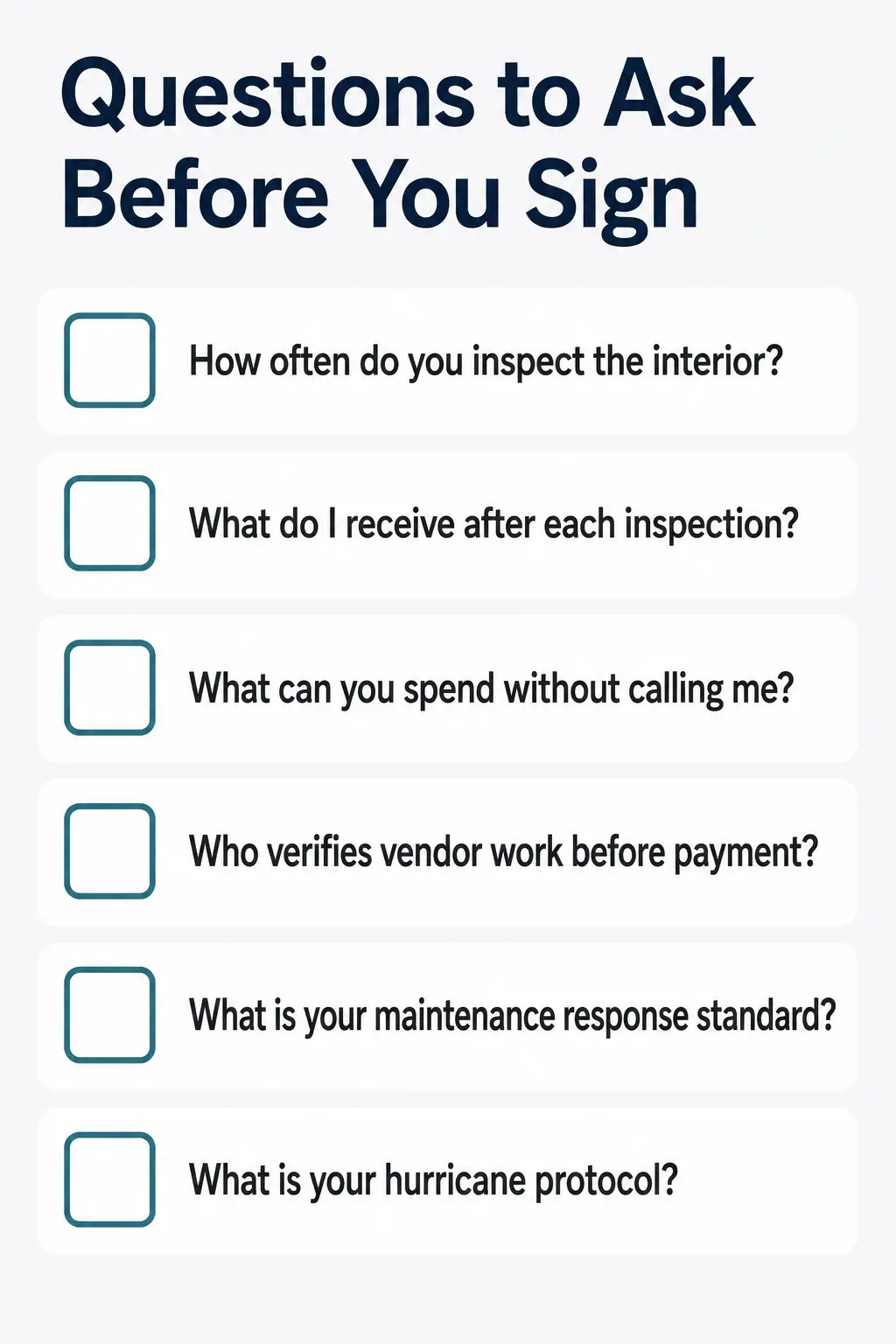
A management agreement rarely specifies operational standards. These questions surface them before the relationship starts.
- How often is the interior physically inspected, and do I receive dated photographs?
- What spending threshold can you act on without contacting me, and what is the escalation path above it?
- Who selects vendors, and who verifies the work before payment is released?
- What is your maintenance response standard, and how is it measured?
- What is your hurricane protocol — specifically, what happens in the 72 hours before landfall and the 48 hours after?
- What maintenance and condition records will I have if I decide to sell or refinance in three years?
- How do you handle renewals: fixed annual increase, or market-based analysis per unit?
Vague answers to any of these are informative. Operational specifics are difficult to invent on the spot.
What This Means for Inherited Portfolios
Trustees, executors, and heirs are frequently absentee owners by circumstance rather than choice. They did not select these properties, may not know their history, and are accountable to beneficiaries or a court for how the asset was handled.
For that reader, documentation is not an administrative preference — it is the record of fiduciary care. A portfolio with dated inspections, a maintenance log, and clear operating financials can be defended, valued, insured, and sold. One without those records cannot, regardless of how well it was actually maintained. This is the same discipline described in residential asset protection, applied to assets held under a fiduciary obligation.
Free Up Your Time with Beam
Beam Residential operates properties for owners who are not on-site: scheduled photographed inspections, pre-authorized response thresholds, vendor work verified before payment, and reporting built for refinance, insurance, and beneficiary conversations.
If you’ve inherited South Florida rental property, or your portfolio is here while you are not, and you need a management partner who treats the asset with the same care it took to build it, we should talk.
Contact Beam Residential to review what your current oversight actually documents.
FAQ
What should a property manager provide to an out-of-state owner?
At minimum: scheduled physical inspections with dated photographs, a written condition summary, pre-authorized maintenance thresholds so routine repairs are not delayed by approval cycles, vendor work verified before payment, and categorized financial and maintenance records per property.
How often should a rental property be inspected if the owner lives out of state?
Practices vary, but the useful principle is that inspections should be frequent enough to catch condition changes before they become failures, documented consistently enough to show a trend, and always performed at move-in, move-out, and before and after hurricane season in South Florida.
What is a reasonable maintenance approval threshold?
The right number depends on the property and the owner’s preferences, but the structure matters more than the amount: a defined dollar limit the manager can act on immediately, with a clear escalation path above it. Without a threshold, every minor repair waits on the owner, which is where small problems become large ones.
How can an absentee owner verify that repair work was actually done?
Through independent verification by someone acting on the owner’s behalf: post-work inspection, dated photographs of the completed repair, and payment released only after verification. Reviewing an invoice remotely confirms that a vendor billed for work, not that the work met standard.
Do I need local management if I have a reliable tenant?
A reliable tenant reduces some risks and hides others. Tenants report what affects them directly; they generally do not report roof deterioration, drainage issues, or systems nearing end of life. Asset condition and tenant satisfaction are separate things that require separate monitoring.
What documentation matters most if I plan to sell or refinance later?
Maintenance history, dated inspection reports with photographs, capital improvement records, lease and renewal history, and clean categorized operating financials. Buyers, lenders, and insurers all price uncertainty. A documented operating history reduces it.
How does hurricane season change what an absentee owner needs?
It adds a time-critical, physical requirement: pre-storm property preparation, immediate post-storm inspection, and condition documentation for insurance purposes. None of that can be performed remotely, and all of it happens on a schedule set by the storm rather than by the owner.
Authority Outbound Links
- Florida Department of Business and Professional Regulation — real estate and property management licensing → https://www.myfloridalicense.com/DBPR/real-estate-commission/
- National Association of Residential Property Managers — professional standards and code of ethics → https://www.narpm.org/