
Stress-Free Ownership: What It Actually Takes Operationally

An owner with four South Florida rentals should not be making eleven decisions a week. When they are, the cause is almost never the number of properties. It is that every question generated by those properties, from a $180 disposal replacement to a roof leak to a lease renewal rate, terminates at the owner’s phone because no one else has been given the authority or the standard to resolve it.
That is the actual mechanic behind ownership stress. Stress does not scale with doors. It scales with the volume of unresolved decisions routed to a single person who has no operating context, no vendor bench, and no written rule that tells them which decisions matter. Two hundred units under a disciplined operating system can be quieter than three units run reactively.
This article is not an argument for hiring a property manager. Plenty of managers make the problem worse by becoming a faster router of the same decisions. This is a breakdown of the specific machinery that has to exist before ownership stops consuming attention, and what an owner should still be deciding once it does.
Why the Owner Becomes the Integration Layer by Default
Residential rental operations produce a constant stream of small, unrelated inputs: tenant reports, vendor availability, invoices, inspection findings, renewal dates, insurance requests, association notices, utility issues, code correspondence. Each one arrives from a different source with no shared context.
Someone has to hold that context. Someone has to know that the same condensate line backed up in April, that the roof was patched two years ago by a vendor who is no longer licensed in the county, that the tenant in the second unit is on a lease expiring in ninety days, and that the insurer asked for a roof condition update at last renewal.
If no system holds that context, the owner does. Not by choice, but by elimination. That is what it means to be the integration layer, and the cost shows up in four places:
- Decision latency. Work stalls while it waits for an owner who is traveling, working, or unfamiliar with the trade in question. A three-day delay on a leak is a materially different repair than a same-day response.
- Price dispersion. Reactive sourcing means paying whoever answers. The same scope varies widely depending on whether it was scheduled or urgent.
- Lost institutional memory. Recurring problems get treated as new problems, so root causes never get corrected and the same money is spent repeatedly.
- Cognitive load that never clears. The open items an owner is carrying mentally are more taxing than the items actually being worked. This is the part owners describe as stress, and it is a direct output of an undefined decision structure.
For an inheritor or a trustee, the cost compounds. They are absorbing all of the above while also being accountable to beneficiaries or a court for whether the asset was administered prudently. Florida law expects a trustee to administer the trust as a prudent person would, considering the purposes, terms, and other circumstances of the trust, under Florida Statute 736.0804. An operation held together by one person’s memory does not produce evidence of that standard.
Responsiveness Is Not Resolution
The most common misdiagnosis in this category is treating responsiveness as the solution. An owner frustrated by slow answers hires a manager who answers quickly, and the volume of contact goes up rather than down.
A manager who forwards every problem within ten minutes has improved the speed of the routing and changed nothing about the structure. The owner still makes the call on the water heater. The owner still chooses between two quotes for a scope they cannot evaluate. The owner is still the last stop.
Resolution is different. Resolution means the decision was made correctly, at the right level, against a standard the owner set once, with the outcome documented and reported. The owner learns what happened, not what might need to happen.
Reactive Routing vs. Resolution Model
| Dimension | Reactive routing | Resolution model |
|---|---|---|
| Tenant maintenance report | Forwarded to owner for direction | Diagnosed, dispatched under standing authority, reported on completion |
| Repair under threshold | Owner approves each one | Pre-authorized; appears in the monthly record |
| Vendor selection | Sourced per incident | Standing bench with agreed pricing and licensing on file |
| Owner contact volume | High and unpredictable | Low, scheduled, exception-driven |
| Owner’s actual role | Dispatcher and approver | Capital allocator and strategist |
| Record produced | Email history | Dated condition and financial record by property |
Notice that responsiveness is present in both columns. The difference is where the decision lands.
The Components That Remove the Owner From the Path
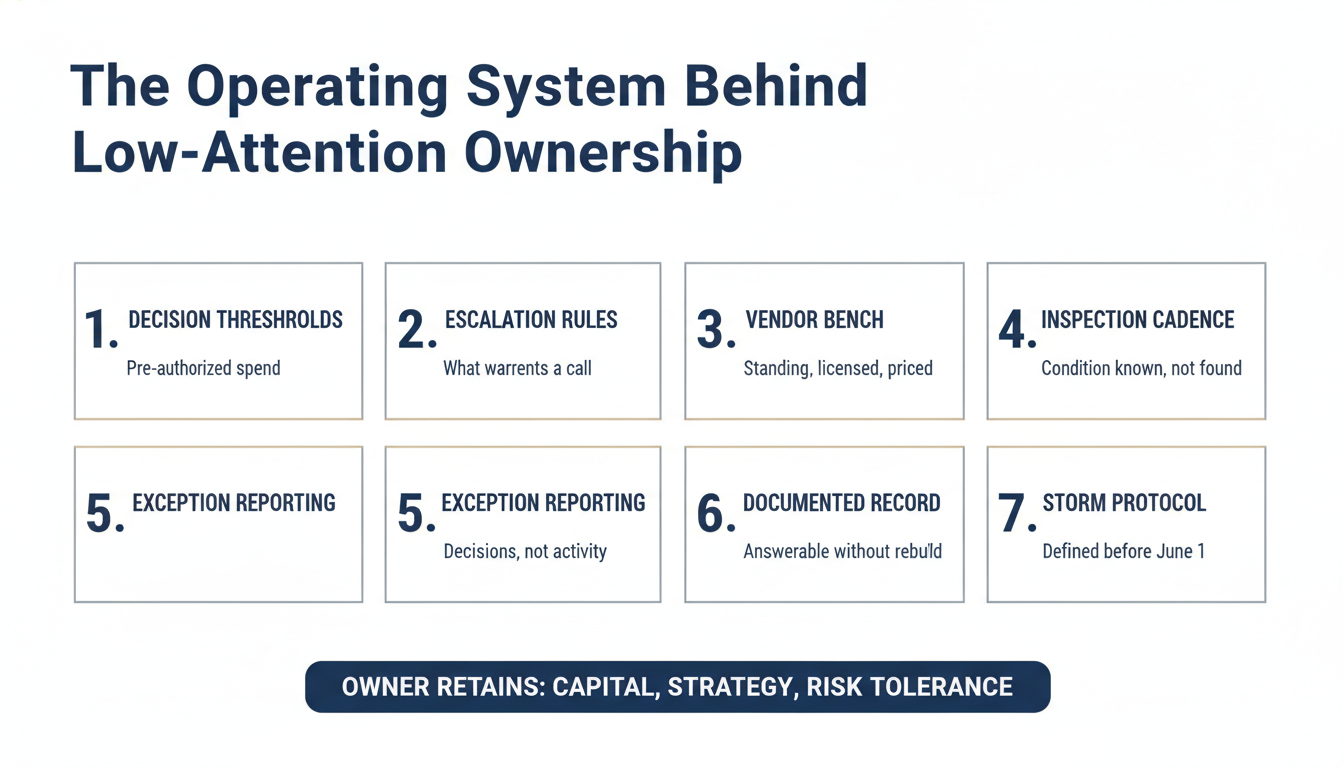
Low-attention ownership is not a personality trait or a service tier. It is the sum of seven specific components. Missing any one of them puts the owner back in the path.
1. Written Decision Thresholds and Pre-Authorized Spend
The single highest-leverage document in the relationship is a one-page authority matrix. It states, in writing, the dollar amount below which routine repairs proceed without contact, the categories that always proceed regardless of amount because delay creates damage or habitability exposure, the amount above which written owner approval is required, and how emergency work is defined and handled outside business hours.
Thresholds should be set deliberately rather than borrowed. An owner holding for long-term cash flow, an owner preparing a property for sale in eighteen months, and a trustee administering an estate under court oversight will reasonably choose different numbers. What matters is that the number exists and is documented, because an undefined threshold defaults to zero, and a threshold of zero means every decision is an owner decision.
2. Defined Escalation Rules
Thresholds handle money. Escalation rules handle judgment. They define what genuinely warrants contacting the owner, and by extension everything that does not.
A defensible escalation list is short. It typically includes:
- Habitability, safety, or life-safety conditions
- Suspected structural, roof, or envelope failure
- Water intrusion or moisture findings beyond routine scope
- Any spend above the approval threshold
- Insurance claims, notices of loss, or carrier requests affecting coverage
- Legal notices, code enforcement, association violations, or eviction decisions
- Tenant non-payment past a defined day count
- Lease renewal or non-renewal recommendations
- Recurring failure of the same system, which is a capital signal rather than a repair
- Anything materially changing the property’s condition, insurability, or income
Everything else is handled and reported. An owner who receives a call about a garbage disposal does not have an escalation problem, they have the absence of an escalation rule.
3. A Standing Vendor Bench
Reactive sourcing is where cost, delay, and quality variance all originate. A standing bench means the licensed and insured HVAC, plumbing, electrical, roofing, general maintenance, pest, and cleaning trades are already identified, already carry current documentation on file, already know the properties, and already have agreed pricing for common scopes.
The operational difference is that work starts because the standard was met, not because three quotes were collected under time pressure. The financial difference is that scheduled work is priced as scheduled work. An owner who has to ask “who should I call” has not delegated operations, they have delegated the phone call.
4. A Scheduled Inspection and Maintenance Cadence
Owners are not usually stressed by planned work. They are stressed by discovery. A cadence exists so that condition is known rather than found. Beam’s annual maintenance schedule for South Florida rental properties sets the operating year; the point here is what a cadence does to the owner’s experience.
When roof, envelope, drainage, HVAC, and plumbing are reviewed on a schedule with dated evidence, the number of surprise events falls, and the events that do occur arrive with history attached. The strategic case for this is covered in preventative maintenance as an asset protection strategy. Operationally, its function is to convert unpredictable emergencies into scheduled decisions with lead time, which is the difference between an owner reacting and an owner planning.
5. Exception-Based Reporting
Most owner reporting fails in one of two directions. It is either too thin to answer questions, or it is a raw activity feed that transfers the analytical work back to the owner. A twenty-page dump of every work order is not reporting, it is homework.
Exception-based reporting leads with what is off-standard and what requires a decision:
- Properties operating normally, stated as a single line
- Exceptions by property, with condition evidence and recommendation
- Open items with age and current status
- Repeat repairs by system, which identify capital candidates
- Planned versus emergency spend
- Upcoming lease expirations and renewal recommendations
- Capital items with an expected decision window
- Insurance and compliance dates approaching
An owner should be able to read the first page and know whether anything requires them. The detail belongs in the record for when it is needed, not in the summary.
6. A Documented Condition and Financial Record
The test of a record is whether a question can be answered without reconstruction. When the insurer asks about roof condition, when a lender asks for two years of maintenance history, when a beneficiary asks what was spent on a property and why, the answer should be retrievable rather than rebuilt from email.
That means, organized by property: dated condition reports and photographs, work orders with scope and approval, vendor and license information, invoices, completion verification, warranties and permits where applicable, lease documents and renewal history, insurance documentation, and written reasoning for any material deferral.
For fiduciaries this is not administrative preference. Florida’s trust code addresses a trustee’s obligation to keep clear, distinct, and accurate records of the administration of the trust under Florida Statute 736.0810. Owners and fiduciaries should confirm their specific obligations with Florida counsel; the operational takeaway is that the record has to be produced continuously, because it cannot be created retroactively with credibility.
7. A Defined Storm and Emergency Protocol
South Florida makes the emergency protocol non-optional. The Atlantic hurricane season runs June 1 through November 30, according to the National Hurricane Center, which means roughly half of every operating year carries a standing readiness requirement.
A written protocol establishes who acts at each forecast stage, where opening protection is stored and who installs it, how occupied units are accessed with proper notice, which properties are inspected first afterward, how pre-event and post-event condition is documented, and what the owner is told and when. Beam’s post-hurricane property inspection protocol covers the sequence in detail.
The reason this belongs in a discussion of ownership attention is simple: an owner without a protocol becomes the emergency coordinator for multiple addresses simultaneously, from wherever they happen to be, during the one week when vendors are least available.
What the Owner Should Still Decide
Removing the owner from operations is not the same as removing them from ownership. A system that makes every decision for the owner is a different failure, and it is one that fiduciaries in particular cannot accept.
The owner should still decide:
- Capital allocation. Replace or repair, scope, timing, and sequence across the portfolio.
- Investment strategy. Hold, refinance, reposition, 1031, or sell.
- Risk tolerance. Deductible levels, coverage decisions, and the thresholds themselves.
- Pricing philosophy. Whether to prioritize rent maximization or tenant retention at renewal, informed by the true cost of tenant turnover.
- Standards. The condition and quality level each asset is maintained to.
The owner should never see:
- Individual routine work orders under threshold
- Vendor scheduling and coordination
- Tenant communication on ordinary requests
- Invoice processing and reconciliation
- Standard renewal administration and notice logistics
- Routine inspection logistics and access arrangements
An owner reviewing a $95 plumbing invoice is not exercising oversight, they are absorbing labor. Oversight is reviewing the exception report, approving the capital plan, and confirming that what was authorized was completed and documented. This distinction is the core of operational oversight vs. rent collection.
How This Reads Differently for a Trustee or Executor
For a portfolio investor, low-attention ownership is primarily an efficiency objective. Time returned to acquisitions and other asset classes is the return.
For a trustee or executor, the requirement is harder, because low attention has to coexist with a defensible record. A fiduciary cannot say “I stayed out of it.” They have to be able to show that condition was assessed, that risk was identified, that decisions were made on stated criteria, that qualified vendors performed the work, and that outcomes were verified and recorded.
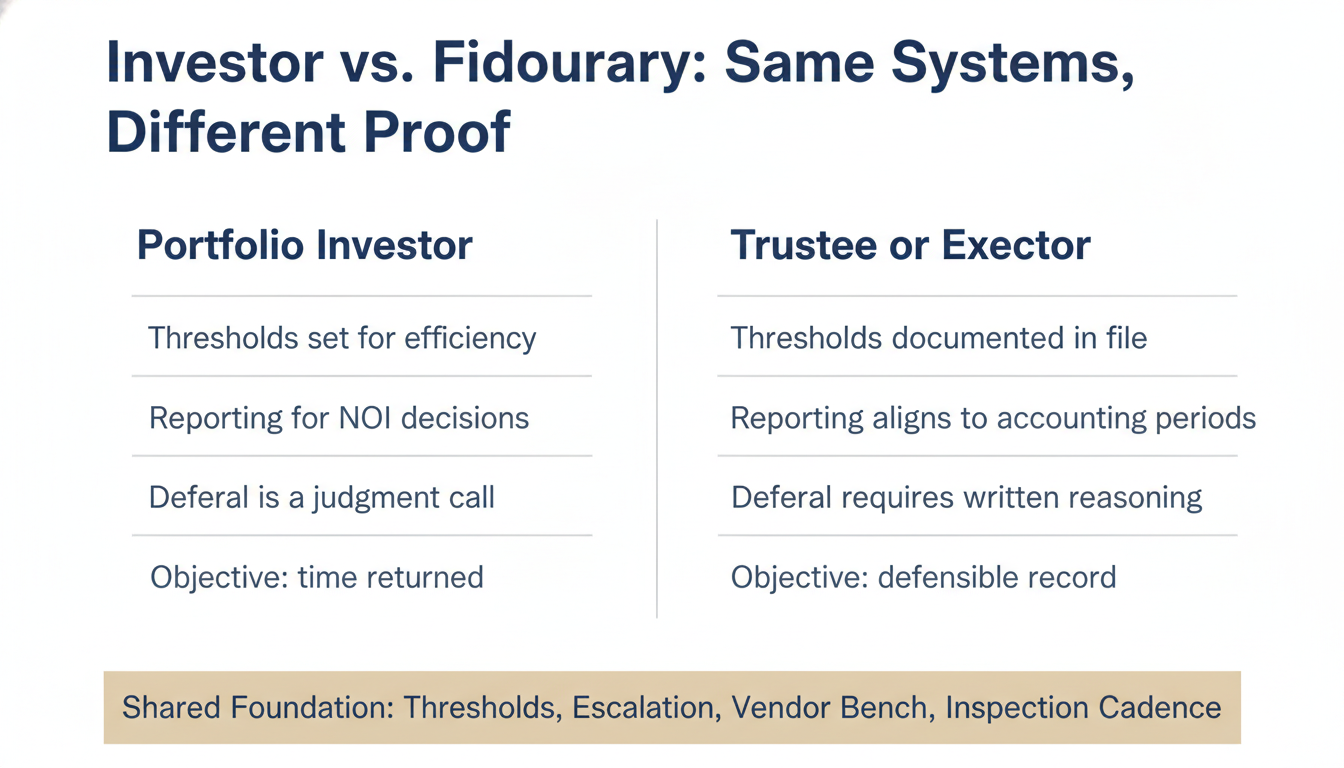
That changes three components:
Thresholds are set more conservatively and documented more formally. The authority matrix becomes part of the administration file, not an informal understanding. Spend categories and approval limits should be reviewed with counsel where the trust instrument or court supervision imposes constraints.
Reporting cadence becomes an accounting input. Exception reports and condition records need to align with the periods and formats used for estate or trust accounting, so beneficiary questions are answered from the operating record rather than assembled defensively later.
Deferrals require written reasoning. When work is postponed, the file needs to show the finding, the options, the cost, the consequence of waiting, and why the decision was made. A deferral with a documented rationale is a decision. A deferral with no record is an omission.
Beam’s approach to property management for trustees and estate executors is built around this: the fiduciary gets the same low-contact operation an investor gets, plus the evidentiary trail the role requires. The related question of value preservation under deliberate non-involvement is covered in property value protection strategies for passive investors.
How to Tell Whether the System Actually Exists
Four questions will separate a real operating system from a responsive vendor relationship.
- Can you produce your authority matrix in writing? If the thresholds live in conversation rather than a document, they do not exist.
- How many owner contacts did you have last quarter, and how many required a decision only you could make? A high ratio of contacts to genuine decisions is the measurement of the problem.
- If your insurer requested two years of roof and maintenance history tomorrow, how long would it take? Minutes indicates a record. Weeks indicates reconstruction.
- What did you learn about your properties’ condition in the last ninety days that you did not learn from a failure? If the honest answer is nothing, condition is being discovered rather than known.
The framework for assessing a prospective partner against these standards is in how to evaluate a property management company in South Florida, and the specific expectations of remote owners are covered in what absentee owners need from a property manager.
Stress-free ownership, accurately described, is an owner who makes five or six consequential decisions a year with good information, and sees a clear record of everything else. That outcome is engineered. It is not the result of properties behaving well.
Build a Stress-Free Ownership Operating System
If your portfolio has grown and your calendar has not, the constraint is usually decision routing rather than property count. Beam Management Group builds the authority matrix, escalation rules, vendor bench, inspection cadence, and exception reporting that keep routine operations off your desk while capital and strategy decisions stay with you, supported by condition evidence rather than opinion.
If you have inherited South Florida rental property or are administering it as a trustee or executor, the requirement is more demanding: the operation has to run without your daily involvement and simultaneously produce a record that holds up with beneficiaries, counsel, and a court. That is a documentation discipline, and it has to be running before anyone asks.
Beam works with multi-property owners, inheritors, trustees, and executors who want operational oversight rather than a rent-collection service. We are not the right fit for single-unit self-managers or short-term rental operators. Contact Beam Management Group to define the decision thresholds and reporting cadence for your properties.
FAQ
What actually causes property ownership stress if it is not the number of properties?
It is the number of unresolved decisions routed to the owner. When no written threshold, escalation rule, or vendor standard exists, every question becomes an owner question by default. Portfolios with far more units run more quietly when authority is defined, because the owner receives outcomes and exceptions rather than open items.
What is a decision threshold in property management?
A written dollar amount and category list defining what a manager may approve and execute without contacting the owner, what requires written owner approval, and what qualifies as an emergency handled outside those limits. It should be documented at the start of the relationship and reviewed periodically. Owners choose different levels depending on strategy, hold period, and any fiduciary constraints on the account.
What should genuinely trigger a call to the owner?
Habitability or safety conditions, suspected structural or envelope failure, water intrusion beyond routine scope, spend above the approval threshold, insurance claims or carrier requests, legal and code notices, tenant non-payment past a defined point, renewal or non-renewal recommendations, repeated failure of the same system, and anything materially changing condition, insurability, or income. Routine repairs within authority should be reported, not escalated.
Is a highly responsive property manager the same as a well-run operation?
No. Fast forwarding still leaves every decision with the owner. Resolution means the decision was made at the correct level against a standard the owner set once, executed by a qualified vendor, verified, and documented. Responsiveness is necessary but it is a communication quality, not an operating structure.
What is exception-based reporting?
Reporting that leads with what is off-standard and what requires an owner decision, rather than listing all activity. Normal properties are confirmed in a line. Exceptions arrive with condition evidence, cost, consequence of deferral, and a recommendation. Full detail remains available in the property record for diligence, insurance, or accounting purposes.
How can a trustee stay uninvolved in daily operations and still meet fiduciary duties?
By ensuring the operation produces continuous evidence rather than requiring personal involvement. Documented condition assessments, written approval thresholds, qualified licensed vendors, verified completion, and recorded reasoning for deferrals demonstrate a process. Fiduciaries should confirm their specific duties and any court or trust-instrument constraints with Florida counsel.
What decisions should an owner keep after delegating operations?
Capital allocation and timing, hold, refinance, or disposition strategy, risk tolerance including coverage and deductible positions, renewal pricing philosophy, and the condition standard each property is maintained to. These are ownership decisions that require the owner’s objectives. Scheduling, invoice processing, routine tenant communication, and vendor coordination are not.
How long does it take to put these systems in place on an existing portfolio?
It depends on the state of the current records, leases, vendor relationships, and property condition. Thresholds, escalation rules, and reporting cadence can be documented immediately. Establishing a verified condition baseline across multiple properties, closing inherited deferred maintenance, and building a complete record takes at least a full operating cycle, which is why the baseline inspection is scheduled first rather than last.