
Post-Hurricane Property Inspection Protocol
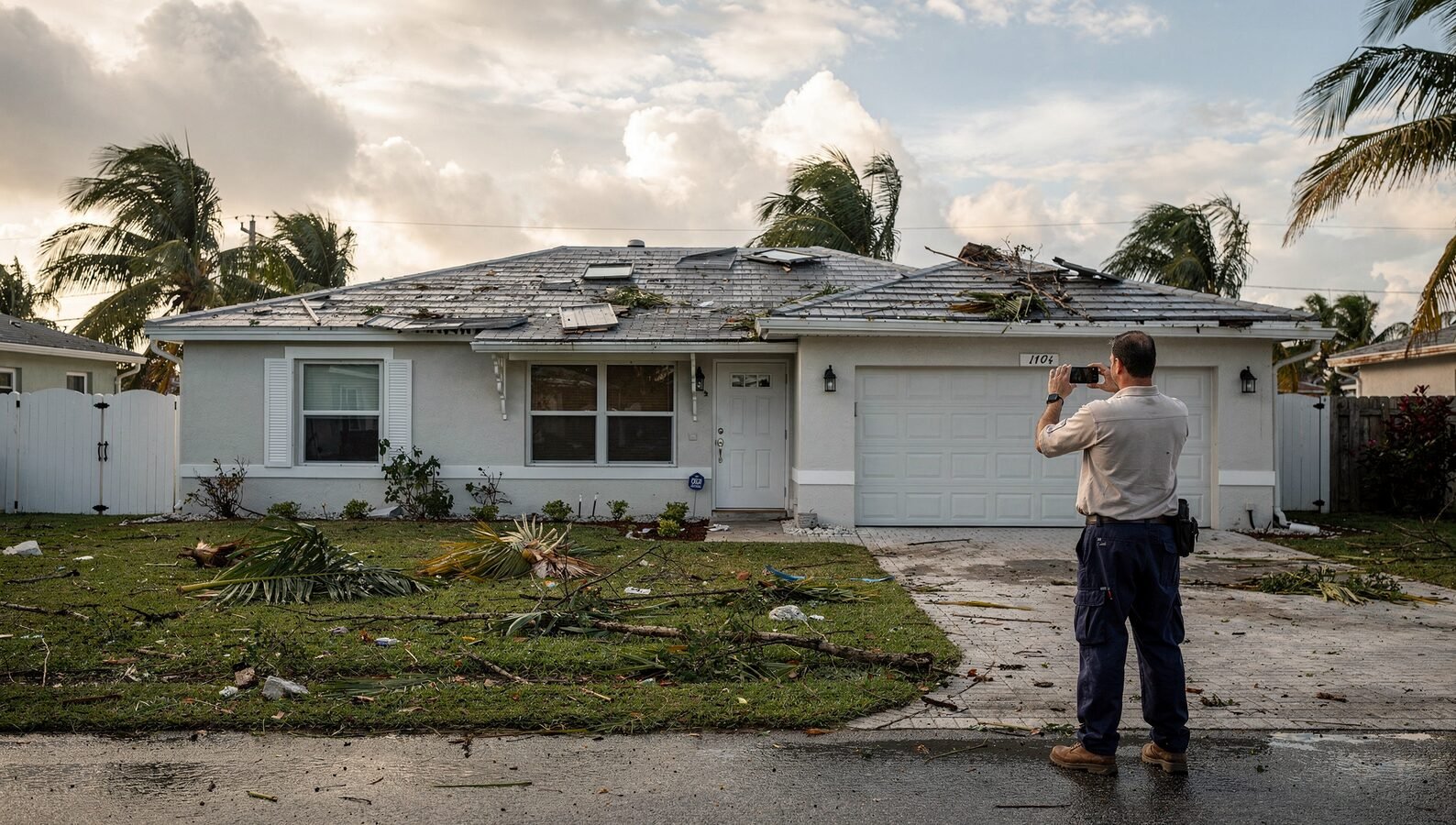
The days after a hurricane are when preventable losses become permanent ones.
Not because of the storm — that damage is already done. Because of what happens next: water sits in a building for a week, mold establishes itself in materials that could have been dried, an unreported roof opening lets in the next rain, a claim is weakened by cleanup that erased the evidence, and an adjuster is scheduled three weeks out because notification came late.
A post-hurricane property inspection is therefore a defined sequence, executed in a specific order, with documentation captured before anything is moved or repaired. Owners who improvise pay for it twice — once in additional damage and once in a diminished claim.
The Governing Rule: Document Before You Touch Anything
The single most consequential mistake after a storm is cleaning up first.
Insurance claims are evaluated on evidence. Once water is extracted, drywall is cut, debris is hauled, and the property looks presentable, the record of what happened is gone. Combined with pre-storm baseline photographs, thorough post-storm documentation is what establishes that the storm caused the damage.
There is a real tension here, because most policies also obligate the owner to mitigate promptly to prevent further damage. Both are satisfied in the same way: document first, then mitigate immediately. Photograph the standing water, then extract it. Photograph the opened roof, then tarp it. Photographs take minutes; the claim they support may take months.
Phase 1: Safety Assessment Before Entry
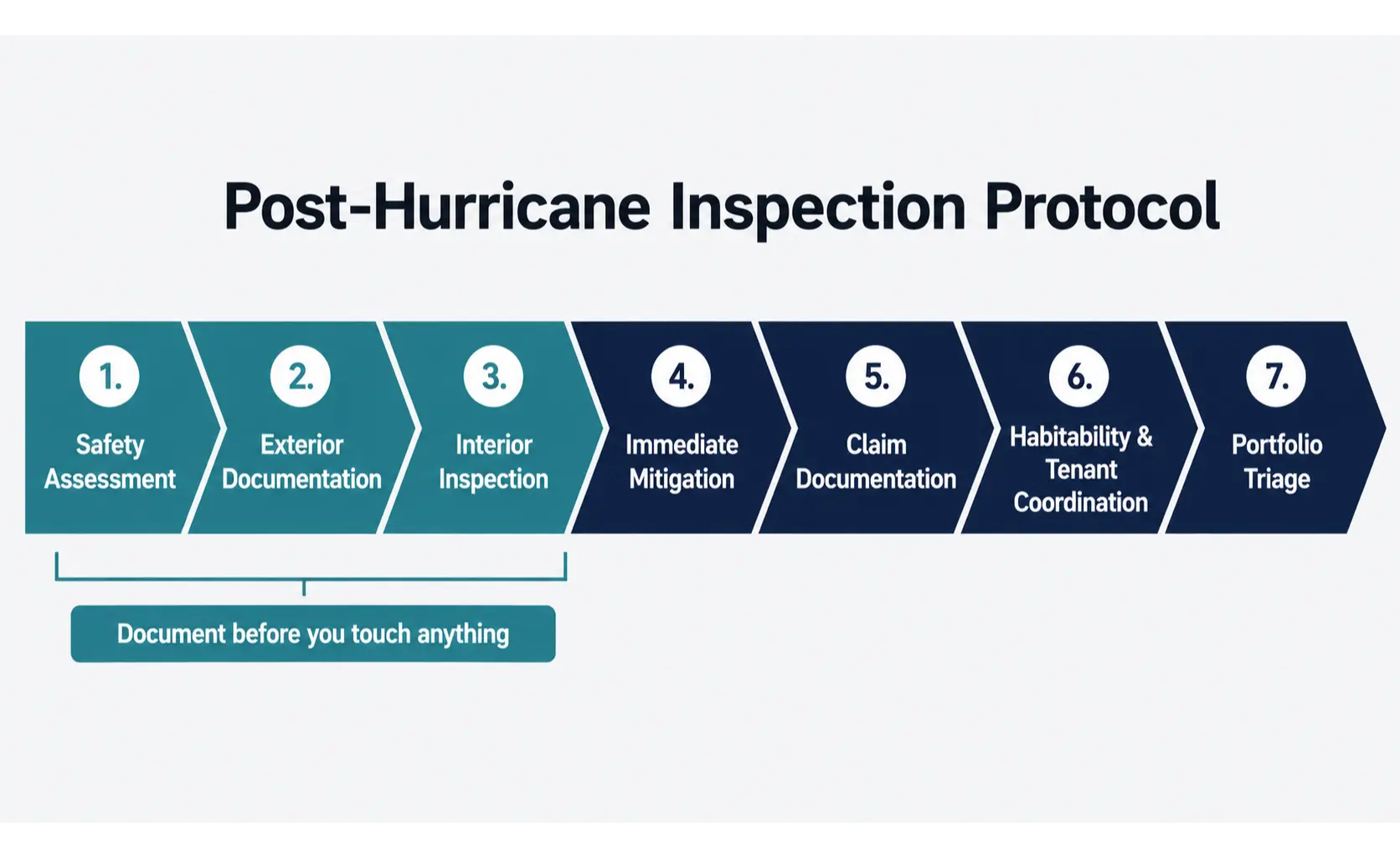
No inspection begins before the property is safe to approach.
- Do not enter until local authorities have cleared the area. Access restrictions after a major event exist because of downed lines and unstable structures.
- Assess from outside first. Look for downed or sagging power lines, structural leaning or displacement, collapsed sections, and standing water that could be energized.
- Treat gas odor as an emergency. Leave immediately and contact the utility.
- Assume standing water is contaminated. Storm water mixes with sewage, fuel, and chemicals.
- Do not restore power to a unit with water intrusion near electrical components until it has been evaluated.
- Confirm tenant safety before assessing property condition. People first.
Only after the exterior assessment indicates the structure is sound does interior inspection begin. FEMA publishes general post-disaster safety guidance at Ready.gov worth reviewing before the season.
Phase 2: Exterior Documentation
Work the exterior systematically. The goal is a complete record, not a highlight reel of the worst damage.
Roof. From the ground and, where it can be done safely, from a drone or elevated vantage point. Missing or lifted covering, displaced ridge or edge material, damaged flashing, debris impact points, and anything protruding. Do not walk a storm-damaged roof.
Each elevation, photographed individually. Wall damage, missing siding or stucco sections, impact marks, and displaced trim.
Windows and doors. Broken glazing, damaged frames, failed seals, and the condition of any shutters or panels that were installed — including whether they held.
Soffits, fascia, and gutters. Missing soffit panels indicate probable attic water intrusion even when no ceiling staining is yet visible.
Mechanical equipment. HVAC condenser position and condition, water heater if exterior, electrical service entrance and meter, and any pool or irrigation equipment.
Grounds. Downed trees and limbs, fence damage, debris, erosion, standing water and where it is pooling, and damage to driveways or walkways.
Wide context shots. Include images showing the property in relation to the surrounding area. These help establish the severity of the event at that specific location.
Phase 3: Interior Inspection
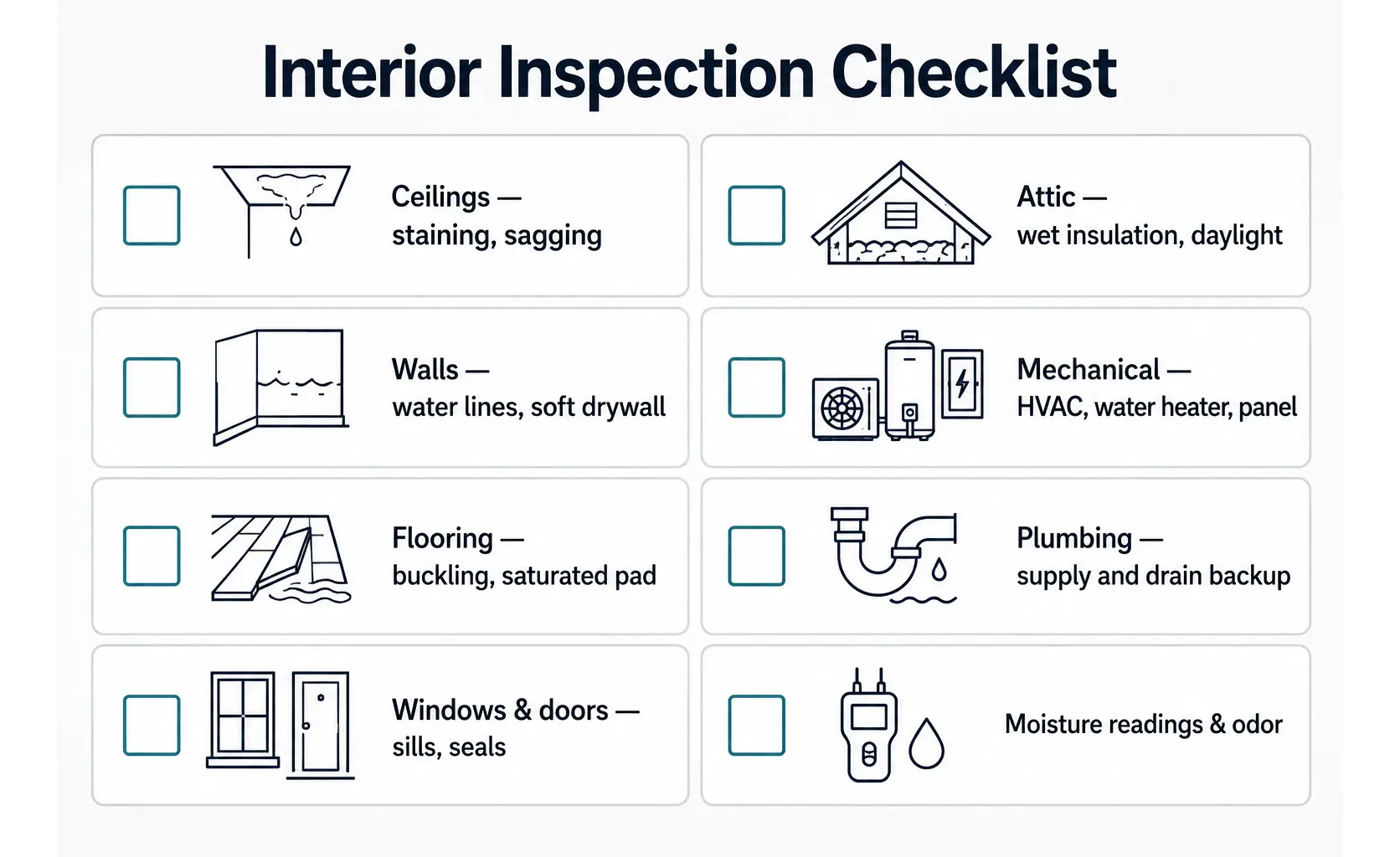
Interior inspection is where the expensive, slow-developing damage is found or missed.
Ceilings, room by room. Staining, sagging, bulging, and active dripping. Ceiling damage in an interior room usually indicates roof or attic intrusion.
Walls, especially exterior-facing. Water lines, discoloration, soft drywall, and separation at trim. Check behind and beneath furniture along exterior walls.
Flooring. Buckling, cupping, lifted tile, saturated carpet or pad. Carpet can feel only slightly damp while the pad beneath is saturated.
Windows and doors from inside. Water at sills, evidence of intrusion, and whether units still operate and seal.
Attic, if safely accessible. Wet or compressed insulation, daylight visible through the roof deck, water staining on framing, and displaced sheathing. Attic intrusion frequently precedes visible ceiling damage by days.
Mechanical systems. Whether HVAC operates, evidence of water in ductwork, water heater condition, and electrical panel condition. Do not test a system that shows evidence of water contact.
Plumbing. Run fixtures to confirm supply and check for drain backup, which is common after heavy rain events.
Moisture readings where available. A moisture meter finds saturation behind surfaces that appear dry, which is what determines whether a wall needs to be opened.
Smell. A musty odor within days of the event indicates active moisture in materials somewhere, even with nothing visible.
Phase 4: Immediate Mitigation
Once documented, mitigation is urgent. In South Florida’s climate, mold can begin developing in wet organic materials within roughly 24 to 48 hours under favorable conditions.
Priority order:
- Stop active water entry. Tarp openings in the roof, board broken openings, and divert water away from the structure.
- Extract standing water. Sooner is materially better than later.
- Begin drying. Air movement and dehumidification. Restoration equipment is in extreme demand after a regional event, which is why pre-established vendor relationships matter.
- Remove saturated porous materials that cannot be dried — carpet pad, saturated insulation, and drywall below the water line — after photographing them in place.
- Secure the property. An open, unoccupied property is exposed to weather and theft.
- Address utilities safely. Do not restore power or gas where water contact is suspected until evaluated.
Every mitigation action gets its own photographs and dated notes. That record demonstrates the owner met the duty to mitigate — which matters if the insurer later questions the extent of the damage.
Phase 5: Claim Documentation and Notification
Notify the carrier early. After a regional event, adjuster scheduling largely follows notification order, and delays compound.
A well-prepared claim file contains:
- Pre-storm baseline photographs for comparison
- Complete post-storm photographs, exterior and interior, organized by area
- A written damage inventory by room and system
- Dated records of every mitigation action taken
- Invoices and receipts for emergency work
- Maintenance history showing the property was reasonably maintained
- Lease and rent records supporting any loss-of-rent claim
- Communication logs with tenants, vendors, and the carrier
Owners can review coverage and claim-process resources through the Florida Office of Insurance Regulation. The broader market context is covered in what South Florida owners should know about insurance rates.
Two practical notes. First, keep loss-of-rent documentation from the outset — if a unit becomes uninhabitable, that claim depends on records established at the time, not reconstructed later. Second, be cautious with unsolicited contractors after a storm; verify licensing and avoid signing agreements that assign your claim rights without understanding them.
Phase 6: Habitability and Tenant Coordination
Damage assessment and habitability are separate questions, and the second one has legal and financial consequences.
Assess whether essential services are functional — water, electricity, sewer, and cooling — and whether the unit is structurally safe and free of active water intrusion. Florida law addresses landlord maintenance obligations and tenant remedies, and how they apply after a casualty depends on the extent of the damage and the lease terms. Consult counsel for a specific situation rather than assuming.
Operationally, what matters is speed and documentation: communicate a realistic timeline in writing, document the condition that supports the habitability determination, keep tenants informed as repairs progress, and record all of it. Tenants who receive clear, prompt communication after a storm are considerably more likely to renew, and retention is one of the largest financial variables in a portfolio, as discussed in operational oversight vs. rent collection.
Phase 7: Post-Hurricane Property Inspection Triage Across a Portfolio
With multiple properties, sequencing is the whole problem. Everything cannot be inspected at once, and the wrong order costs money.
A workable priority order:
- Occupied units with reported damage or safety concerns. People and liability first.
- Vacant units. No one is present to notice a leak or report a failure, so damage compounds unobserved.
- Properties in areas that took the worst of the event, based on local reporting and conditions.
- Properties with known pre-existing vulnerabilities — older roofs, prior water intrusion, drainage issues.
- Everything else, on a defined schedule with confirmation that each was inspected and documented.
Every property gets inspected and recorded, including those with no damage. “No damage found,” with dated photographs, is itself a valuable record — it closes the question and prevents a later claim of storm damage that actually developed afterward.
This is the same portfolio-level coordination logic described in portfolio management services for multi-property investors, applied under time pressure.
Why Trustees and Executors Need This Documented
For a trustee or personal representative, post-storm documentation is not just claim support. It is evidence of prudent administration.
A complete file — pre-storm condition, post-storm assessment, mitigation actions with dates, claim correspondence, and repair records — demonstrates that the fiduciary acted promptly and reasonably to preserve estate property. Its absence creates exposure regardless of how well the situation was actually handled, because beneficiaries and courts evaluate the record rather than the intention. That standard is detailed in property management for trustees and estate executors.
The preparation side of this cycle is covered in the hurricane season prep checklist for South Florida rentals and how to protect a rental property before a hurricane.
Master Post-Storm Inspection with Beam
Beam Residential executes post-storm inspection as a protocol, not a scramble: safety assessment, complete photographic documentation before anything is touched, immediate mitigation with dated records, early carrier notification, habitability assessment with tenant communication, and portfolio-wide triage that reaches every property.
If you’ve inherited South Florida rental property, or your portfolio is here while you are not, the week after a storm is when having local operational oversight either saves money or the lack of it costs a great deal.
Contact Beam Residential to put a documented post-storm protocol in place before you need it.
FAQ
What should be done first after a hurricane damages a rental property?
Confirm safety before entry — no downed lines, no structural instability, no gas odor, no energized standing water — then document everything photographically before any cleanup or repair. Only after documentation should mitigation begin, starting with stopping active water entry.
How should storm damage be documented for an insurance claim?
Photograph every exterior elevation, the roof from a safe vantage point, all openings, and each interior room including ceilings, walls, and flooring, before anything is moved or cleaned. Add a written damage inventory by room and system, dated records of every mitigation action with receipts, and pre-storm baseline photographs for comparison.
How quickly does mold develop after water intrusion in South Florida?
Mold can begin developing in wet organic materials within roughly 24 to 48 hours under favorable temperature and humidity conditions, which are common in South Florida year-round. That is why extraction and drying should begin immediately after documentation rather than waiting for an adjuster.
Should I wait for the insurance adjuster before cleaning up?
No. Policies generally obligate the owner to prevent further damage, and delaying mitigation can result in additional damage being attributed to the owner rather than the storm. Document thoroughly first, retain saturated material samples where practical, keep all receipts, and then mitigate without waiting.
Does a tenant still owe rent if a rental is damaged by a hurricane?
It depends on the extent of the damage, the lease terms, and applicable Florida law regarding habitability and casualty. Because outcomes vary by situation, document the condition thoroughly, communicate in writing, and consult counsel rather than assuming either way.
How do I inspect a roof after a hurricane without going on it?
Assess from the ground with a zoom lens or binoculars, from an elevated safe vantage point, or with a drone. A storm-damaged roof may have compromised decking and fasteners that are not visible from below, so walking it is unsafe. Interior indicators — attic daylight, wet insulation, ceiling staining — also reveal roof breaches.
What if there is no visible damage after a storm?
Still complete and record the inspection. A dated “no damage found” record with photographs closes the question, protects against later disputes about when damage occurred, and adds to the property’s condition history. Check the attic and exterior-facing walls specifically, since intrusion often becomes visible days later.
Authority Outbound Links
- FEMA / Ready.gov — hurricane response and post-disaster safety guidance → https://www.ready.gov/hurricanes
- Florida Office of Insurance Regulation — residential property claim resources → https://www.floir.com/