
Hurricane Season Prep Checklist for South Florida Rentals
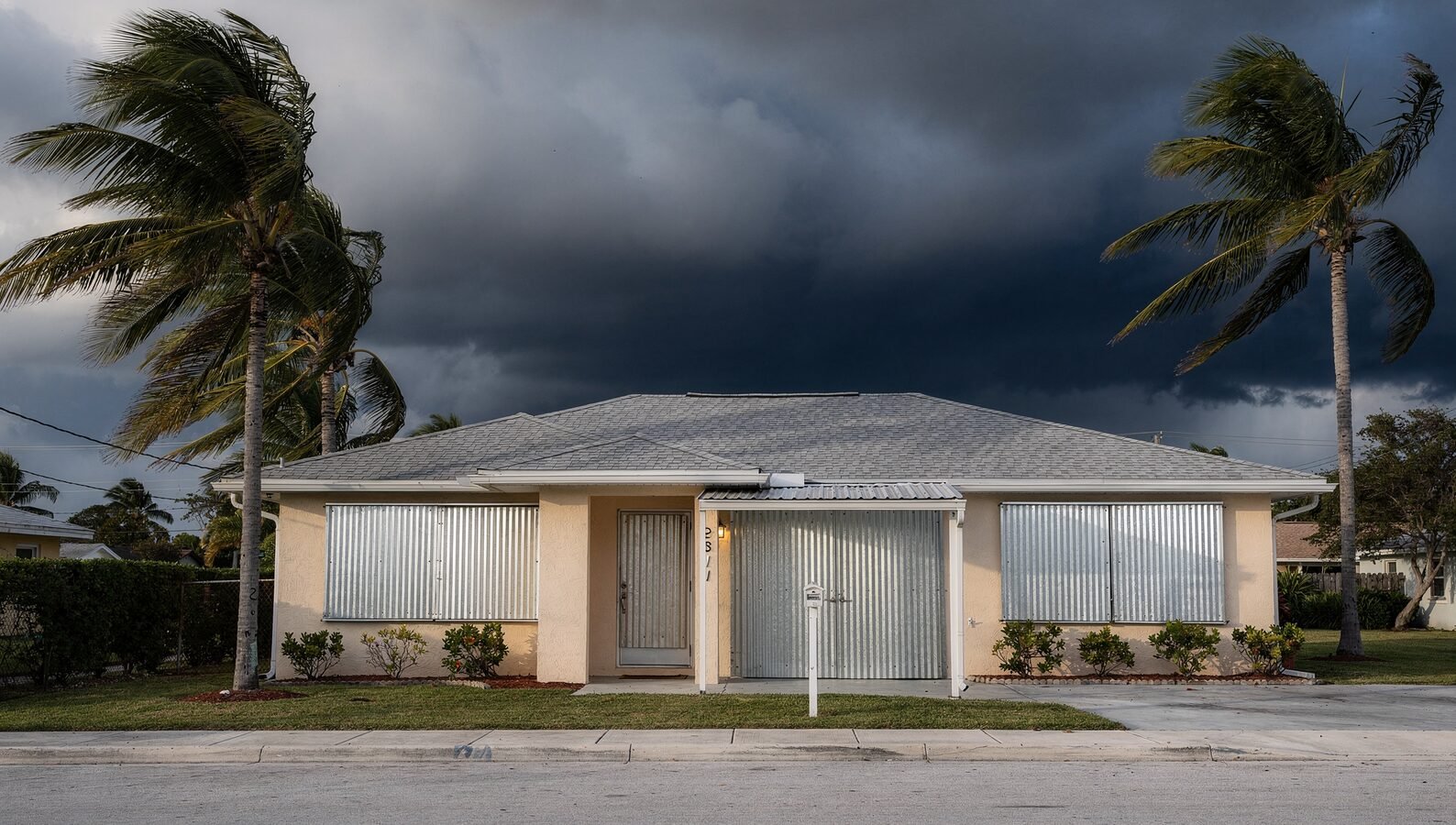
Hurricane preparation is not something that happens when a storm is named. By then, plywood is gone, contractors are committed, tree crews are booked into the following month, and the useful window has closed. A hurricane season prep checklist is a calendar, not a shopping list.
The Atlantic hurricane season runs from June 1 through November 30, according to the National Hurricane Center. For an owner with rental property in South Florida, that is a six-month operating condition, not an event — and the work that actually protects a portfolio is scheduled in May, verified monthly, and executed on a defined timeline when a specific storm develops.
For an owner who is not local, this is also the clearest example of why physical presence matters. Every item below requires someone on the ground, in the same week, at multiple properties.
Why the Season-Long Approach Wins
The failure mode is predictable: an owner intends to prepare, waits for a storm to be forecast, and then discovers that everything required is unavailable.
Vendor capacity vanishes first. Tree trimming, roof inspection, shutter installation, and generator service all compress into the same 72-hour window across the entire region. Firms honor existing relationships and scheduled work.
Materials sell out. Panels, fasteners, sandbags, batteries, and fuel disappear from the market ahead of landfall.
Documentation cannot be created retroactively. Pre-storm condition photographs only have value if they were taken before the storm. This is the single most commonly skipped step and the one that most affects claim outcomes.
Tenant coordination takes time. Tenants need to know what they are responsible for, what the property has, and who to contact. That communication is far more effective in May than the night before landfall.
Preparation done early is inexpensive and scheduled. The same work attempted late is expensive, rushed, and often simply unavailable.
Phase 1: The Pre-Season Hurricane Season Prep Checklist (Complete by May 31)
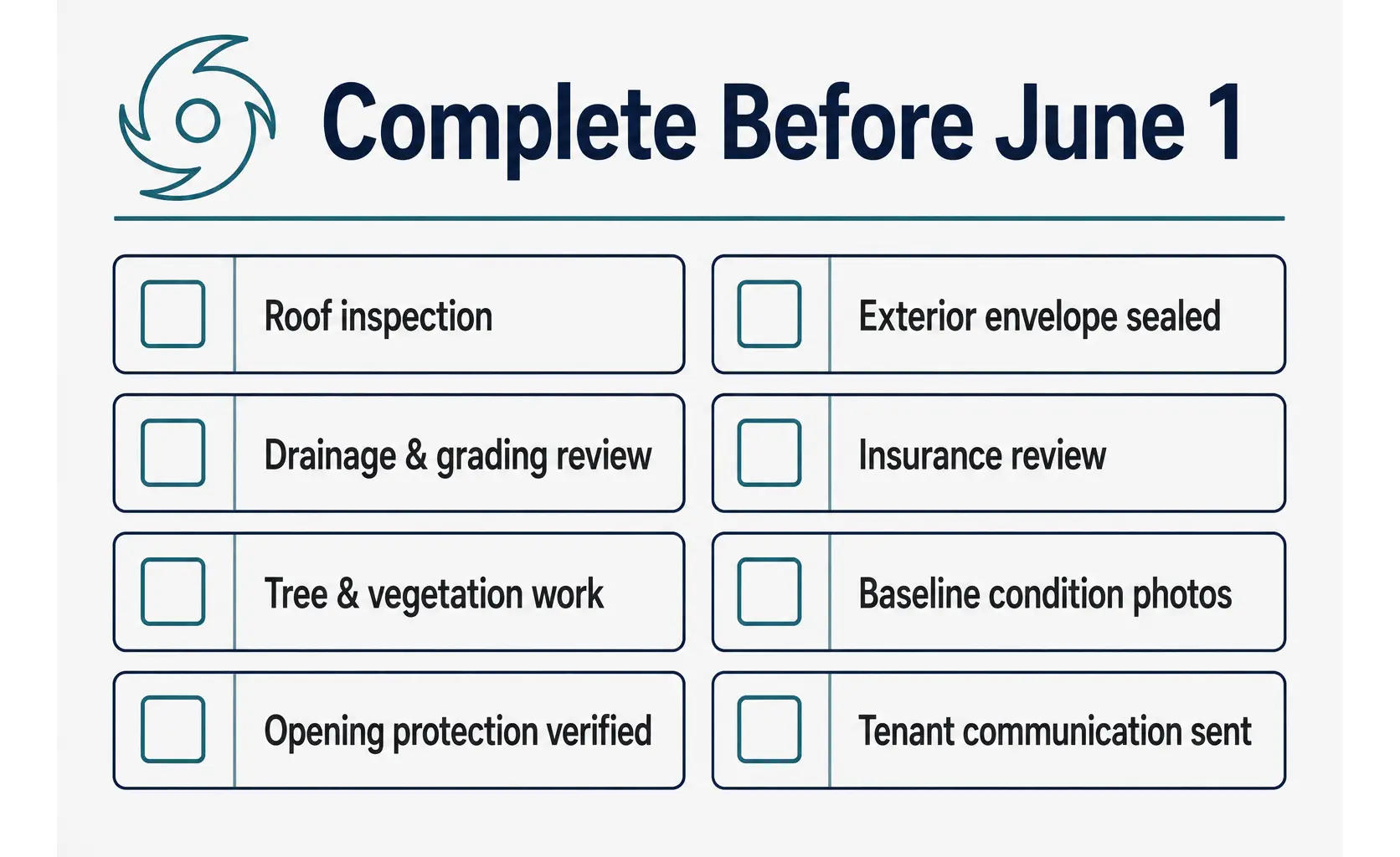
This is where the actual protection is created. Everything here requires vendor availability, which is why it belongs before June.
Roof inspection. A professional assessment of covering condition, flashing, fasteners, and any prior repair. The roof is the primary failure point, and a compromised roof converts a survivable wind event into an interior water loss.
Drainage and grading review. Clear gutters and downspouts, confirm they discharge away from the foundation, verify area drains and swales are not blocked, and check that grading still directs water away from the structure. Inland flooding causes more damage across a portfolio than wind in many storms.
Tree and vegetation work. Remove dead limbs, thin canopy where it overhangs structures, and clear branches away from the roof and service lines. This is the first service to become unavailable and one of the least expensive to complete early.
Opening protection verified. Locate every shutter, panel, or track component. Confirm the hardware is present, undamaged, and correctly labeled by opening. Test-fit if it has not been used since the prior season. Missing panels discovered during a watch are effectively unprotected openings.
Exterior envelope check. Reseal window and door perimeters, confirm soffit and fascia are secure, and verify that vents and attic openings are intact.
Insurance review. Confirm policies are active, correctly titled to the current ownership entity, and adequate for current replacement cost. Verify what flood coverage exists, separately from windstorm. Note deductibles, including any percentage-based hurricane deductible. Owners tracking the current market should also review what South Florida owners should know about insurance rates.
Baseline condition documentation. Dated photographs of roof, all elevations, windows and doors, interior rooms, and major systems at every property. This is the comparison set that establishes pre-storm condition for any future claim.
Tenant communication. Written notice to every tenant covering what protection the property has, what they are responsible for, how to reach the manager, evacuation zone information, and what to do after a storm. Local county emergency management sites publish evacuation zone lookups worth including.
Vendor confirmations. Confirm which roofer, tree service, restoration contractor, and general contractor will respond, and where you sit in their priority order. Doing this in May is a relationship conversation; doing it in September is a queue.
Phase 2: In-Season Monthly Verification (June Through November)
Short, recurring checks that keep readiness from decaying over six months.
- Drainage clear — after every heavy rain event, not just monthly
- No new vegetation growth against structures or over the roof
- Shutter and panel hardware still complete and accessible
- Exterior loose items inventoried: furniture, grills, planters, trash containers, and anything else that becomes a projectile
- Any new roof or exterior damage from routine storms documented and repaired promptly
- Generator or pump equipment, if present, tested under load
- Tenant contact information current
Monthly verification is inexpensive and prevents the most common failure: preparation completed in May that quietly degraded by September.
Phase 3: Storm-Specific Timeline
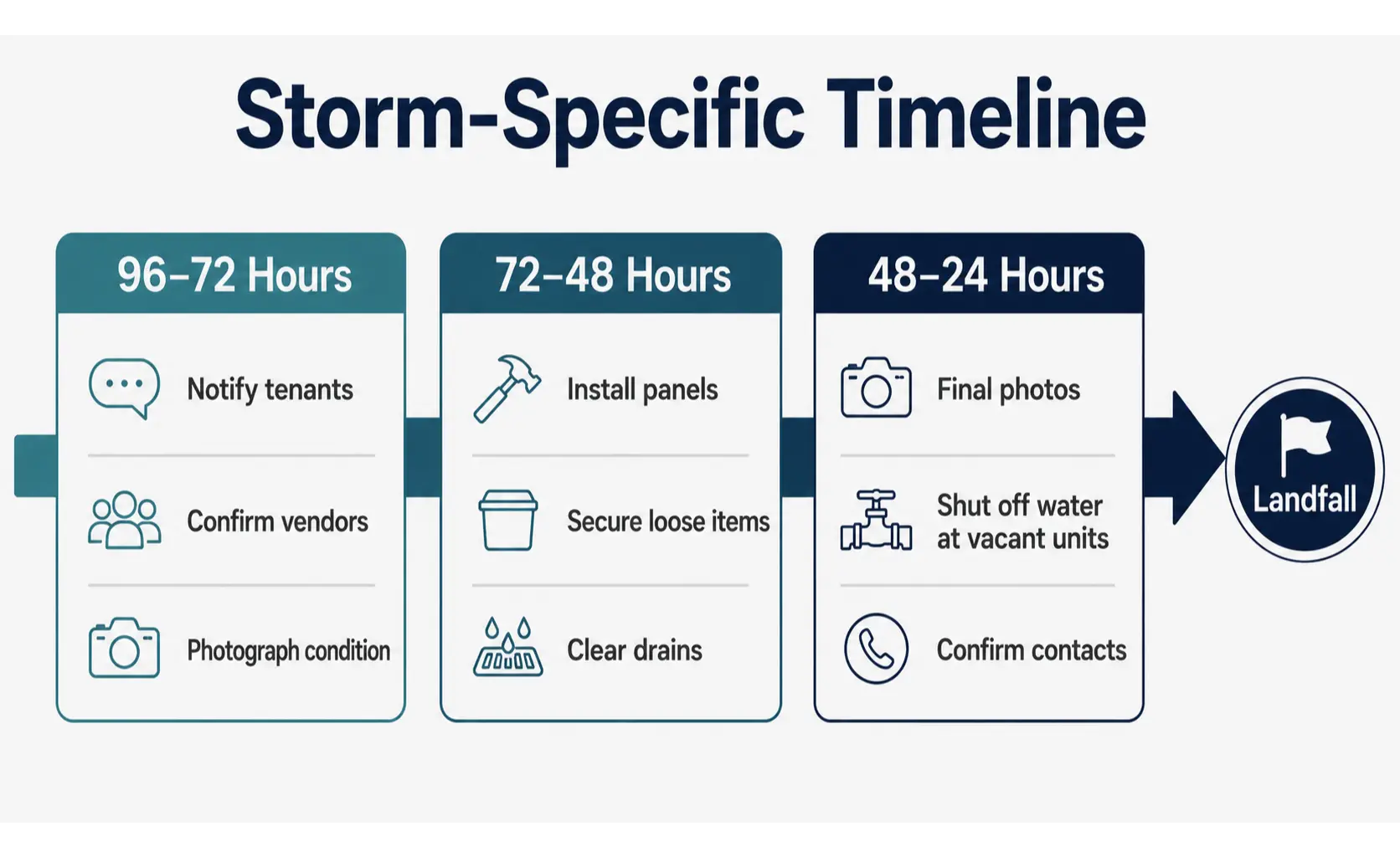
Once a specific system threatens the area, the work is sequenced against the forecast rather than the calendar.
96 to 72 Hours Out
- Notify tenants that preparation is beginning and confirm what they should do
- Confirm vendor availability and place any needed materials on hold
- Photograph current condition again if material changes have occurred since the baseline
- Verify insurance documents and policy numbers are accessible from anywhere, not stored only on-site
72 to 48 Hours Out
- Install shutters or panels
- Secure or bring in all exterior loose items
- Trim any remaining hazardous limbs if a crew is still available
- Clear drains and gutters again
- Confirm every tenant has evacuation information and emergency contacts
48 to 24 Hours Out
- Complete final photographic documentation of the fully prepared property
- Turn off water at the main for vacant units to limit damage from a failure while the property is unattended
- Set HVAC appropriately and, for vacant units, decide on power configuration
- Confirm emergency contacts are reachable and that someone local is designated to inspect after the storm
Landfall
No one should be at the property. Preparation is complete or it is not.
Phase 4: Immediately After
Post-storm work has its own protocol, but three items are time-critical.
Document before mitigating. Photograph all damage before any cleanup or temporary repair. Removing evidence first weakens the claim.
Mitigate promptly. Policies generally obligate the owner to prevent further damage — tarping an opened roof, extracting standing water, and drying wet materials. Delayed mitigation can be treated as owner-caused additional damage, and in this climate mold develops quickly in wet materials.
Notify the insurer early. Claim volume after a regional event is enormous, and adjuster scheduling follows notification order.
The full sequence is covered in the post-hurricane property inspection protocol.
What This Requires of an Owner
Read the timeline again from the perspective of an owner living in another state with four properties in South Florida.
Every item requires physical presence, local vendor relationships, and same-week execution across multiple sites — during a period when the entire region is competing for the same crews and materials. Someone has to install panels at four properties, secure exterior items, photograph each one, shut off water at vacant units, and then return afterward to inspect and document.
That is not a willingness problem. It is a capacity problem, and it is precisely why absentee owners need local operational support, as detailed in what absentee owners need from a property manager.
For trustees and executors, there is an additional dimension: storm preparation is part of preserving the asset, and the documentation of that preparation is part of demonstrating prudent administration. See property management for trustees and estate executors.
Hurricane Readiness with Beam
Beam Residential runs hurricane readiness as a scheduled program: pre-season roof, drainage, vegetation, and opening-protection work completed before June; monthly in-season verification; a storm-specific timeline executed at every property; and photographic documentation before and after each event.
If you’ve inherited South Florida rental property, or your portfolio is here while you are not, storm season should not depend on your travel schedule.
Contact Beam Residential to put a documented hurricane protocol in place across your properties.
FAQ
When does hurricane season start and end in South Florida?
The Atlantic hurricane season runs from June 1 through November 30 per the National Hurricane Center, with activity historically peaking in the late summer and early fall. Preparation work that depends on vendor availability should be completed before June 1.
What should a landlord do to prepare a rental property for hurricane season?
Before June: professional roof inspection, drainage and grading review, tree and vegetation work, verification that all shutters or panels and their hardware are present and functional, exterior envelope resealing, insurance review, dated baseline condition photographs, written tenant communication, and confirmed vendor relationships. During the season: monthly verification that those conditions still hold.
Who is responsible for hurricane preparation, the landlord or the tenant?
Responsibilities depend on the lease and applicable law, but the practical division is that the owner is responsible for the property’s physical protection — roof, drainage, opening protection, and structural condition — while tenants are typically responsible for their own belongings, their evacuation decisions, and securing items they placed outside. This should be stated explicitly in the lease and repeated in writing before each season.
What documentation should I have before a hurricane?
Dated photographs of the roof, every exterior elevation, all windows and doors, interior rooms, and major systems, plus accessible copies of insurance policies with policy numbers and deductibles. Pre-storm condition photographs are the comparison set that supports a damage claim, and they cannot be created after the fact.
Should water be shut off at a vacant rental before a storm?
For a vacant unit, shutting off water at the main is a common precaution, because a supply failure at an unattended property can run for days. For an occupied unit, that decision has to account for the tenant’s needs and their plans to remain or evacuate.
How does hurricane preparation affect insurance claims?
It affects them in two ways: documented pre-storm condition establishes what damage the storm actually caused, and evidence of reasonable maintenance and preparation supports the claim’s credibility. Policies also generally require prompt mitigation after a loss, so documented, timely action after the storm matters as much as preparation before it.
Can an out-of-state owner handle hurricane preparation remotely?
Not the physical portion. Installing opening protection, securing exterior items, clearing drainage, shutting off water at vacant units, and photographing prepared condition all require someone on-site — at every property, within the same compressed window before landfall.
Authority Outbound Links
- NOAA National Hurricane Center — season climatology and forecasts → https://www.nhc.noaa.gov/climo/
- FEMA — hurricane preparedness and property protection guidance → https://www.ready.gov/hurricanes