
How Strong Property Management Affects Resale Value

The retrade almost never arrives as an argument about value. It arrives as a request for documents that do not exist. A buyer asks for three years of service history on the air handlers, the permit for the re-roof, the deposit ledger for the two inherited tenants, and the invoice behind a large repair line item. The seller produces two of the four. The other two become assumptions, and assumptions are always priced against the seller.
That is the mechanism by which management quality shows up in a sale price. Not as goodwill, and not as a bullet point in a listing. As the amount of uncertainty a buyer, a lender, and an appraiser have to absorb on the day they commit capital.
Owners who plan to hold a South Florida rental portfolio indefinitely still face this test. Refinancing, adding a lender, restructuring an estate, or transferring an asset between beneficiaries all involve someone outside the ownership group examining how the property has been operated. The exit event is simply where the consequences are largest and least reversible.
Everyone at the Table Is Pricing Uncertainty
A residential investment sale involves three parties evaluating the same asset for different reasons, and all three respond to missing information the same way.
The buyer is underwriting a forward income stream. Every unknown becomes a reserve, a contingency, or a price concession. A buyer who cannot verify the age and condition of the roof does not assume the roof is fine. The buyer assumes the roof is a near-term capital event and prices accordingly.
The lender is sizing debt against verifiable cash flow and collateral condition. Leases, payment history, insurance, and property condition all feed loan sizing. Investors financing acquisitions through cash-flow-based products know this from the origination side; the same underwriting logic applies to DSCR financing whether you are the borrower or the seller whose buyer is the borrower.
The appraiser is reconciling an opinion of value that has to withstand review. An appraiser working from a clean rent roll, actual operating statements, and documented capital work has support for a conclusion. An appraiser working from estimates and verbal history builds in more conservative assumptions.
None of these parties is being unreasonable. They are all doing the same thing: converting what they cannot verify into a discount. Management quality determines how much there is to convert.
What a Buyer Actually Diligences on a Tenant-Occupied Rental
A tenant-occupied South Florida rental is bought with the operation attached. The diligence list is narrower and more specific than most sellers expect.

Rent Roll and Lease Quality
The buyer wants a current rent roll that reconciles to executed leases: unit, tenant, rent, term, expiration, renewal status, concessions, pet or parking arrangements, and any side agreements. Leases must be complete and signed, with amendments attached. A rent roll that does not tie to the lease documents is the single fastest way to lose credibility in diligence.
Payment History and Deposit Accounting
Ledgers matter more than the current rent figure. A buyer reads twelve to twenty-four months of payment history looking for late patterns, partial payments, NSF activity, and unexplained credits. Separately, the buyer wants deposit accounting: how much is held for each tenant, where it is held, and what the lease and Florida law require. Florida Statute 83.49 addresses how deposit money and advance rent must be handled and disclosed, with requirements that vary by arrangement. Owners and sellers should have Florida counsel confirm obligations for their specific leases and transaction.
Maintenance and Capital History
This is where sellers diverge most sharply. A buyer wants to know what has been serviced, what has been replaced, when, by whom, and at what cost — organized by property and system rather than as a pile of invoices.
Physical Condition
The buyer’s inspector will produce a report regardless of what the seller provides. The question is whether the report contains surprises. Findings that already appear in the seller’s own condition history, with a documented decision attached, are far less damaging than the same findings discovered cold.
Insurance History and Current Insurability
Loss history, claim detail, current coverage, current premium, and — increasingly the controlling question — whether the property can be insured at all on terms the buyer’s lender will accept.
Permit Status of Past Work
Roof replacements, window and door openings, electrical panel changes, and structural work generally require permits and inspections. A buyer’s title and municipal searches surface open or missing permits. Unresolved permit status on completed work is a delay, a cost, and a negotiating lever all at once. The Florida Building Commission maintains the code framework; permitting and closeout are administered locally, which is exactly why the record has to be kept locally and contemporaneously.
A Documented Maintenance History Removes the Worst-Case Assumption
Deferred maintenance is the most expensive thing a buyer cannot see. Faced with an undocumented ten-year-old property, a disciplined buyer does not average the possibilities. The buyer underwrites the unfavorable end of the range: aging mechanical equipment, unknown roof remaining life, unresolved moisture exposure, plumbing of unknown material and age.
A documented history collapses that range. When the file shows dated HVAC service records, condensate maintenance, water heater ages and replacement dates, drainage work, exterior sealant and coating history, and pre- and post-season condition photographs, the buyer is no longer guessing. The remaining capital exposure becomes a calculation instead of a fear.
That is also the difference between a price negotiated once and a price negotiated twice. Retrades are usually powered by discovery, not by market movement. A buyer who finds something material that the seller did not disclose or did not know gains leverage on both price and terms. A buyer who finds only what was already in the file has very little to work with.
This is the compounding return on operating discipline described in preventative maintenance as an asset protection strategy and in the annual maintenance schedule for South Florida rental properties. The maintenance protects the building. The record protects the price.
Rent Roll Quality Is a Pricing Input
An income buyer is not buying rent. The buyer is buying the durability of rent. Three characteristics of the rent roll drive what that durability is worth.
Market-rate leases versus below-market drift. Portfolios that renew on autopilot accumulate below-market rents. Sellers often expect credit for the upside. Buyers apply a discount instead, because capturing that upside requires turnover, downtime, make-ready cost, and leasing risk that the buyer will bear. Below-market drift also weakens the in-place NOI the sale is priced from, which is the more direct problem.
Staggered versus clustered expirations. A rent roll with several leases expiring in the same short window concentrates turnover risk, and a buyer prices concentrated risk. Expiration sequencing is a management output, controlled through renewal timing and lease term selection rather than at listing.
Tenant payment history and quality. Tenants with clean, verifiable payment records support the income stream. Tenants with chronic delinquency, unresolved balances, or documented lease violations reduce it, and any active dispute or eviction posture becomes a diligence issue in its own right.
Each of these is decided during the hold, in the renewal conversations described in the true cost of tenant turnover and the leasing discipline behind reducing vacancy between tenants in South Florida. None of them can be fixed in the sixty days before a listing.
Clean Financials Support the NOI You Are Asking to Be Paid For
Income property is priced from net operating income. If the buyer will not accept the NOI, the capitalization rate applied to it is irrelevant.
Consider a purely illustrative structure: two identical properties, identical rents, identical actual expenses. Property One presents three years of monthly statements with income and expense categorized consistently by property, capital work separated from repairs, invoices attached, and a maintenance history that explains every material line. Property Two presents a spreadsheet reconstructed from bank statements after the property went under contract.
The underlying economics are the same. The credibility is not. Reconstructed records invite normalization: the buyer adds a management fee whether or not one was paid, raises the maintenance and reserve assumptions to cover what cannot be verified, and treats questionable expense classification as a reason to be conservative everywhere. Each adjustment reduces the NOI the price is built on. At any cap rate, a reduced and distrusted NOI produces a reduced value.
Clean financials do not inflate value. They prevent the erosion of value the owner actually earned. This is the reporting infrastructure behind portfolio management services for multi-property investors — the same statements that support a hold decision are the statements that survive a buyer’s review. The categorization discipline that makes those statements credible is the same discipline discussed in tax considerations for multi-property owners in South Florida, where the separation of repairs from capital work matters for a different reason entirely.
Diligence Friction Is a Price Term
Sellers underestimate how much slow document production costs them. Diligence periods are finite. When a seller takes two weeks to produce leases, then another week to locate deposit records, then cannot find the permit for work completed four years ago, three things happen.
First, the timeline extends. Extensions require the buyer’s consent, and consent is rarely free.
Second, the buyer’s confidence declines. A seller who cannot answer basic operational questions quickly signals that other things may also be unknown, which raises the buyer’s assumed risk on everything not yet examined.
Third, the buyer’s leverage grows. Every unanswered item is a live issue at the point where the buyer decides whether to close on the original terms.
An organized seller compresses diligence. Documents arrive complete and in order, questions are answered the same day, and the buyer runs out of open items early. Deals that close on the original terms are usually deals where the buyer never developed a reason to reopen them.
Insurance History and Roof Age Deserve Their Own Discussion
In current South Florida residential transactions, insurance is frequently the item that determines whether a deal closes on the agreed terms. A buyer’s lender will require coverage. If coverage is expensive, restricted, or unavailable, the buyer’s underwriting changes materially — and so does the price the buyer can pay.
Two records carry disproportionate weight.
Loss history. A property with repeated water or wind claims presents differently to a carrier than a property with a clean record and documented maintenance. Claim frequency is part of how residential property risk is evaluated; the Florida Office of Insurance Regulation publishes market and rate filing data for owners tracking the environment. Underwriting appetite and pricing vary by carrier, property, and time, so a licensed Florida agent should evaluate any specific asset.
Roof age and documented condition. Roof age and condition influence insurability and premium in Florida more than almost any other single physical attribute. A seller who can produce the permitted replacement date, the contractor, the warranty, and subsequent inspection records is presenting a different asset than a seller who says the roof “was done maybe eight or nine years ago.”
Owners tracking this environment should read what South Florida owners should know about insurance rates. At exit, the practical point is narrow: insurability is diligenced, and it is documented or it is discounted.
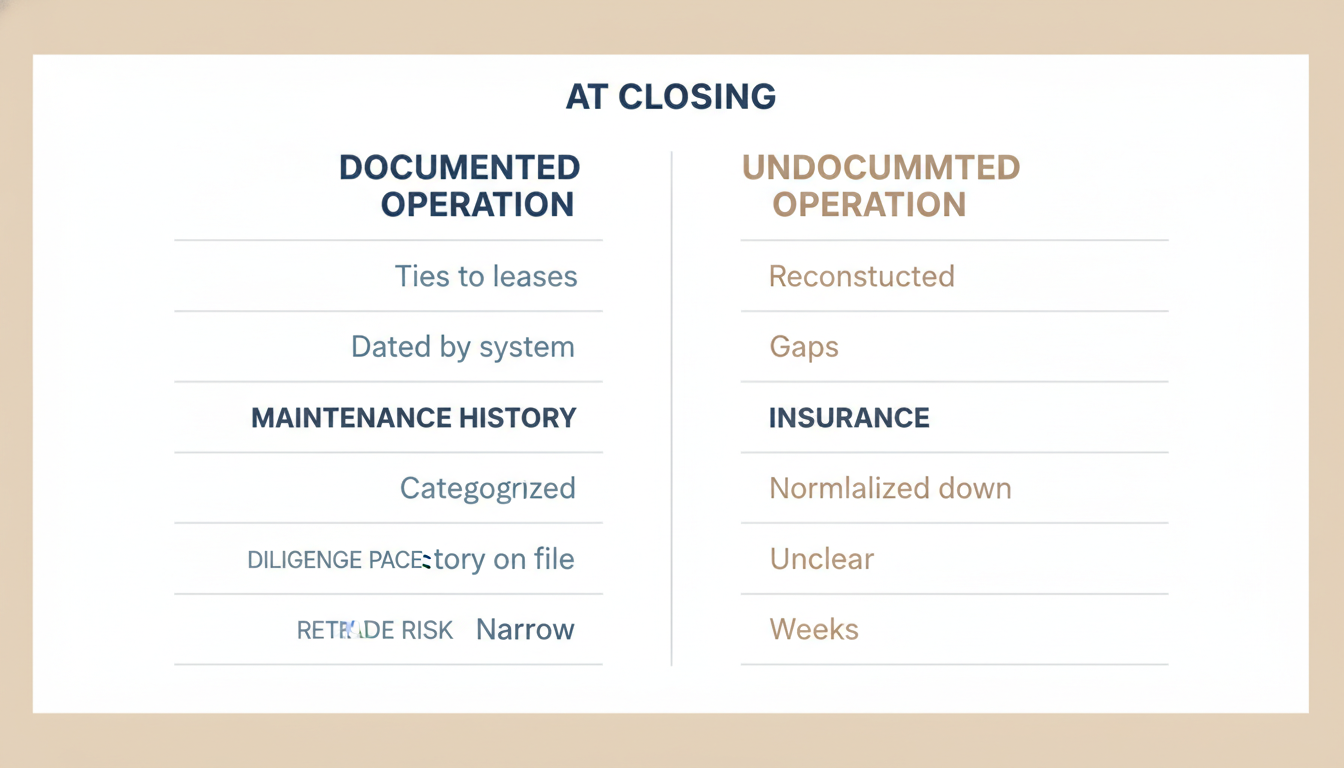
Documented Operation vs. Undocumented Operation at Closing
| Transaction element | Documented operation | Undocumented operation | |
|---|---|---|---|
| Rent roll | Reconciles to executed leases and ledgers | Assembled from memory and bank deposits | |
| Lease expirations | Staggered deliberately through renewal timing | Clustered by accident | |
| Payment history | Verifiable ledger per tenant | Partial or unavailable | |
| Deposits | Reconciled and traceable per tenant | Reconstructed at closing | |
| Maintenance history | Dated records by property and system | Invoice folder, gaps unexplained | |
| Capital work | Scope, cost, date, permit, warranty | “It was replaced a while ago” | |
| Inspection findings | Already known and addressed | Discovered by the buyer | |
| Insurance | Loss history and current terms documented | Unclear insurability | |
| Financials | Categorized statements, expenses supported | Normalized downward by the buyer | |
| Diligence pace | Days | Weeks, with extensions | |
| Retrade exposure | Narrow | Broad | |
| Closing certainty | High | Conditional |
Every row on the right is a place where a buyer can reasonably ask for less. Collectively, they explain why two properties with the same rents and the same physical condition do not sell for the same number.
The Record Has to Be Built During the Hold
There is no version of this work that can be completed at listing. Maintenance history cannot be created retroactively. Deposit accounting cannot be reconstructed accurately from memory. Lease expirations cannot be re-staggered inside a diligence period. Below-market rents cannot be corrected without turnover the seller no longer has time to absorb. Permits cannot be closed on a buyer’s schedule.
What can be done at listing is disclosure of what is missing — at a price. That is the choice an owner without records is actually making.
This is the distinction between operational oversight and rent collection. A rent collector produces monthly deposits. An operational partner produces monthly deposits and an asset file: condition history, capital record, lease and renewal discipline, categorized financials, insurance documentation, and verified completion of material work. The first is a service. The second is a component of value that shows up on the closing statement.
When the Seller Is a Trustee or Executor
For fiduciaries, resale value is only part of the exposure. A sale of estate or trust property has to be defensible to beneficiaries and, in some circumstances, to a court.
Florida Statute 736.0804 requires a trustee to administer a trust as a prudent person would, exercising reasonable care, skill, and caution. Applied to a disposition, that standard is difficult to satisfy with no record of how the asset was maintained, why capital decisions were made or deferred, how the property was marketed, or why the accepted price was reasonable given documented condition.
A beneficiary who questions a sale price years later will not be evaluating the fiduciary’s judgment in the abstract. The available evidence will be the file. Dated condition reports, capital decisions with supporting proposals, insurance records, lease and rent history, and the diligence package delivered to the buyer collectively show a process. Their absence shows nothing, which is a poor position for a fiduciary and a worse one for the estate.
Beam’s approach to property management for trustees and estate executors treats documentation as part of administration rather than as cleanup before a closing. Fiduciaries should also involve Florida counsel and the estate’s tax advisors well before a sale, since authority to sell, required notices, and reporting obligations depend on the governing instrument and the specific circumstances.
How Beam Protects Exit Value During the Hold
Beam Management Group operates the portfolio so the exit file is a byproduct rather than a project:
- Maintain a per-property asset record covering systems, ages, condition history, and capital decisions.
- Manage renewals for market-rate rents and deliberately staggered expirations.
- Keep tenant ledgers, deposits, and lease documents complete and reconciled.
- Produce categorized monthly and annual financials by property.
- Document insurance-relevant condition, including roof and envelope status and loss history.
- Verify that material and permitted work is closed out and filed.
- Deliver a diligence-ready package when the owner refinances, transfers, or sells.
The compounding effect on residential asset protection is that the same discipline improves NOI during the hold and defends price at the exit. Owners are not choosing between operating well and selling well.
Prepare Your Property Records for Sale or Refinance
If you are within a few years of a refinance, a 1031 exchange, or a disposition, the file a buyer will demand should already exist. Beam can take over operations across your South Florida properties, rebuild the condition and capital record, bring the rent roll and financials to a defensible standard, and keep them there — so a diligence period becomes a document transfer rather than a negotiation.
If you are a trustee, executor, or inheritor who may need to sell inherited South Florida rentals, the record matters twice: once to the buyer and once to the beneficiaries. We can establish a dated condition baseline now, document decisions as they are made, and provide the reporting your counsel and CPA will expect when the property is marketed.
Beam works with multi-property owners, inheritors, trustees, and executors who need local operational oversight and a documented asset, not a rent-collection vendor. Contact Beam Management Group to review what your current records would support in a transaction.
FAQ
Does property management actually affect what a rental property sells for?
It affects the inputs a buyer prices from. Management determines rent levels, lease expiration sequencing, tenant payment quality, documented condition, capital history, insurance record, and the credibility of the operating statements. Buyers, lenders, and appraisers convert unverifiable information into conservative assumptions, so the quality of those inputs shows up in price, terms, and closing certainty.
What documents should I have ready before listing a tenant-occupied rental?
Executed leases with all amendments, a rent roll that reconciles to those leases, tenant ledgers covering recent payment history, deposit accounting, categorized operating statements, maintenance and capital records by system, insurance policy and loss history, permit documentation for completed work, warranties, and recent condition reports or inspections. Confirm the full requirement list with your broker, Florida counsel, and CPA for your specific transaction.
Why do buyers discount properties with no maintenance records?
Because the absence of records does not read as an absence of problems. Without a documented history, a buyer underwrites the unfavorable end of the range for roof remaining life, mechanical equipment condition, plumbing age, and moisture exposure. Documentation replaces that assumption with a calculation.
How do below-market rents affect resale value?
They reduce the in-place net operating income the price is built from. Sellers often expect to be paid for the upside, but a buyer who has to capture that upside through turnover, downtime, and make-ready cost generally prices the risk rather than the potential. Correcting drift takes renewal cycles, which is why it has to be managed during the hold.
What causes a buyer to retrade after going under contract?
Most commonly, discovery: an inspection finding, a permit issue, a deposit or ledger discrepancy, an insurance problem, or an expense that cannot be supported. Slow document production compounds it by extending the timeline and keeping issues open. A seller whose file contains no surprises gives a buyer little basis to reopen agreed terms.
Why does roof age matter so much in a South Florida sale?
Roof age and documented condition strongly influence insurability and premium, and the buyer’s lender will require coverage. A permitted replacement date, contractor documentation, warranty, and subsequent inspection records let a buyer and carrier evaluate the actual asset. Underwriting varies by carrier and property, so a licensed Florida agent should assess any specific property.
Can I improve resale value in the last few months before selling?
Only at the margins. Cosmetic preparation and organized document assembly help. Maintenance history, deposit accounting, lease expiration structure, rent positioning, and permit closeout cannot be created inside a listing window. Those are hold-period outcomes, which is why owners planning an exit within a few years should address operations now.
What does a trustee or executor need before selling inherited rental property?
Authority to sell under the governing instrument, guidance from Florida counsel and the estate’s tax advisors, and a documented record of how the property was maintained and how decisions were made. Florida’s prudent administration standard is easier to demonstrate with dated condition reports, supported capital decisions, insurance records, and a complete diligence package than with a verbal account years after the fact.