
Plumbing Maintenance for South Florida Rental Investors
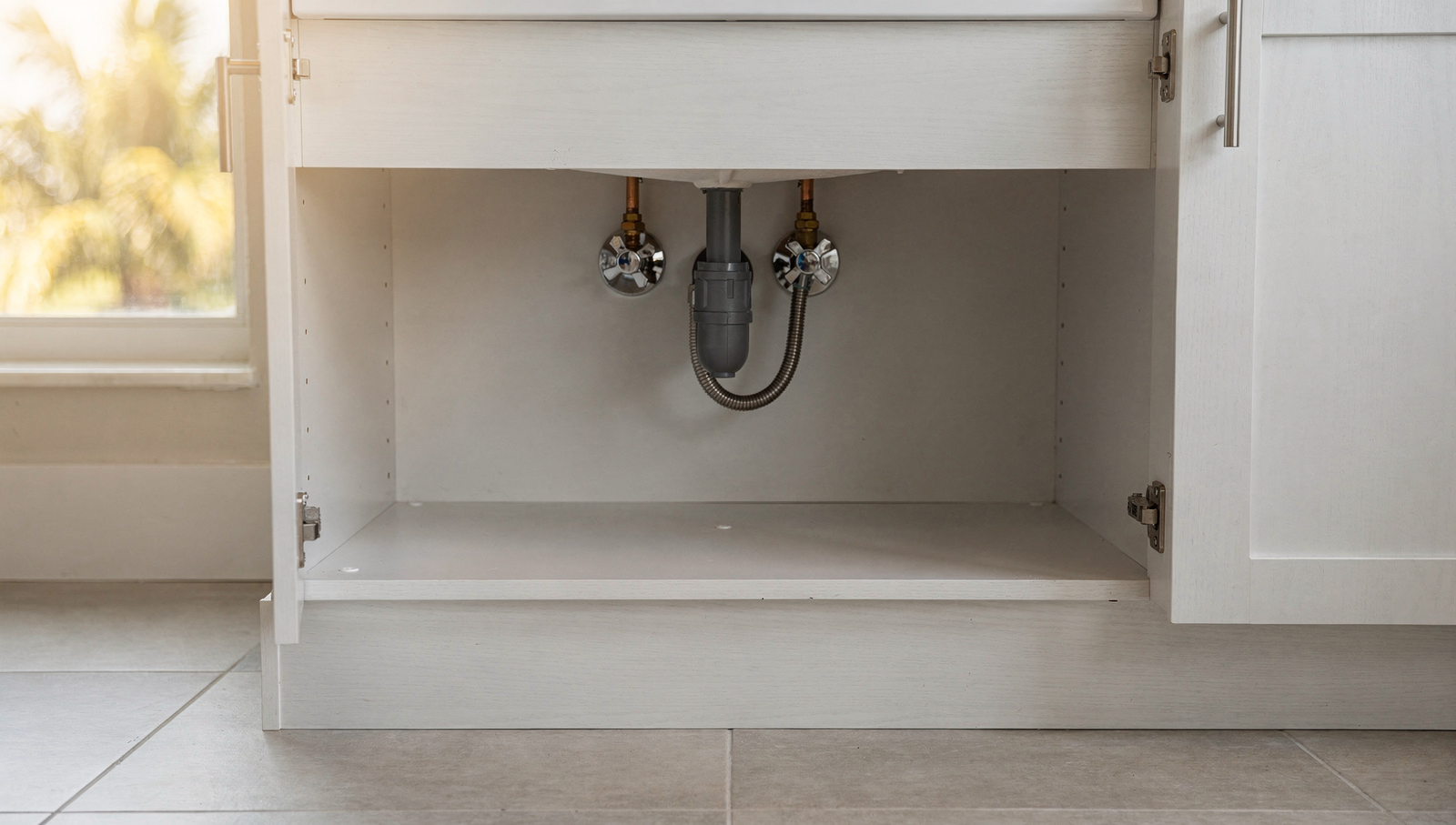
A braided supply line under a bathroom vanity failed at 2 a.m. in a Miami-Dade duplex. The tenant heard nothing, because the failure was a weep rather than a burst, and the water ran into the cabinet base and under the tile for six weeks. The invoice was not for a supply line. It was for cabinetry, subfloor, baseboard, a section of drywall, a licensed remediation scope, four weeks of abated rent, and a claim that followed the property into its next two insurance renewals. The part that failed cost less than lunch.
That is the shape of nearly every plumbing loss in a residential rental. The failure itself is small and cheap. The cost comes from duration, concealment, and what water does to organic materials after the first 48 hours. Which means water loss is not a repair-skill problem. It is an interval problem, and interval is an ownership decision.
This article is written for owners of multiple South Florida rentals and for the trustees, executors, and advisors accountable for them. It is not a repair guide. It contains no do-it-yourself instructions, because plumbing work in Florida is licensed work and should be performed by licensed plumbers. Its purpose is to define what an owner should know, verify, and document so that a small component failure stays a small invoice.
Why the Slow Leak Is the Expensive One
Owners tend to fear the dramatic event: a burst line, a ruptured water heater, water visible across a floor. Those events are unpleasant and they are also the cheaper category, because a burst line announces itself. Somebody calls within minutes, the water gets shut off, and the loss is bounded by how long it took to reach a valve.
The expensive loss is the one nobody reports. Four factors compound:
Duration. A weeping connection can run for weeks or months. Volume is not the driver of cost; time is. The EPA WaterSense program notes that the average household’s leaks account for more than 9,300 gallons of wasted water per year, and that nine percent of homes have leaks wasting 50 gallons or more per day. On a rental, that water is not just a utility line item. It is going somewhere inside the building.
Concealment. Slow leaks favor the places nobody looks: the back of a vanity cabinet, a wall cavity behind a shower valve, the underside of a water heater, a slab penetration, the ceiling below a second-floor bathroom. By the time a stain appears on a ceiling, the assembly above it has been wet for a long time.
Secondary damage. Water does not damage plumbing. It damages cabinetry, subfloor, flooring adhesive, drywall, trim, insulation, and finish carpentry, and it corrodes adjacent hardware. The repair is a fraction of the reconstruction.
Mold consequence. In South Florida, sustained moisture in an interior assembly reliably becomes a biological problem. EPA mold guidance recommends drying water-damaged materials within 24 to 48 hours. A six-week leak has been outside that window roughly 250 times over. That converts a plumbing ticket into an assessment, a remediation scope, and a habitability conversation, which is the subject of mold prevention in South Florida rental properties.
The operational conclusion is uncomfortable and useful: a tenant is a poor leak detector for anything that does not inconvenience them. Tenants reliably report loss of function — no hot water, a fixture that will not drain, visible standing water. They frequently do not report a slightly damp cabinet floor, a faint musty smell under a sink, a toilet that rocks, or a water heater weeping at its base.
The Failure Points That Actually Produce Claims
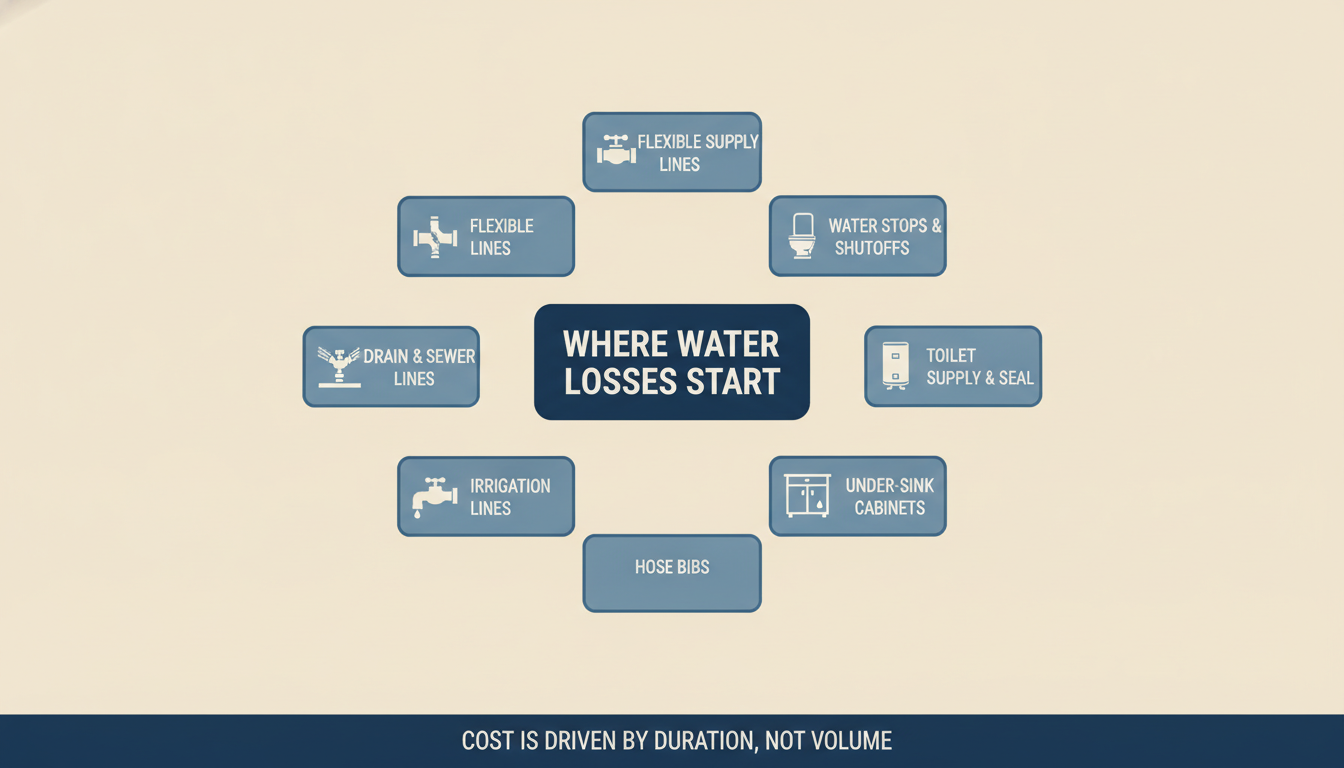
Across a portfolio, plumbing losses repeat from a short and predictable list. Knowing the list is what turns a walkthrough into a verification.
Supply Connections and Flexible Lines
Braided stainless and plastic-coupling flexible supply lines to faucets, toilets, dishwashers, ice makers, and washing machines are the highest-frequency origin of interior water loss. They are consumable hardware with a service life, they are installed once and forgotten for fifteen years, and they fail at the coupling rather than the visible braid. Washing machine hoses are the worst case because they sit under full pressure and discharge at high volume when they let go.
Angle Stops and Fixture Shutoffs
The valve under a sink or behind a toilet is the device that limits a failure to one fixture. Old multi-turn stops seize, and a seized stop means the only way to stop water at 2 a.m. is the main. A stop that has to be forced is also a stop that may weep after being closed. These are inexpensive licensed replacements and they are the difference between a towel and a claim.
Water Heaters
Tanks fail at the bottom, from the inside, without warning, and they fail more often as they age. Two facts drive the risk: age and location. A tank in a garage or utility area, sitting in a code-compliant drain pan with a real drain line to daylight, produces a wet floor. The same tank in an interior closet above finished living space, with no pan or a pan draining nowhere, produces a ceiling collapse. The U.S. Department of Energy’s Building America Solution Center installation checklist states the standard directly: where leakage could damage the home, a code-compliant emergency drain pan with a three-quarter-inch or larger drain line running to a drain or pumping to daylight should be installed, and the unit set on blocks within the pan.
Toilets
Toilets produce two distinct failures. The supply side — fill valve, flapper, supply line — leaks water the tenant can hear or see, and EPA guidance suggests flappers be checked periodically and replaced at least every five years. The drain side is worse: a failed wax seal or a toilet that rocks on its flange releases small volumes of contaminated water into the subfloor at every flush, silently, for years. A toilet that moves when you sit on it is a subfloor issue in progress.
Under-Sink and Cabinet Interiors
Kitchen and bath cabinet bases are where evidence accumulates: staining, swelling, corrosion at fittings, mineral crust, a disposal weeping at its seam, or a p-trap connection that has been hand-tightened one time too many. Photographing under every sink at every visit is one of the cheapest diagnostic habits in property management.
Hose Bibs and Exterior Connections
Exterior spigots in salt air corrode, vacuum breakers fail, and a bib leaking behind its escutcheon keeps the wall base and slab edge wet indefinitely. This is also the connection tenants and vendors use most casually.
Irrigation
Irrigation is a plumbing system that runs unattended on a timer, usually before dawn, and nobody watches it. EPA notes that an irrigation system leak roughly 1/32 of an inch in diameter can waste about 6,300 gallons per month. A broken head or line spraying a wall base or a window sill is simultaneously a water bill problem, an envelope problem, and a moisture problem.
Drain and Sewer Performance
Drains degrade gradually, and the symptom pattern is a slow gurgle before a backup. Repeat backups at the same address are a system signal, not a series of tickets.
Aging Material Stock and the Inherited-Property Problem
South Florida’s rental inventory spans several eras of plumbing practice, and the era determines the risk profile. Galvanized steel supply piping scales and restricts internally and eventually leaks at threads and elbows. Polybutylene supply piping, common in construction from the late 1970s through the mid-1990s, has a well-known failure history and is treated as a material risk by many carriers regardless of whether it has leaked yet. Cast iron drain lines, standard in older Florida housing, corrode from the inside, develop channeling at the bottom of the pipe, and eventually fail beneath a slab, which is the most disruptive plumbing repair a residential property can require.
Material history is the single most common documentation gap on inherited property. A trustee or executor typically receives keys, leases, and a tax bill. They do not receive a record of what the supply lines are made of, whether a partial repipe was done in 2004, how old each water heater is, whether the drain line has been camera-inspected, or how many prior water claims the address carries. Every one of those unknowns is a pricing input for a carrier and a decision input for a capital plan.
The correct first move on an inherited or newly acquired South Florida property is not a repair. It is a baseline: a licensed plumber’s condition assessment that identifies supply and drain material, water heater age and location, shutoff condition and location, visible corrosion, water pressure, and drain performance, with a camera inspection of the main drain line where the age of the property warrants it. That baseline is what makes every subsequent decision a scheduled one. Fiduciaries carrying this burden should read it alongside property management for trustees and estate executors.
Shutoffs: Knowing, Labeling, and Verifying
A water loss is priced by the minutes between failure and shutoff. Most of those minutes are spent looking for a valve.
For each property, three things must be true. The main shutoff location must be known and recorded in the property file with a photograph. The main must have been physically operated recently enough to know it works, because valves that have not moved in twenty years often will not. And the fixture-level stops must turn by hand.
Then there is the part most owners skip: the tenant needs to know where the main is. At move-in, the tenant should be shown the main shutoff, given its location in writing, and told plainly that they are expected to shut it off and call immediately if water is running and they cannot stop it. That single conversation is often worth more than any device an owner can buy. It belongs in the move-in process described in rent-ready systems, not in a maintenance log.
Labeling matters more than it sounds. A durable label at the main, at the water heater shutoff, and at the irrigation valve turns a panicked search into a ten-second action for a tenant, a neighbor, or a vendor who has never been to the property.
Leak Detection and Automatic Shutoff as a Portfolio Decision
Flow-based leak detection has moved from novelty to a legitimate risk control. Devices installed on the main monitor flow patterns, alert on anomalies, and in many cases close a motorized valve automatically when flow behavior indicates a failure. EPA WaterSense publishes a consumer-facing overview of leak detection and flow monitoring devices, including selection and maintenance considerations.
Treat this as a portfolio-level capital decision rather than a gadget purchase, and apply it where the downside is worst first:
- Properties where a water heater or supply line sits above finished living space
- Properties with known aging supply material and no repipe history
- Properties that are frequently vacant or seasonally unoccupied
- Properties with a prior water claim, where another loss carries outsized insurance consequences
- Properties where no one can reach the address quickly
Two operational cautions. A device that alerts to an app nobody monitors is not a control; the alert has to route to a person with authority to dispatch. And point-of-use water sensors under sinks, at water heaters, and behind washing machines are inexpensive and often catch exactly the slow, concealed leak that a whole-house flow monitor may read as normal usage. Neither device replaces the inspection interval. They shorten duration, which is the variable that costs money.
Drain Performance and Repeat Backups
Drain calls are the most commonly mishandled category in residential management, because clearing a stoppage feels like resolution. It usually is not. A drain that has been cleared three times in eighteen months has an underlying condition: root intrusion at a joint, a bellied or offset section, scale and channeling in cast iron, a grade problem, or a venting defect.
The correct escalation rule is simple and should be written into the operating standard. On a second stoppage at the same location within twelve months, stop buying clearings and buy a camera inspection with a written finding and a recommendation from a licensed plumber. The inspection costs a fraction of one emergency after-hours call and it converts an open-ended recurring expense into a defined capital item that can be scheduled, budgeted, and sequenced across the portfolio rather than triggered at 9 p.m. on a holiday weekend.
Root intrusion deserves specific mention in South Florida. Mature landscaping, ficus in particular, and older clay or cast iron laterals are a reliable combination. Root intrusion recurs on a seasonal cycle, so a property that backs up every year at the same time does not have bad luck.
What to Inspect at Every Turnover
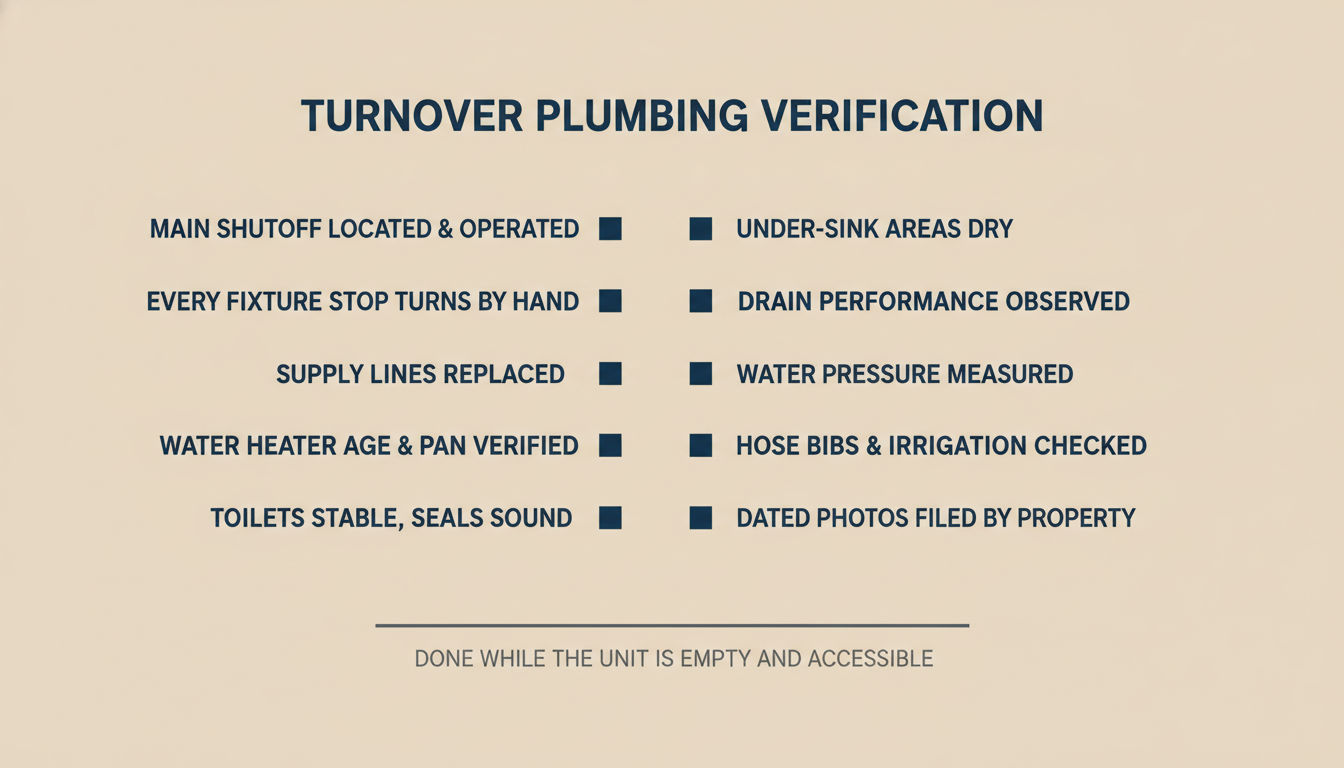
Turnover is the only window when the unit is empty, accessible, and already generating cost. Verification during that window is nearly free compared to doing the same work around a tenant later.
At every turnover, a licensed plumber or a qualified maintenance technician should verify and the manager should document:
- Main shutoff — located, operated, labeled, photographed.
- Every fixture stop — turns by hand, closes fully, no weeping after operation.
- All flexible supply lines — age, condition, and replacement of anything questionable, including washing machine hoses.
- Water heater — serial-date age recorded, location risk assessed, pan and drain line present and clear, T&P discharge correct, no corrosion or weeping at the base, sediment condition noted.
- Toilets — no rocking at the flange, no movement at the seal, fill valve and flapper condition and age, supply line condition.
- Under every sink — dry, no staining, no swelling, no corrosion, disposal seams dry, traps sound.
- Drain performance — every fixture run and observed for slow drainage or gurgling, not just tested for flow.
- Water pressure — measured, with a pressure-reducing valve evaluated where readings are high, since excess pressure shortens the life of every connection in the building.
- Hose bibs and irrigation — no leaks, no spray against the structure, timer verified.
- Photographic record — dated images of all of the above filed by property.
That record is the asset. It converts plumbing from a reactive expense into a tracked condition trajectory, and it feeds directly into the annual maintenance schedule for South Florida rental properties, which governs how these intervals sit alongside HVAC, roof, and envelope work rather than duplicating them.
Reactive Model vs. Managed Model
Reactive model. Plumbing is addressed when a tenant reports something. Supply lines are original. Nobody knows the water heater’s age or whether the main valve turns. Drain stoppages are cleared repeatedly without a diagnosis. Vendors are chosen under emergency pricing. The first time an owner learns a property’s plumbing history is during a claim investigation.
Managed model. Material and equipment history is documented per address. Water heaters are replaced on age, before failure, on a scheduled basis at a planned price. Supply lines and stops are replaced at turnover as consumables. Repeat drain issues trigger camera diagnosis. Detection devices are deployed where the downside is worst. Shutoffs are labeled and tenants know the main. Losses still occur, but they are short, small, and documented.
The difference is not plumber skill. It is interval and follow-through, the same argument made in preventative maintenance as an asset protection strategy.
Claim History, Insurability, and Why Small Losses Matter More Than They Used To
In the current Florida property insurance market, an owner’s claim record is an operating asset. Non-weather water damage is a frequency exposure, and frequency is what underwriting reacts to most sharply. A single documented, well-handled loss is a manageable fact. Two water claims on the same address in a short period can affect eligibility, deductible structure, endorsements, and pricing at renewal, and in some cases the willingness of a carrier to write the property at all. Coverage terms, sublimits, exclusions, and notice requirements vary by carrier and policy form, and no article can determine how a specific loss would be treated. The Florida Office of Insurance Regulation publishes market data and rate filing information for owners who want to understand the environment they are renewing into; specific coverage questions belong to a licensed agent. Broader context is in what South Florida owners should know about insurance rates.
There is a related point that portfolio owners understand faster than single-property owners: the decision of whether to file at all depends on knowing the true scope quickly and accurately. That requires a dated record, photographs, a licensed vendor’s written finding, and a manager who documented the sequence while the water was still on the floor. Owners who reconstruct events from memory three weeks later make worse decisions and get worse outcomes.
Florida also imposes statutory obligations on landlords regarding the condition of rental premises, including plumbing in reasonable working condition, under Florida Statute 83.51, with provisions that vary by property type and written agreement. Obligations for a specific property and lease should be reviewed with Florida counsel.
How Beam Runs Plumbing Risk Across a Portfolio
Beam Management Group treats water as the primary non-storm threat to a residential asset and manages it as a standing control rather than a repair category:
- Establish a per-property plumbing baseline: supply and drain material, water heater age and location, pan and drain status, shutoff locations and condition, water pressure, and prior water history.
- Photograph and label main and equipment shutoffs, and confirm tenant awareness of the main at move-in in writing.
- Replace supply lines, stops, and toilet components as consumables at turnover rather than on failure.
- Track water heater age by serial date across the portfolio and schedule replacement on age and location risk, not on rupture.
- Escalate a second stoppage at the same location to camera inspection with a written finding.
- Deploy flow monitoring, automatic shutoff, and point-of-use sensors where downside severity justifies it, with alerts routed to a person authorized to dispatch.
- Coordinate all of it with the annual maintenance schedule and the moisture controls in HVAC maintenance for South Florida rental properties, so verification happens on an interval rather than on a complaint.
Owners holding several addresses need this to run without their attention, which is the operating model described in portfolio management services for multi-property investors and expected by every owner in what absentee owners need from a property manager.
Schedule a Plumbing Baseline Assessment
If you own multiple South Florida rentals and cannot state the age and location of every water heater, whether every main shutoff turns, and what the supply lines are made of, that is the exposure most likely to produce your next five-figure invoice. Beam can establish the baseline, set the verification intervals, and put the shutoff, detection, and documentation controls in place before a component failure becomes a reconstruction scope.
If you have inherited South Florida rental property, plumbing is usually the least documented system you received and the one with the longest tail. Beam can produce a dated condition record per address, identify the material and equipment risks that drive both loss probability and insurability, and sequence capital work so beneficiaries and advisors see decisions made on evidence rather than on emergencies.
Beam works with multi-property owners, inheritors, trustees, and executors who need local operational oversight, not a weekend project list. Contact Beam Management Group to review water-loss exposure across your properties.
FAQ
Why is a slow leak more expensive than a burst pipe in a rental property?
A burst line is reported immediately, so the loss is bounded by how quickly someone reaches a shutoff. A slow leak is concealed and runs for weeks, saturating cabinetry, subfloor, drywall, and trim. EPA mold guidance recommends drying water-damaged materials within 24 to 48 hours, and a leak that has run for a month is far outside that window, which adds assessment, remediation, and habitability consequences to what began as an inexpensive licensed repair.
How often should flexible supply lines be replaced on a rental?
Treat braided and flexible supply lines to faucets, toilets, dishwashers, ice makers, and washing machines as consumables rather than permanent hardware, and have a licensed plumber evaluate and replace questionable lines at turnover while the unit is empty. Washing machine hoses deserve particular attention because they sit under constant pressure and discharge at high volume when they fail. Replacement intervals should follow the plumber’s assessment and manufacturer guidance for the specific product installed.
When should a water heater be replaced on a rental property?
Replace on age and location risk rather than on failure. Record each unit’s manufacture date from the serial number and assess what is beneath and around it. A tank in an interior closet above finished living space with no functioning pan and drain warrants earlier replacement than an identical tank in a garage with a code-compliant pan and a drain line to daylight. DOE Building America installation guidance calls for a code-compliant emergency drain pan with a three-quarter-inch or larger drain line where leakage could damage the home. Sizing, service life, and replacement timing should be confirmed with a licensed plumber.
Should tenants know where the main water shutoff is?
Yes. Show the main shutoff at move-in, provide its location in writing, and state the expectation that the tenant shut off the water and call immediately if water is running and they cannot stop it. Loss severity is largely a function of the minutes between failure and shutoff, and most of those minutes are usually spent searching for the valve. Label the main, the water heater shutoff, and the irrigation valve durably.
Are automatic water shutoff devices worth installing on rental properties?
They are worth evaluating as a portfolio-level risk decision, prioritized by downside severity: units with plumbing above finished living space, aging supply material with no repipe history, frequently vacant properties, addresses with a prior water claim, and properties nobody can reach quickly. EPA WaterSense publishes guidance on leak detection and flow monitoring devices. Two conditions determine whether the investment works: alerts must route to someone authorized to dispatch, and point-of-use sensors should supplement whole-house monitoring, which can read a slow leak as normal usage.
What should an owner do about repeat drain backups?
Stop buying clearings and buy a diagnosis. A second stoppage at the same location within twelve months indicates an underlying condition such as root intrusion, an offset or bellied section, scale and channeling in cast iron, or a venting defect. A camera inspection with a written finding from a licensed plumber costs far less than repeated emergency calls and converts an open-ended expense into a defined capital item that can be budgeted and scheduled.
Why does plumbing material matter on older South Florida properties?
Material determines failure mode and carrier appetite. Galvanized steel supply piping scales internally and leaks at threads and fittings. Polybutylene supply piping from roughly the late 1970s through the mid-1990s carries a known failure history and is treated as a risk factor by many carriers regardless of whether the property has leaked. Cast iron drain lines corrode and channel from the inside and can fail beneath a slab. Inherited properties rarely come with a record of what is installed, which is why a licensed baseline assessment should precede any capital plan.
Does a water damage claim affect insurance on a Florida rental property?
Claim frequency is a significant underwriting input, and non-weather water damage is a frequency exposure. Multiple water claims at one address in a short period can affect eligibility, deductibles, endorsements, and pricing at renewal. Treatment varies by carrier, policy form, and cause of loss, so specific questions belong to a licensed agent. The practical control is documentation: a dated record with photographs and a licensed vendor’s written finding lets an owner assess true scope quickly and make a better filing decision.