
HVAC Maintenance for South Florida Rental Properties
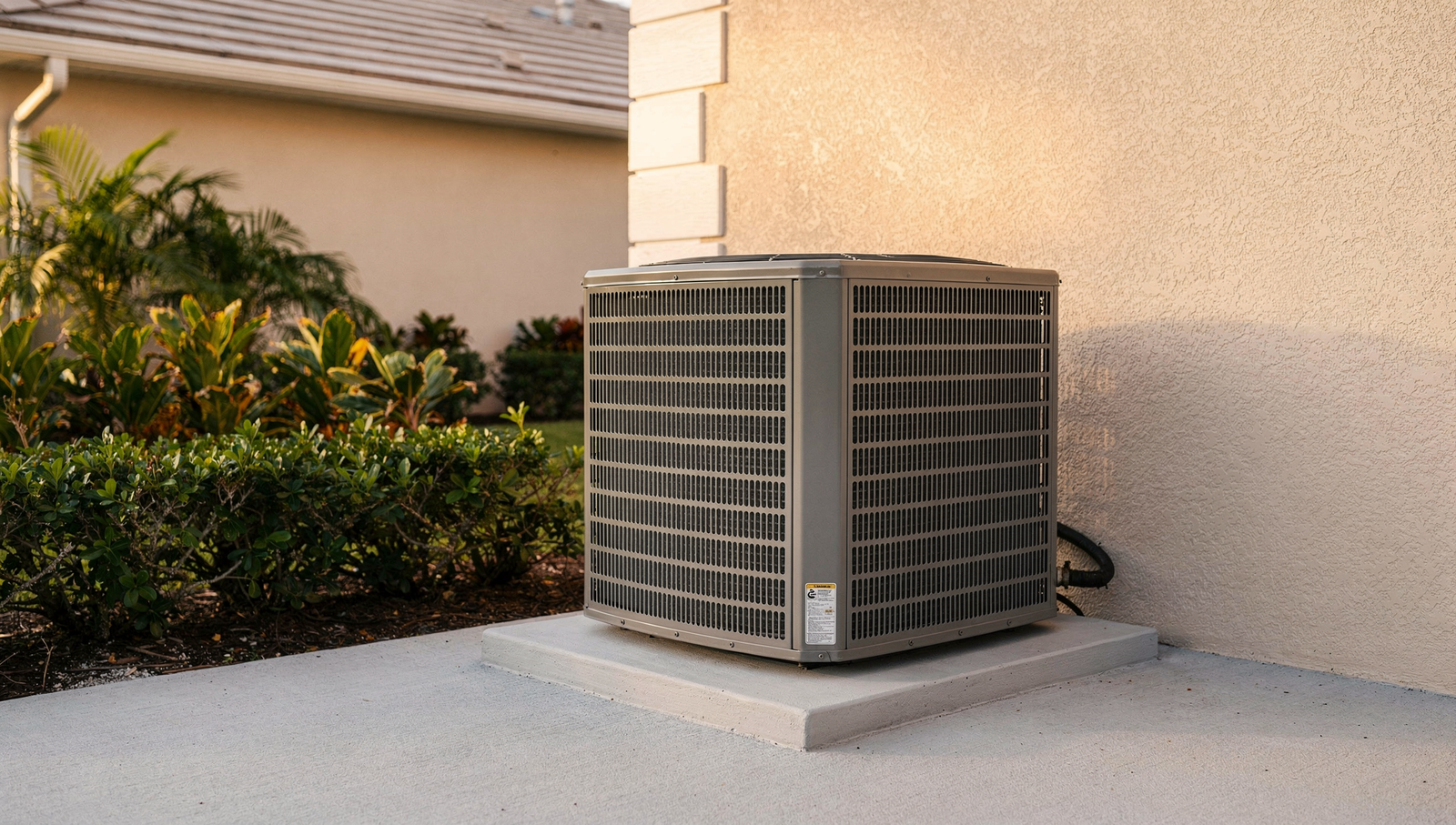
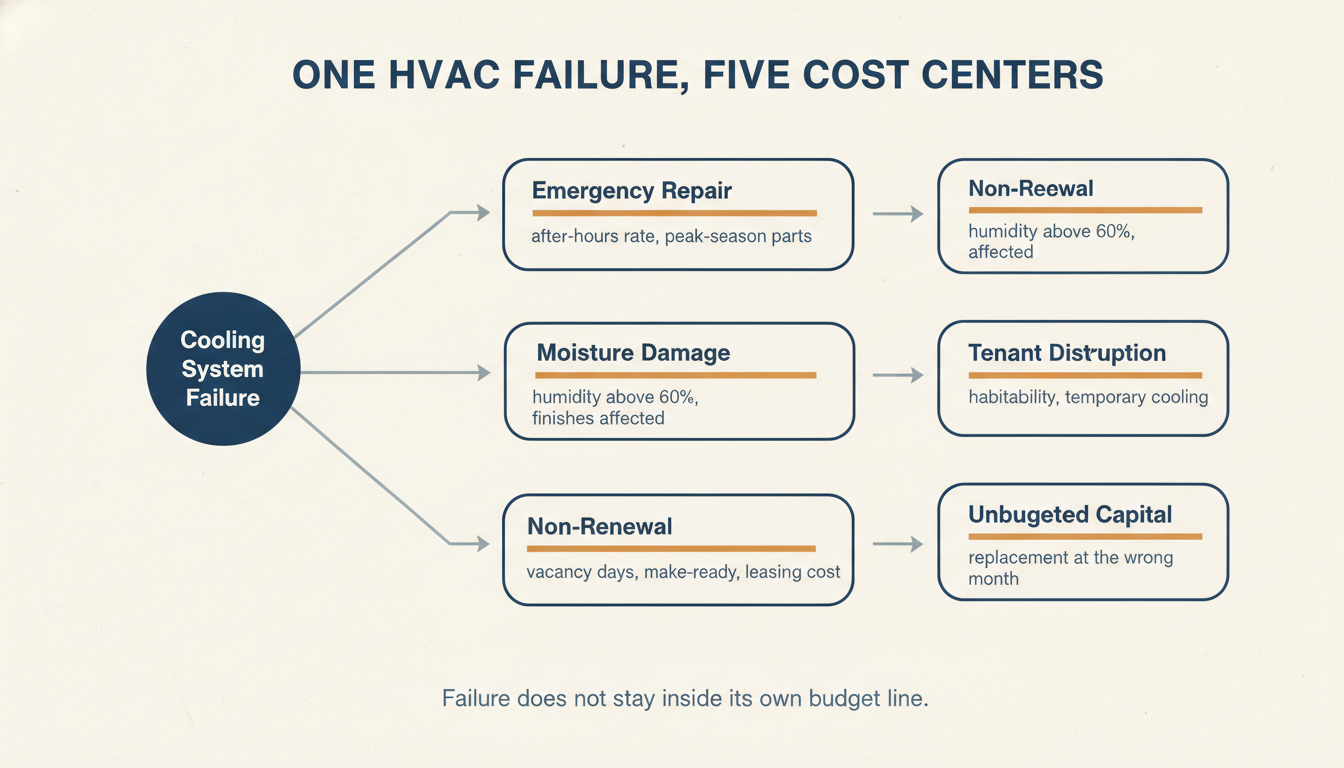
An air conditioning failure in July is rarely a single line item. It is an after-hours diagnostic call, an emergency equipment order at whatever price the market allows that week, a temporary cooling arrangement, a habitability conversation, several days of elevated indoor humidity, and — often enough — a moisture claim in a closet or along a duct chase that nobody connected to the outage until three weeks later. Then the lease comes up for renewal and the tenant who spent four days in an 84-degree unit does not sign.
That sequence is why HVAC is the highest-failure-cost system in a South Florida residential rental. Not the most expensive component to buy, and not the most frequent repair. The most expensive to get wrong, because its failure does not stay inside its own budget category.
The maintenance calendar that positions this work across the operating year is covered in the annual maintenance schedule for South Florida rental properties, and the broader financial argument for planned work sits in preventative maintenance as an asset protection strategy. This article covers something narrower and more consequential for a multi-property owner: how to actually manage cooling equipment as an asset with a service record, a performance trend, and a replacement date you chose rather than one the equipment chose for you.
The Climate Load Is Different, and So Is the Job the Equipment Does
Most HVAC guidance is written for a system that cools for four months and rests for eight. That system does not exist here. A South Florida rental runs cooling in some form nearly year-round, through humid shoulder seasons that never fully release the building.
More importantly, the equipment is doing two jobs at once. It cools, and it dehumidifies. Air passing over a cold evaporator coil gives up moisture, which drains away as condensate. The U.S. Department of Energy notes that one way an air conditioner makes occupants feel cooler is by reducing the amount of moisture in the air. In a climate where outdoor dew points sit high for months, that dehumidification function is not a comfort bonus. It is the primary defense keeping the interior of the building within a safe moisture range.
The U.S. Environmental Protection Agency recommends keeping indoor relative humidity below 60%, ideally between 30% and 50% where possible, and addressing condensation and moisture promptly. Nothing else in a typical residential rental holds that line. When cooling capacity degrades, humidity control degrades with it — and it usually degrades first.
This is the operational consequence owners miss. A system losing performance does not announce itself with a hot unit. It announces itself with a clammy room, a musty return closet, condensation on a supply register, longer runtimes, and building materials absorbing more moisture than they were designed to hold. By the time the thermostat cannot reach setpoint, the interior has been running outside its intended range for weeks.
Cooling equipment in a South Florida portfolio should therefore be managed as a moisture-control system that also lowers temperature. That framing changes what gets inspected and what counts as an exception. Moisture-specific controls are addressed in mold prevention in South Florida rental properties.
What a Real Service Visit Includes
Owners routinely pay for “maintenance” and receive a filter change and a signature. The difference between a service visit and a site visit shows up two summers later in repair frequency.
Scope should follow the manufacturer’s requirements and a licensed HVAC contractor’s recommendation for the specific system. Nothing below is a repair instruction or should be attempted by an owner, manager, or tenant. It is a checklist for verifying that the work you paid for was performed. A defensible visit produces documented findings on:
- Filter condition and correct specification for the equipment, not whatever size the last vendor had on the truck
- Evaporator coil condition and cleaning as needed. The Department of Energy’s home cooling guidance directs that the evaporator coil be checked annually and cleaned as necessary
- Condenser coil condition, outdoor unit cleanliness, and clearance
- Condensate drain line, pan, secondary pan, float switch, and termination point — verified as flowing, not assumed
- Refrigerant charge and pressures, evaluated by a qualified technician
- Blower operation, static pressure, and airflow
- Electrical connections, contactors, capacitors, and amp draw compared against nameplate
- Supply and return temperature differential recorded as a number, not described as “cooling fine”
- Duct condition and accessible insulation, including signs of sweating or disconnected sections
- Thermostat operation and setpoint behavior, including whether the tenant has been fighting the system
- Equipment age, model, serial, and observed deterioration
The recorded numbers matter more than the narrative. Temperature differential, amp draw, and static pressure let you compare this visit to last year’s visit on the same unit and see a trend. ENERGY STAR’s HVAC maintenance guidance reinforces the value of a consistent seasonal routine over intermittent attention. Frequency itself should follow the manufacturer’s requirements, the contractor’s recommendation, and actual condition; in practice a South Florida plan for an occupied rental sets one window before peak cooling demand and a second check after the heaviest cooling and storm period.
Filters Are an Operating Control, Not a Consumable
Filter neglect is the cheapest way to raise operating cost and shorten equipment life at the same time. The Department of Energy states that routinely replacing or cleaning air filters can lower an air conditioner’s energy consumption by 5% to 15%, and that annual maintenance can improve comfort and efficiency while prolonging the life of the unit.
In a rental, the operational question is not what the interval should be. It is who is accountable for it and how you know it happened. Tenant responsibility defined in the lease with filters supplied, scheduled vendor replacement, and subscription delivery matched to each unit’s specification all work. An assumption does not. A restricted filter raises static pressure, reduces airflow across the coil, and pushes the system toward the frozen-coil and water-overflow failures that convert a routine consumable into a drywall and flooring claim.
Condensate: The Small Component With the Largest Damage Radius
A cooling system in this climate removes a meaningful volume of water from the air every day it runs. That water has to leave the building through a drain line, a pan, and a termination point, all of which are subject to biological growth, debris, poor slope, and disconnection.
Condensate failure is the most common route by which an HVAC system damages a building rather than simply stopping. The drain backs up, the pan fills, the float switch either works or does not, and the water finds the ceiling below, the closet wall, the subfloor, or the interior of the air handler cabinet.
Three operating rules matter for a portfolio:
Verify flow, do not assume it. A condensate line is either confirmed clear on a documented date or it is unknown. Slow drainage found during a scheduled visit is a finding. Water found by a tenant is an incident.
Confirm the safety devices exist and function. Secondary pans and float switches are the difference between an inconvenient shutdown and a ceiling repair. On inherited properties, their presence is frequently unverified. A licensed contractor should confirm the configuration against current requirements for the specific installation.
Treat repeat backups as a root-cause signal, not a recurring ticket. Two clogs in one year at the same unit is not bad luck. It usually points to line slope, line routing, oversized equipment short-cycling, a coil condition issue, or a termination point that is partially obstructed. When a work-order system shows the same address and the same complaint three times, the correct response is a diagnostic scope, not a fourth clearing. Repeat-repair visibility across addresses is one of the practical benefits of portfolio management services for multi-property investors.
Outdoor Unit Condition and Clearance
The condensing unit rejects heat to outdoor air. Anything that restricts airflow across that coil raises operating pressures, increases energy use, and shortens compressor life.
Field reality in South Florida: hedges planted for privacy grow into the unit, mulch and clippings pack the coil fins, a fence gets rebuilt eighteen inches from the cabinet, salt-laden air near the coast corrodes coil fins and cabinet fasteners, and a well-intentioned tenant stacks storage against the housing. None of that generates a service call. All of it degrades performance and shows up as premature failure.
The inspection standard is simple and should be documented with photographs at every visit: clearance maintained per the manufacturer’s installation requirements, coil surfaces clean, pad level and intact, disconnect and electrical enclosure in sound condition, no evidence of corrosion advancing on coil or cabinet, and no vegetation or stored material inside the clearance envelope. Coastal properties warrant closer attention to corrosion, which is also a central issue for the building shell, covered in roof and exterior maintenance in a tropical climate (queued this batch, /roof-exterior-maintenance-tropical-climate/).
Reading Decline Before Failure
Total failure is the last event in a sequence, not the first. A portfolio operator should be watching for the earlier signals — most of which are visible in service data or tenant behavior long before the emergency call.
Indicators worth escalating:
- Longer runtimes or a system that no longer cycles off during the hottest part of the day
- Setpoint reached but the unit feels humid, or condensation appears on registers, windows, or supply boxes
- Rising electric consumption at the unit without an occupancy change
- Musty odor at the return, in a closet, or in the air handler space
- Repeat condensate backups, repeat capacitor replacements, or repeat refrigerant additions
- Any refrigerant recharge without a leak diagnosis — refrigerant is not consumed in normal operation
- Increasing noise, hard starting, or breaker trips
- Tenant complaints that reappear after each “fixed” visit
The last one deserves emphasis because it is the signal owners most often lose. Tenant reports arriving through a manager who logs, categorizes, and trends them are early diagnostics. Tenant reports arriving through a phone call that gets handled and forgotten are nothing at all. This is one of the concrete differences described in operational oversight vs. rent collection.
Capital Replacement: Plan on Age and Condition, Not Age Alone
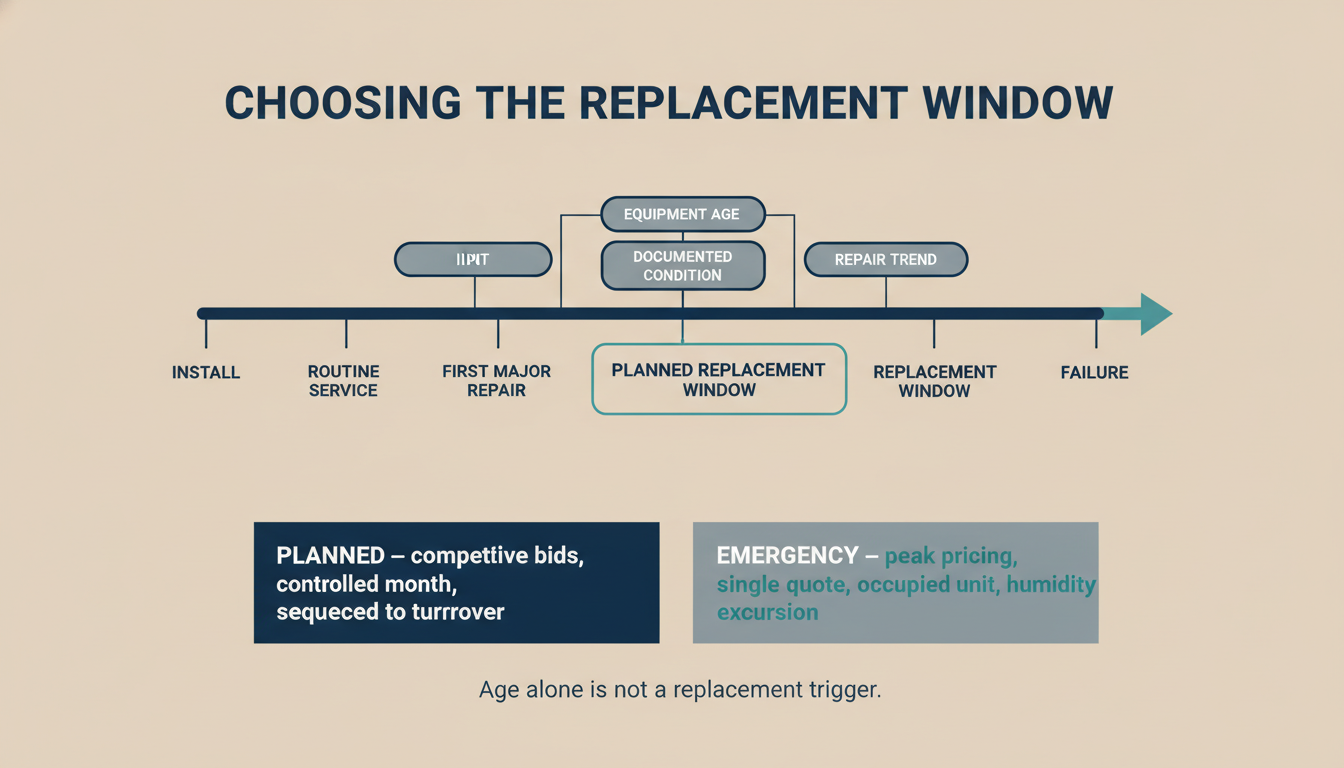
Owners tend to fall into one of two errors. The first is replacing nothing until it dies, which guarantees the replacement happens in peak season, at peak pricing, with an occupied unit and no competitive bidding. The second is replacing on a fixed age rule, which retires serviceable equipment and destroys capital for no operational gain.
The defensible position sits between them: build a replacement window from age, documented condition, repair history, and consequence of failure, then decide.
| Reactive Model | Managed Model |
|---|---|
| Equipment age unknown or estimated | Make, model, serial, install date recorded per unit |
| Service performed when a complaint arrives | Scheduled service with recorded performance values |
| Replacement triggered by total failure | Replacement window forecast from age, condition, and repair trend |
| Emergency pricing, single quote, peak-season lead time | Competitive scoping in a controlled month |
| Occupied-unit emergency, possible temporary cooling cost | Work sequenced to a turnover or planned window |
| Humidity excursion during the outage, possible moisture damage | Interior conditions never leave the intended range |
| Capital surprise absorbed in one quarter | Reserve funded against a known schedule |
Inputs that should sit in the capital forecast for every unit:
Age against expected service life for that equipment type and installation. Coastal exposure, prior repair quality, and duty cycle all move the number.
Repair history and cost trajectory. Two significant repairs in eighteen months on aging equipment changes the calculation even if the unit is currently operating.
Consequence of failure. A system serving a second-floor unit above finished space, or the only cooling for an occupied family, is not the same risk as a system with an accessible drain path and a straightforward replacement route.
Component obsolescence and refrigerant considerations, which a licensed contractor should assess for the specific system.
Efficiency and operating cost, relevant where the owner pays utilities or where efficiency affects the unit’s competitiveness in the rental market.
Turnover calendar. Replacement during a planned vacancy costs less in disruption and produces a stronger rent-ready position. That sequencing logic is the same discipline applied in rent-ready systems.
Comfort Is a Retention Variable
In South Florida, cooling performance is not an amenity conversation. It is the baseline condition a tenant evaluates every day, and it is one of the few maintenance issues that directly influences renewal behavior.
The economics are not subtle. A renewal preserved costs nothing. A turnover consumes vacancy days, make-ready expense, leasing cost, and often a rent concession to re-fill — quantified in the true cost of tenant turnover. Set against that, a documented service program on a cooling system is one of the lowest-cost retention levers available to a portfolio owner, and it protects the building at the same time.
There is also a quality-of-tenancy effect. Tenants who see fast, competent, scheduled responses report problems earlier. Tenants who have learned that reports go nowhere stop reporting, and small failures mature privately inside the unit until they are expensive.
What an Absentee Owner Cannot Verify Remotely
This is where out-of-state ownership quietly loses money. An invoice proves a vendor was paid. It does not prove the work was performed to scope, and remote owners have no mechanism to close that gap.
An owner reviewing paperwork from another state cannot confirm:
- That the filter installed matches the equipment specification
- That the condensate line was actually cleared and verified flowing, not just noted
- That the secondary pan and float switch exist and function
- That the outdoor unit clearance is maintained today, not the day the photo was taken two years ago
- That temperature differential and amp draw were measured rather than estimated
- That refrigerant was added after a leak diagnosis rather than instead of one
- That an “annual service” was a technician’s full visit rather than a fifteen-minute stop
- That indoor humidity in the unit is inside the intended range
- That the tenant’s third complaint about the same room was ever escalated
Closing that gap requires someone locally accountable with a defined verification standard — the core requirement described in what absentee owners need from a property manager. For a trustee or executor, the gap is not only financial. It is evidentiary. Beneficiaries and courts assess process, and an unverified invoice is a weak record.
The Documentation Standard, Per Unit
Every cooling system in the portfolio should have its own file. Not a folder of invoices by year — a record by equipment.
- Make, model, serial number, tonnage, and installation date
- Filter specification, quantity, and replacement interval with accountability assigned
- Every service date, technician, scope performed, and findings
- Recorded performance values: temperature differential, amp draw, static pressure, pressures where taken
- Condensate configuration, safety devices present, and verification dates
- All repairs with parts, cost, and cause
- Refrigerant additions with leak diagnosis outcome
- Photographs of the air handler, condenser, and clearance at each visit
- Warranty and registration status
- Tenant-reported comfort or humidity complaints, with disposition
- Forecast replacement window and current recommendation
- Owner decisions, including documented deferrals and the reasoning
That record does real work beyond maintenance. It supports warranty claims, defends an insurance position on a water event by showing the system was maintained, substantiates the repair-versus-improvement characterization your CPA will need, answers buyer and lender diligence without scrambling, and — for a fiduciary — demonstrates that high-consequence equipment was monitored deliberately. Beam’s approach to property management for trustees and estate executors treats that file as part of the asset, because at refinance or sale it is priced like one.
How Beam Manages HVAC Across a Portfolio
- Inventory and baseline every system: equipment data, age, condensate configuration, filter specification, and current condition.
- Assign service windows by property with a defined scope, not a vendor’s default visit.
- Coordinate licensed contractors and occupied-unit access so the owner is never dispatching a technician.
- Capture recorded performance values at each visit so decline is visible as a trend.
- Route repeat repairs into a root-cause scope instead of a fourth ticket.
- Maintain the per-unit record with photographs, findings, and next-due dates.
- Present replacement recommendations with condition evidence, options, cost, and the consequence of waiting.
- Sequence approved capital work into planned windows and turnovers wherever possible.
The result is not zero HVAC spend. It is HVAC spend that arrives on a schedule, at a price you negotiated, without a moisture event and without a non-renewal attached to it.
Schedule an HVAC Condition Review
If your portfolio has grown past the point where you can personally verify what a technician did at each address, the HVAC program is usually where that gap costs the most. Beam coordinates the service intervals, licensed vendors, occupied-unit access, condition documentation, and replacement forecasting across every property, so cooling equipment stops producing surprises and starts producing a schedule.
If you have inherited South Florida rental property, the equipment you now hold likely has no service history at all. Establishing a documented baseline on every cooling system is one of the fastest ways to quantify what you actually own, protect the buildings from moisture damage while you decide, and show beneficiaries or a court that high-consequence systems are being managed rather than hoped for.
Beam Management Group works with multi-property investors, inheritors, trustees, and executors who need local operational oversight and verified work — not a maintenance checklist to run themselves. Contact Beam Management Group to review the cooling systems across your properties and build a service and capital plan around their actual condition.
FAQ
How often should HVAC be serviced in a South Florida rental property?
Follow the equipment manufacturer’s requirements and a licensed HVAC contractor’s recommendation for the specific system. In practice, a South Florida operating plan for an occupied rental typically establishes one service window before peak cooling demand and a second check after the heaviest cooling and storm period, with filter attention on a shorter interval based on the system, occupancy, and actual filter condition.
Who should be responsible for changing filters in a rental unit?
One party should be named and the arrangement should be documented. Common approaches are tenant responsibility defined in the lease with the correct filters supplied, scheduled vendor replacement, or subscription delivery matched to each unit’s filter specification. What fails is leaving it undefined, because a restricted filter reduces airflow, raises energy use, and increases the risk of coil freezing and water overflow.
Why does the condensate drain line matter so much in Florida?
Cooling equipment here removes a significant volume of moisture from the air, and that water leaves the building through the drain line, pan, and termination point. When the line clogs, water backs up into the pan, the cabinet, the ceiling below, or adjacent finishes. Condensate failure is the most common way an air conditioner damages a building rather than simply stopping.
What does repeated condensate backup indicate?
Repeat backups at the same unit generally point to an underlying condition rather than routine debris — line slope or routing, coil condition, equipment short-cycling, or a partially obstructed termination point. After the second occurrence, a licensed contractor should diagnose the cause rather than simply clearing the line again.
Should HVAC equipment be replaced based on age?
Age alone is a weak trigger. A better decision uses age together with documented condition, repair frequency and cost trend, consequence of failure at that specific unit, component and refrigerant considerations, and the turnover calendar. The objective is to choose the replacement window rather than have peak-season failure choose it, without retiring equipment that is still performing reliably.
How does air conditioning performance affect indoor humidity?
Cooling equipment dehumidifies as it cools, and in this climate that function is the primary control on interior moisture. The EPA recommends keeping indoor relative humidity below 60%, ideally between 30% and 50% where possible. Declining capacity usually shows up as clammy conditions, condensation, or musty odors before it shows up as an inability to reach temperature setpoint.
What HVAC records should a trustee or executor keep?
Keep equipment identification and install dates, every service date with scope and findings, recorded performance values, condensate configuration and verification, all repairs with cause and cost, refrigerant additions with diagnosis outcome, photographs, warranty status, tenant complaints with disposition, the forecast replacement window, and written reasoning for any deferral. Organize it per unit so it supports estate accounting and demonstrates prudent oversight of high-consequence equipment.
Can an out-of-state owner verify HVAC work from invoices alone?
No. An invoice confirms payment, not scope. Filter specification, verified condensate flow, functioning safety devices, maintained outdoor clearance, and measured performance values cannot be confirmed remotely. That verification requires a locally accountable party working to a defined standard and documenting each visit.