
The True Cost of Tenant Turnover (And How to Reduce It)
Most rental property owners measure turnover cost by the number that shows up on a single invoice: cleaning, a few repairs, maybe a lockbox re-key. That number is real, but it is a small fraction of what turnover actually costs.
The full cost of tenant turnover includes lost rent during vacancy, marketing and leasing expenses, make-ready repairs, administrative time, and — the part most owners never calculate — the rent growth and stability a long-term tenant would have provided instead. When all of it is added up, a single turnover on a South Florida rental property commonly costs an owner the equivalent of one to two months of rent, sometimes more.
For an investor holding a property for cash flow, turnover is not a minor operational event. It is one of the largest controllable drags on annual return.
What “Turnover Cost” Actually Includes
When owners underestimate turnover cost, it is almost always because they are only counting the visible, invoiced expenses. A complete accounting includes several categories that rarely appear on the same invoice, which is exactly why they get missed.
Vacancy Loss
The days a unit sits empty between tenants are the most direct cost, and in practice they add up faster than most owners expect. A property that takes three weeks to turn and re-lease is not losing “some rent.” At a typical South Florida rent level, three weeks of vacancy is a meaningful percentage of that month’s income, gone permanently — it cannot be recovered later.
Make-Ready and Repair Costs
Paint touch-ups, carpet or flooring cleaning or replacement, appliance servicing, pest control, and general repairs between tenants are unavoidable. The range varies significantly based on how the previous tenant left the unit and how well it was maintained during the lease, which is exactly why residential asset protection and ongoing preventative maintenance matter — a property maintained throughout the tenancy requires far less make-ready work at turnover.
Marketing and Leasing Costs
Professional photography, listing syndication, showings, and application processing all carry real cost, whether paid directly or absorbed as management time. A property that sits listed longer also tends to attract more price-sensitive applicants, which can pressure the next lease’s rent downward.
Screening and Placement Risk
Every new tenant is an unknown. Thorough screening reduces risk, but it does not eliminate it. Each placement resets the clock on the investor’s exposure to non-payment, property damage, or an early lease break — risks that a renewing tenant with a proven track record simply does not carry.
Administrative and Coordination Time
Scheduling vendors, coordinating move-out and move-in inspections, processing security deposits, and handling the lease paperwork all take real time. For a self-managing owner, this is hours pulled directly from other responsibilities. For a managed property, it is time that a well-run operation should be systematizing rather than repeating from scratch with every turnover.
The Opportunity Cost of a Reset Rent Trajectory
This is the cost most owners never calculate. A tenant who renews year over year typically absorbs modest, predictable rent increases. A new tenant resets that relationship — and if the unit was vacant for even a few weeks during a rate-sensitive season, the new lease may be signed at a rate that reflects urgency to fill the unit rather than the property’s actual market position.
The True Cost of Tenant Turnover Framework
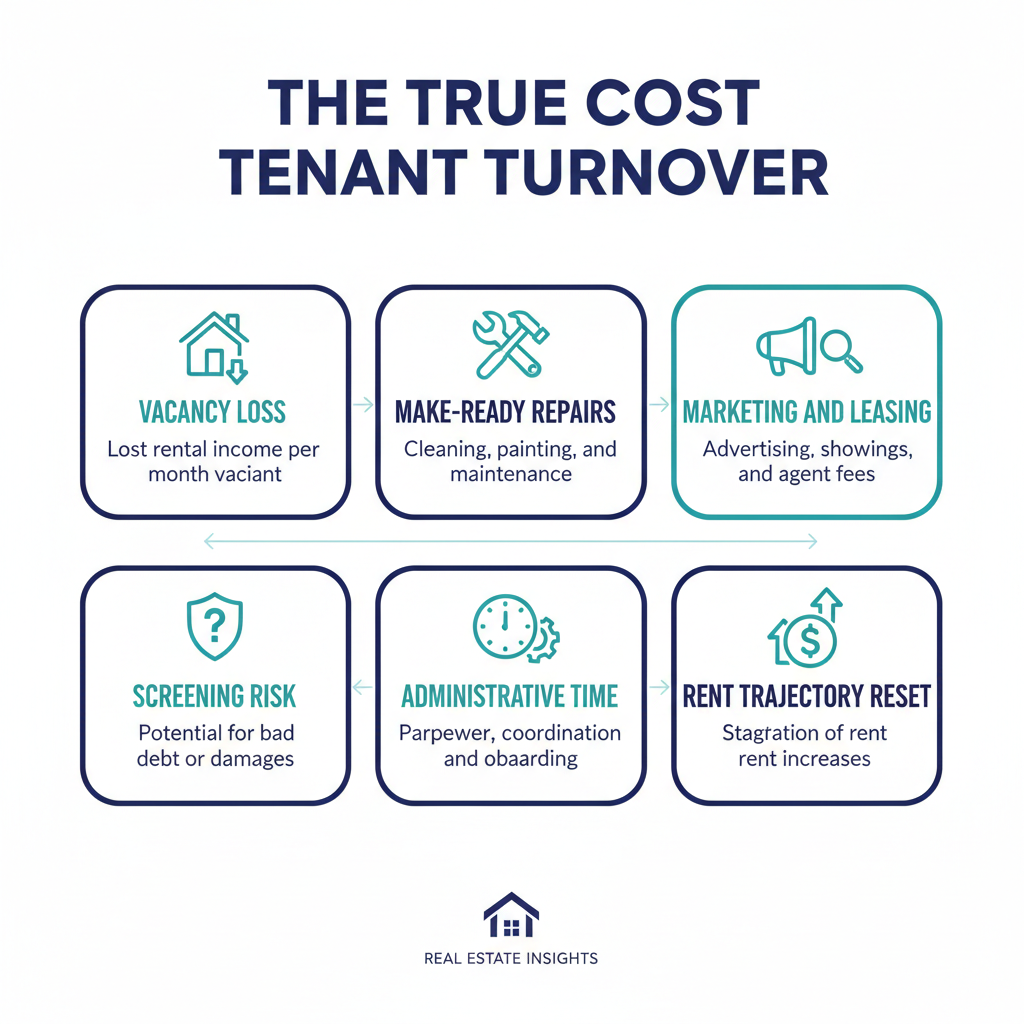
Looking at the categories together rather than in isolation is what changes how an investor should think about turnover. Vacancy loss and make-ready costs are visible and easy to budget for. Screening risk, administrative time, and the rent trajectory reset are largely invisible — and they are often larger over a multi-year hold than the visible costs combined.
This is the core argument for treating tenant retention as a financial strategy, not a customer service nicety. Every renewed lease is a turnover event that did not happen, and every turnover event that does not happen preserves the full stack of costs above.
Why Tenants Leave — and Which Reasons Are Preventable
Not all turnover is avoidable. Tenants relocate for jobs, buy homes, or have life changes that have nothing to do with property management. But a meaningful share of turnover is driven by conditions a well-run operation can directly influence.
Slow or inconsistent maintenance response. A tenant who submits a repair request and waits weeks for a response starts looking at their lease renewal differently. This is one of the most common, and most preventable, drivers of non-renewal.
Rent increases that feel disconnected from the property’s condition. Tenants tolerate renewal increases when they feel the property is well cared for. An increase on a property with unresolved maintenance issues reads very differently than the same increase on a property that has been proactively maintained.
Poor communication. Tenants who cannot reach their property manager, or who receive inconsistent answers, disengage well before their lease is up for renewal.
A genuinely better option nearby. In competitive South Florida submarkets, tenants have choices. A property that is not keeping pace on condition or amenities relative to comparable units will lose tenants to ones that are.
Life and financial changes. Job relocation, family changes, and shifts in household income are outside an owner’s control — but even here, a tenant with a strong relationship to their property manager is more likely to give advance notice and cooperate on a smooth transition, which reduces the operational cost even when the turnover itself is unavoidable.
How Retention-Focused Management Reduces Turnover
Reducing turnover is not about persuading tenants to stay who want to leave. It is about removing the preventable reasons tenants leave in the first place, through consistent operational practices.
Responsive Maintenance as a Retention Tool
The connection between maintenance speed and lease renewal is one of the most consistent patterns in rental housing. A defined response-time standard, transparent status updates, and follow-through on repairs signal to a tenant that the property is being professionally managed — which is precisely the impression that supports renewal decisions.
Proactive Communication Before Renewal Time
Waiting until 60 days before lease expiration to think about renewal is reactive. A retention-focused approach checks in with tenants throughout the lease, addresses small frustrations before they compound, and approaches the renewal conversation as a continuation of an existing relationship rather than a cold negotiation.
Market-Aware, Not Reflexive, Rent Increases
Renewal increases should reflect actual market movement, not a fixed annual percentage applied regardless of context. A well-supported increase, communicated with context about the local rental market, is far less likely to trigger a tenant’s decision to shop elsewhere than an increase that feels arbitrary.
Documented Property Condition
Tenants notice when a property has been consistently maintained versus one where issues accumulate. Residential asset protection — the discipline of maintaining a property’s condition and documentation over time — supports retention directly, because tenants are more likely to renew a lease on a property that continues to look and function like it did on move-in day.
Treating Move-Out as Data, Not Just an Event
Every non-renewal is information. A retention-focused operation tracks why tenants leave and feeds that back into how the property is managed — closing the loop rather than treating each turnover as an isolated event disconnected from the last one.
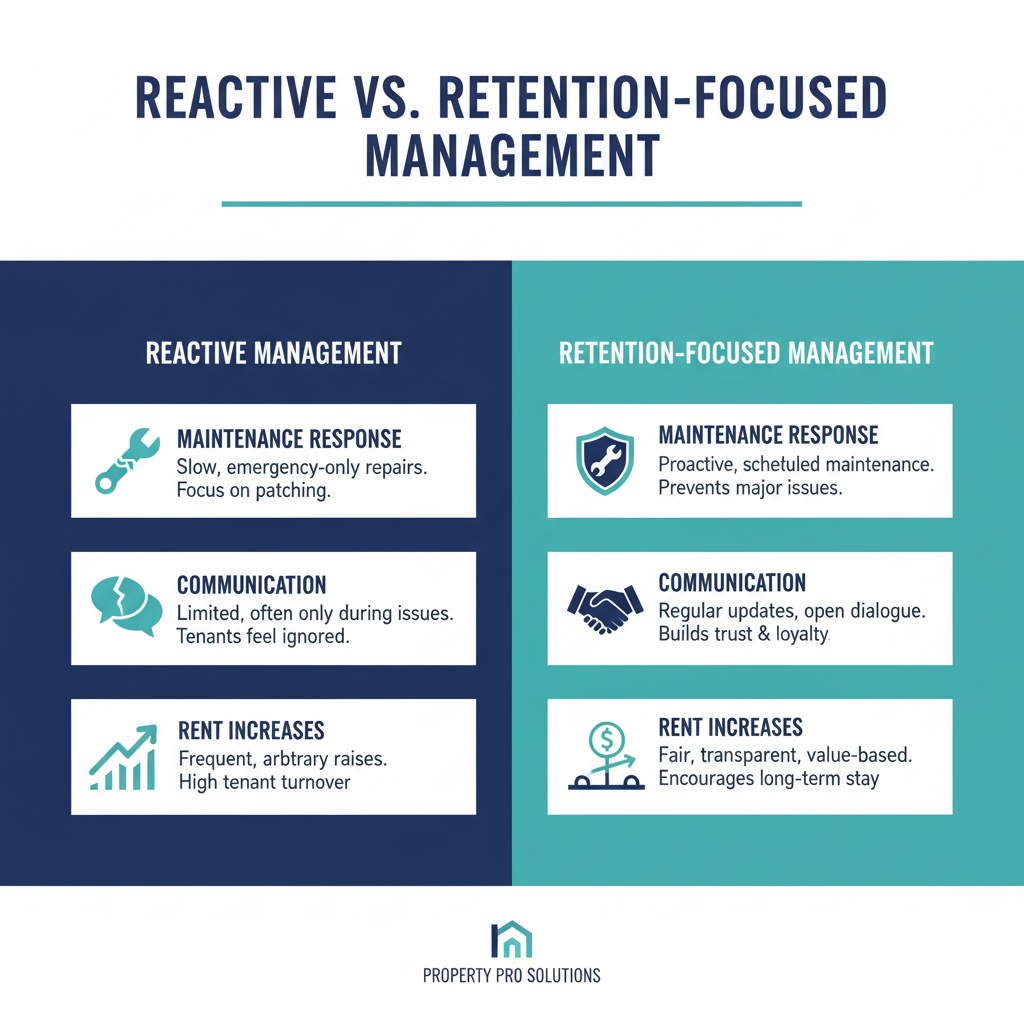
Reactive Management vs. Retention-Focused Management
Reactive Management
- Maintenance: Addressed when tenants escalate or complain repeatedly
- Communication: Sporadic, usually only at lease renewal or during a problem
- Rent increases: Applied as a flat percentage regardless of market or property condition
- Move-out: Treated as an isolated administrative task
- Result: Higher turnover frequency, unpredictable vacancy, and a rent trajectory that resets more often than it should
Retention-Focused Management
- Maintenance: Defined response-time standards with proactive follow-up
- Communication: Ongoing check-ins throughout the lease term
- Rent increases: Grounded in current market data, communicated with context
- Move-out: Logged and reviewed to identify preventable patterns
- Result: Higher renewal rates, more predictable income, and a property that compounds value instead of resetting it
Why This Matters More in South Florida
South Florida’s rental market adds two specific pressures that make turnover more expensive here than in slower-moving markets.
Competitive tenant options. In Broward and Miami-Dade counties, strong rental demand has also brought strong rental supply. Tenants comparing units side by side will notice — and act on — differences in property condition and management responsiveness.
Seasonal leasing dynamics. Turnover that lands in a slower leasing window can extend vacancy well beyond the South Florida average, compounding the direct cost of the vacancy itself. Retention reduces an owner’s exposure to that timing risk entirely, since a renewed lease never has to compete against the calendar.
What This Means for Your Portfolio
If you own one South Florida rental property, avoiding even one unnecessary turnover event over a multi-year hold can be worth thousands of dollars once vacancy loss, make-ready costs, and the rent trajectory reset are all counted together.
If you manage a portfolio, the effect compounds. A portfolio with a structurally higher turnover rate is not just less profitable in a given year — it is absorbing the visible and invisible costs described above across every unit, every year, indefinitely, until the underlying operational causes are addressed.
This is why tenant retention should be evaluated as a core operational metric, not a soft or secondary consideration. Operational oversight that treats maintenance, communication, and renewal strategy as connected systems — rather than three unrelated tasks — is what actually moves this number.
Try Beam Residential
Beam Residential works with South Florida rental property owners who want a management approach built around retention, not just placement. That means defined maintenance response standards, proactive tenant communication, and renewal strategy grounded in real market data — the operational systems that reduce turnover before it happens.
If reducing turnover and protecting your rent trajectory matters to your portfolio, we should talk.
👉 Contact us today to discuss a tenant retention strategy that protects your rental income and reduces the true cost of turnover.
Frequently Asked Questions
How much does tenant turnover actually cost a landlord?
When vacancy loss, make-ready repairs, marketing, screening, and administrative time are all counted together, a single turnover on a South Florida rental commonly costs the equivalent of one to two months of rent. That figure grows further when the reset in rent trajectory — the difference between a renewing tenant’s predictable increase and a new lease signed after a vacancy — is factored in.
What is a good tenant turnover rate for a rental property?
There is no single universal benchmark, since it varies by property type and submarket, but a property retaining the majority of its tenants at renewal is generally performing well operationally. A property with turnover well above that level usually has an identifiable, addressable cause — most often maintenance response time, communication gaps, or renewal pricing that feels disconnected from market reality.
Does raising rent at renewal always increase the risk of turnover?
Not inherently. Tenants generally tolerate reasonable, market-grounded increases, especially on a well-maintained property where they feel the increase reflects genuine value. Turnover risk rises when an increase feels arbitrary, is poorly communicated, or is applied to a property where maintenance issues have gone unresolved.
How does preventative maintenance connect to tenant turnover?
Maintenance response time is one of the most consistent, controllable drivers of a tenant’s renewal decision. A property with documented, proactive maintenance signals professional management, which directly supports the trust that leads to lease renewal.
Can a property management company actually reduce turnover, or is it mostly outside an owner’s control?
A meaningful share of turnover is driven by factors within a management operation’s control — maintenance responsiveness, communication consistency, and renewal strategy chief among them. Turnover caused by a tenant’s job relocation or personal circumstances is not preventable, but even in those cases, strong tenant relationships tend to produce smoother, lower-cost transitions.
Authority Outbound Links
- National Apartment Association (turnover and resident retention research) → https://www.naahq.org/
- U.S. Census Bureau — Rental Vacancy and Homeownership Rates → https://www.census.gov/housing/hvs/