
Mold Prevention in South Florida Rental Properties
A vacant unit in Broward County with the cooling system switched off to save fifty dollars a month can produce a five-figure remediation scope, a delayed lease-up, and a conversation with a carrier that no owner wants to have. Nothing broke. No storm arrived. The building simply sat in South Florida air with no mechanical control over moisture, and the interior finishes absorbed the consequence.
That is the correct way for a non-resident owner to think about mold: not as a biological event, but as the predictable output of an unmanaged moisture condition. The organism is not the variable you control. Moisture is. And moisture in South Florida is a standing condition that requires continuous mechanical and operational management, not an occasional problem that announces itself.
This article is written for owners of multiple South Florida rentals and for the trustees, executors, and advisors accountable for them. It is not a remediation guide, and it contains no instructions for cleaning or removing mold. Its purpose is to define the operating controls that keep a moisture condition from becoming a habitability claim, a displacement, and a loss of asset value.
Why South Florida Is a Standing Moisture Condition
In most of the country, elevated indoor humidity is seasonal. In South Florida it is the baseline for most of the year, and the building’s mechanical systems are the only thing holding interior conditions inside a safe range. When cooling capacity, airflow, condensate drainage, or the envelope degrades, interior moisture rises immediately. There is no dry season to absorb the mistake.
The U.S. Environmental Protection Agency states the governing principle plainly: the key to mold control is moisture control. EPA guidance recommends keeping indoor relative humidity below 60%, ideally between 30% and 50%, and drying water-damaged areas and materials within 24 to 48 hours. Those two numbers, a humidity ceiling and a response clock, are the entire operating standard. Everything else is the system that makes them hold across a portfolio when the owner is not in the state.
The operational implication is uncomfortable but useful: in South Florida, a property that is not being actively conditioned and monitored is accumulating risk on a schedule. That risk does not distribute evenly. It concentrates in vacant units, in properties with marginal HVAC, in older stock with envelope and plumbing wear, and in units where a tenant has quietly adapted to a problem instead of reporting it.
The Recurring Moisture Sources in a Rental
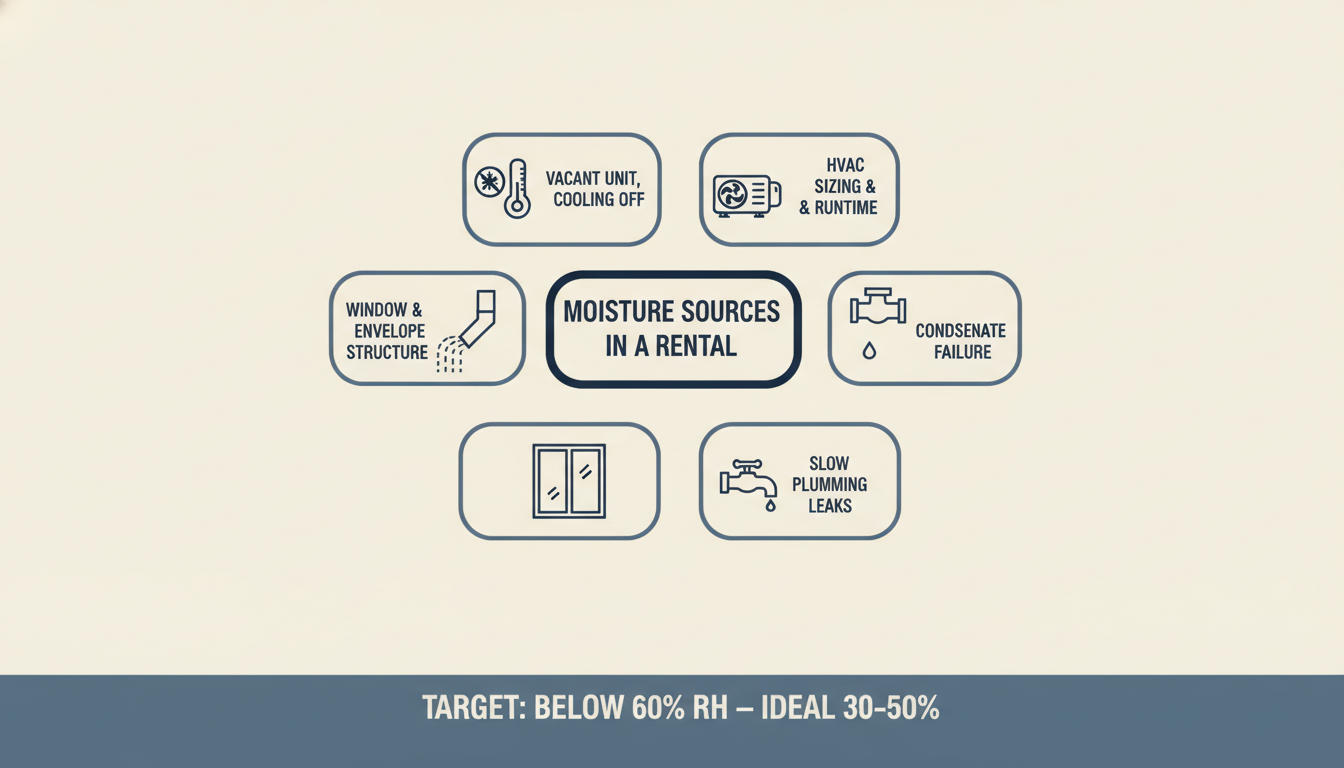
Across a portfolio, moisture problems repeat from a short list of sources. Knowing the list turns inspection from a general walkthrough into a targeted verification.
HVAC Capacity, Runtime, and Condensate
A cooling system in South Florida is a dehumidification system that also lowers temperature. Equipment that is undersized runs constantly and still cannot hold humidity. Equipment that is oversized satisfies the thermostat quickly, short-cycles, and never runs long enough to remove meaningful moisture, which is why a unit can feel cold and clammy at the same time. Both conditions produce the same outcome, and neither shows up on a rent roll.
Condensate is the other half. A blocked drain line, a failed pan, a disconnected trap, or a compromised secondary drain puts water directly into a closet, ceiling, or wall cavity, often slowly enough that no one notices until staining appears. Repeated condensate calls at the same address are a system defect, not a series of tickets. The equipment side of this is covered in HVAC maintenance for South Florida rental properties.
Slow Plumbing Leaks
A supply connection weeping behind a vanity, a toilet seal that releases a small volume with each use, or a pinhole in a concealed line can saturate cabinetry, subfloor, and drywall for weeks. This is the most common concealed moisture source in an occupied unit, and it is addressed in detail in plumbing maintenance for South Florida rental investors.
Envelope and Window Seal Failure
Failed sealant at windows and doors, stucco cracking, flashing defects, and roof penetrations admit water in wind-driven rain and then dry incompletely. The result is intermittent wetting in a wall assembly, which is worse than a single large event because the material never returns to a dry state. The envelope discipline behind this is covered in roof and exterior maintenance in a tropical climate.
Site Drainage Against the Structure
Grading that slopes toward the slab, a blocked area drain, a downspout discharging at the foundation, or an irrigation head spraying the exterior wall keeps the base of the structure wet. This is a landscape maintenance decision with a building science consequence, and it is one of the few moisture sources that a driveway-level photograph will actually reveal.
Bathroom and Laundry Ventilation
An exhaust fan that is disconnected, terminating into an attic, or simply never used moves shower and dryer moisture into the building rather than out of it. Ventilation is inexpensive to verify at turnover and expensive to ignore for three years.
Vacant Units With Cooling Off
This is the source that creates the largest single-event losses, and it is entirely an owner decision.
Vacant-Unit Conditioning Is Not Optional
An unoccupied South Florida property with no cooling is a closed container of humid air with no mechanical moisture removal and no occupant to report anything. Interior surfaces reach conditions where organic growth on drywall, trim, cabinetry, and soft goods becomes likely, and the damage is discovered by the next person who opens the door, which is often a prospective tenant or a listing agent.
The operating standard is straightforward: every vacant unit runs conditioning continuously at a documented setpoint that holds relative humidity in the EPA range, gets a scheduled physical check with dated photographs, and gets a verified condensate and drainage inspection. A supplemental dehumidifier with a plumbed drain is appropriate for some properties, but only when someone is verifying it is running and draining. A dehumidifier with a full reservoir is decoration.
The electricity cost of conditioning a vacant unit is a rounding error against remediation, replaced finishes, and additional vacancy weeks. Owners working to compress turnover time, as described in reducing vacancy between tenants in South Florida, should treat conditioning as part of that cost calculation rather than as a utility line to trim.
Early Indicators, and What a Tenant Will Actually Report
Tenants report loss of function. They call when the air conditioning stops cooling, when water appears on the floor, and when something stops working entirely. They frequently do not report the conditions that precede a mold problem, because those conditions are not inconveniencing them yet.
Reliably reported: no cooling, active dripping, visible standing water, a fixture that will not drain.
Frequently unreported: a faint musty odor they have grown used to, a small ceiling stain, condensation on interior vents or windows, a bathroom fan that has never worked, an air handler closet that is damp, a dark line at the base of a cabinet, a room that feels humid while the rest of the unit is comfortable.
That reporting gap is why the inspection interval matters more than the tenant’s diligence. The indicators worth documenting at each visit are consistent enough to standardize: musty odor, staining or discoloration on ceilings and walls, soft or swollen baseboards and cabinet bases, condensation on supply registers or glass, elevated humidity readings, buckling flooring, corrosion at plumbing connections, and any repeat work order touching water.
The right response to a suspected condition is a defined escalation, not an opinion. Find the moisture source, stop the water, document conditions with dates and photographs, and engage a licensed professional for assessment where the scope or cause is unclear. A property manager’s job is to control the response sequence, not to characterize a health condition.
The Tenant Communication and Documentation Protocol

Moisture disputes are usually won or lost on the record, not the repair. The record has to be built while the work is happening.
Set expectations in writing at move-in. Communicate the humidity and ventilation expectations for the unit, how to report water and moisture concerns, and the fact that the owner wants small items reported early. Reporting obligations and permitted responsibilities vary by lease and by circumstance, so lease language should be reviewed by Florida counsel rather than copied from a template.
Acknowledge every moisture report the day it arrives. Response time is the single most reviewable fact in a later dispute. A same-day written acknowledgment with a scheduled inspection is a different posture than a call returned in five days.
Document before, during, and after. Dated photographs, humidity and moisture-meter readings where used, the identified source, the scope authorized, the vendor and license information, and verification that the repair actually resolved the source. A file that shows the cause was corrected is materially stronger than one that shows a surface was cleaned.
Close the loop with the tenant in writing. Confirm what was found, what was done, and what to watch for. Silence after a repair is how a resolved issue becomes a claimed pattern.
Escalate on defined triggers. Repeat reports at the same location, any concealed-cavity moisture, any event involving displacement, and any request involving occupant health should move immediately to licensed assessment, counsel, and carrier notification as appropriate.
For a trustee or executor, this protocol is doing double duty. It controls the physical risk and it produces the evidence of prudent administration described in property management for trustees and estate executors.
Prevention vs. Remediation: The Actual Economics
Owners who compare a humidity monitor against a remediation invoice are comparing the wrong two numbers. The full downside of a mature moisture condition includes:
- Assessment and remediation scope, including containment and demolition of affected materials
- Reconstruction of finishes, cabinetry, flooring, and trim after remediation
- Correction of the underlying source, which is the repair that would have been cheap on its own
- Lost rent during the work, which in an occupied unit may run weeks
- Relocation or displacement cost where the unit is not habitable during work
- Concession, dispute, legal, or claim expense
- Insurance consequences, including how the loss history affects future terms
- Time and attention from an owner who hired management specifically to avoid this
Against that, prevention is a short list of recurring, low-cost controls: correct HVAC sizing and service, condensate verification, humidity setpoints, vacant-unit conditioning, ventilation confirmation, drainage correction, and prompt response to small water events on a documented interval.
Reactive Model vs. Managed Model
Reactive model. Moisture is discovered when a tenant reports visible growth or an odor becomes undeniable. The source has been active for weeks. Scope is large because materials are saturated, vendors are selected under time pressure, and documentation begins after the fact. The owner learns about the problem and the cost in the same phone call.
Managed model. Humidity and condensate are verified on a schedule. Vacant units are conditioned and checked. Small water events are corrected within the EPA 24-to-48-hour window. Repeat work orders trigger root-cause review. Every finding has a date, a photograph, an owner, and a closure. Scope stays small because duration stayed short.
The difference is not vendor skill. It is interval and follow-through, which is the same argument made in preventative maintenance as an asset protection strategy.
Documentation, Insurance, and Fiduciary Defensibility
Policy treatment of mold and water-related loss varies significantly by carrier, form, endorsement, and cause, and South Florida owners already operate in a constrained market. Owners should review actual coverage, sublimits, exclusions, and notice requirements with their agent or carrier rather than assuming a loss will be covered. Context on the market itself is in what South Florida owners should know about insurance rates.
What documentation does reliably accomplish is establish sequence and cause. A dated maintenance and inspection record can help demonstrate when a condition began, that it was reported and addressed promptly, that qualified professionals were engaged, and that the source was corrected. Absent that record, the owner is arguing from memory against a tenant, an adjuster, or a beneficiary holding a written timeline.
For fiduciaries, the standard is process, not perfection. A trustee cannot guarantee that no moisture event will occur across an inherited portfolio. A trustee can show that humidity was controlled, inspections occurred on a defined interval, findings were acted on, licensed professionals were used, and decisions were documented as they were made.
Florida-Specific Note: Mold Work Is a Regulated Activity
Florida regulates mold assessment and mold remediation as licensed professions under Chapter 468, Part XVI, Florida Statutes, administered by the Florida Department of Business and Professional Regulation. Owners engaging this work should verify license status and current insurance coverage for both the assessor and the remediator.
Florida law also constrains how those two roles interact. Under Florida Statute 468.8419, a mold assessor or the assessor’s company generally may not perform remediation on a structure it assessed within the previous 12 months, and a remediator generally may not perform an assessment on a structure it remediated within the previous 12 months, with a statutory exception for certain certified Division I contractors. The statute also addresses referral compensation and contingent-fee arrangements. Owners should read the separation requirement as a procurement control worth preserving: independent assessment produces a scope defined by conditions rather than by the party that will bill for the work.
Landlord obligations concerning applicable codes and the condition of the premises are addressed in Florida Statute 83.51, with provisions that vary by property type and written agreement. Obligations for a specific property and lease should be reviewed with Florida counsel.
Disclaimer
This article is operational guidance for property owners. It is not legal advice, medical advice, or environmental-health advice, and it does not diagnose conditions or recommend remediation methods for any specific property. It intentionally contains no do-it-yourself remediation instructions. Health questions belong to a qualified medical professional. Assessment and remediation belong to appropriately licensed Florida professionals. Lease, habitability, and disclosure questions belong to Florida counsel. Coverage questions belong to your carrier or licensed agent.
How Beam Runs Moisture Control Across a Portfolio
Beam Management Group treats moisture as a standing operating control rather than a maintenance category:
- Record HVAC configuration, condensate path, ventilation, envelope condition, drainage, and prior water history for each property.
- Set and verify conditioning standards for occupied and vacant units, including documented vacant-unit setpoints and physical checks.
- Verify condensate drainage and exhaust ventilation on a defined interval rather than on complaint.
- Standardize moisture indicators across every inspection so conditions are comparable between properties.
- Respond to reported water on a same-day acknowledgment standard and drive toward source correction inside the EPA response window.
- Escalate concealed, repeat, or occupant-health matters to licensed assessment, counsel, and carrier notification as appropriate.
- Maintain a dated record by property that connects each finding to a verified resolution, and coordinate it with the annual maintenance schedule for South Florida rental properties.
Owners who are out of state need this to run without them. That expectation is described further in what absentee owners need from a property manager.
Schedule a Moisture and Mold Risk Review
If your portfolio includes properties you have not personally walked in the last quarter, moisture is the exposure most likely to be developing without a work order attached to it. Beam can establish the conditioning standards, inspection intervals, condensate and ventilation verification, and documentation that keep a small moisture condition from becoming a remediation scope and a vacancy.
If you have inherited South Florida rental property, moisture history is often the least documented part of what you received. Beam can establish a dated baseline for each address, identify the conditions that create recurring exposure, and produce the record that beneficiaries, advisors, and courts expect from prudent administration.
Beam works with multi-property owners, inheritors, trustees, and executors who need local operational oversight, not a DIY checklist. Contact Beam Management Group to review moisture and habitability exposure across your properties.
FAQ
What indoor humidity level should a South Florida rental property maintain?
EPA guidance recommends keeping indoor relative humidity below 60%, and ideally between 30% and 50%, while addressing condensation and water-damaged materials promptly. In South Florida, holding that range depends on correctly sized cooling equipment, adequate runtime, functioning condensate drainage, and working exhaust ventilation. The setpoint is only meaningful if someone is verifying that the equipment is actually achieving it.
Should air conditioning run in a vacant rental property in South Florida?
Yes. An unoccupied property with cooling off has no mechanical moisture removal and no occupant to report developing conditions, which is how the largest single-event moisture losses occur. The operating standard is continuous conditioning at a documented setpoint, scheduled physical checks with dated photographs, and verified condensate drainage. Utility cost during vacancy is small relative to remediation, finish replacement, and additional vacancy weeks.
How quickly does a water event need to be addressed?
EPA guidance recommends drying water-damaged areas and materials within 24 to 48 hours. That window is why response time matters more than repair complexity. An owner or manager should be able to show when the report arrived, when the property was inspected, when the water source was stopped, and when drying and repair were completed and verified.
Will a tenant report the early signs of a moisture problem?
Usually not. Tenants reliably report loss of function such as no cooling, active dripping, or standing water. They frequently do not report faint musty odors, small ceiling stains, condensation on registers, a bathroom fan that has never worked, or a room that feels humid. That is why scheduled inspection with standardized moisture indicators is the control, rather than relying on tenant diligence.
Does Florida require a license to perform mold remediation?
Florida regulates mold assessment and mold remediation as licensed professions under Chapter 468, Part XVI, Florida Statutes, administered by DBPR. Florida Statute 468.8419 also generally restricts a company from performing both the assessment and the remediation on the same structure within a 12-month period, with a statutory exception for certain certified Division I contractors. Owners should verify license status and insurance before engaging any provider and consult Florida counsel on requirements for their situation.
Is mold damage covered by insurance on a Florida rental property?
It depends entirely on the policy form, endorsements, sublimits, exclusions, cause of loss, and notice compliance, and treatment varies significantly by carrier. No article can answer this for a specific property. Owners should review actual coverage and reporting requirements with their carrier or licensed agent, and should maintain dated documentation of maintenance, inspections, and response, because sequence and cause are usually the contested facts.
How does documentation protect an owner in a mold or habitability dispute?
A dated record can establish when a condition was identified, how quickly it was acknowledged, what source was found, which licensed professionals were engaged, what scope was authorized, and that the underlying cause was corrected rather than the surface concealed. Without that record, the owner is relying on recollection while the other party presents a written timeline.
What should a trustee or executor do first on an inherited property with moisture history?
Establish a dated condition baseline with photographs, confirm that conditioning and ventilation are functioning in every unit including vacant ones, review prior work orders for repeat water-related items, and engage licensed assessment where a source is unclear or concealed. Then set a documented inspection interval. The objective is a defensible process, not a guarantee that no event will ever occur.