
How to Reduce Vacancy Between Tenants in South Florida

A vacancy that lasts three weeks instead of five days does not feel like a crisis. Nothing broke, no one called, and the property will re-lease eventually. That is exactly why it goes unexamined — and why it quietly becomes one of the most expensive recurring line items in a South Florida rental portfolio.
To reduce vacancy between tenants, it helps to understand that the gap is almost never caused by weak demand. It is caused by sequencing. Notice arrives, the tenant moves out, someone walks the unit, vendors get scheduled, work gets done, photos get taken, the listing goes live, showings begin, an application is screened, and a lease is signed. Run in that order, each step waits for the one before it. Run in parallel, most of those steps disappear from the vacancy calendar entirely.
For an owner with several properties, this distinction compounds. Each unit that turns over on a sequential timeline instead of an overlapping one gives back income that no rent increase later in the year recovers.
What Actually Creates Vacancy Days
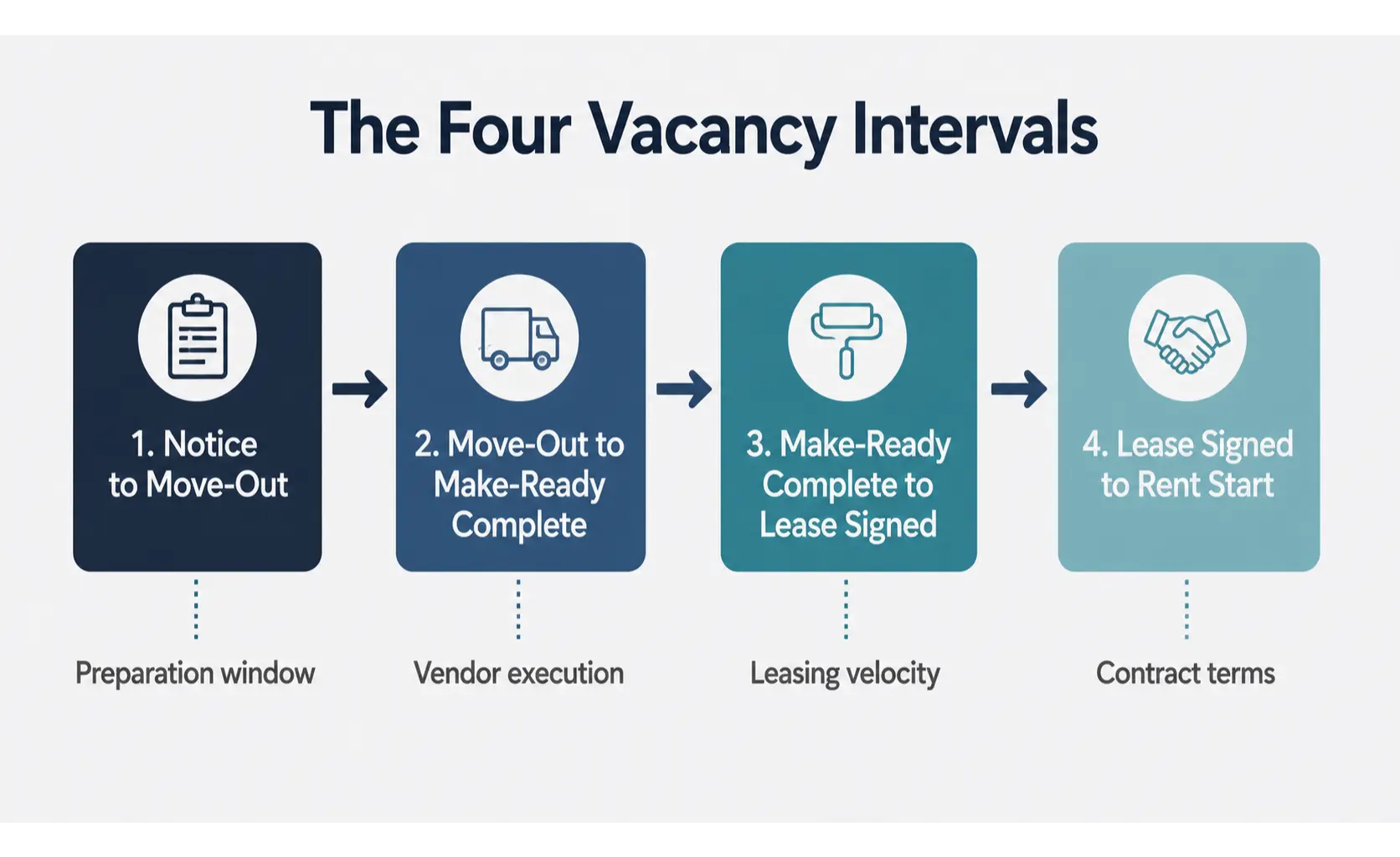
Vacancy is not one number. It is four separate intervals, each with a different owner and a different fix.
Interval 1: Notice to Move-Out
This window is usually 30 to 60 days depending on the lease. It is the most valuable time in the entire turnover cycle and the most commonly wasted. Everything that does not require physical access to an empty unit — market rent analysis, listing copy, pricing decisions, vendor scheduling, pre-marketing — can be completed here at zero vacancy cost.
Interval 2: Move-Out to Make-Ready Complete
This is the only interval that genuinely requires the unit to be empty. Its length is determined less by the amount of work than by how quickly vendors were scheduled. A painter booked during Interval 1 starts the morning after move-out. A painter called after the walkthrough starts whenever the next opening appears, which in a busy South Florida season can be a week or more.
Interval 3: Make-Ready Complete to Lease Signed
If marketing did not begin until the unit was finished, this interval absorbs the entire leasing cycle — photography, listing, inquiries, showings, applications, and screening. If marketing began during Interval 1, most of this has already happened.
Interval 4: Lease Signed to Rent Start
Often overlooked, and often the easiest to shorten. A signed lease with a move-in date two weeks out is still vacancy. Aligning the lease start date closely to the make-ready completion date is a scheduling decision, not a market condition.
The Overlap Principle
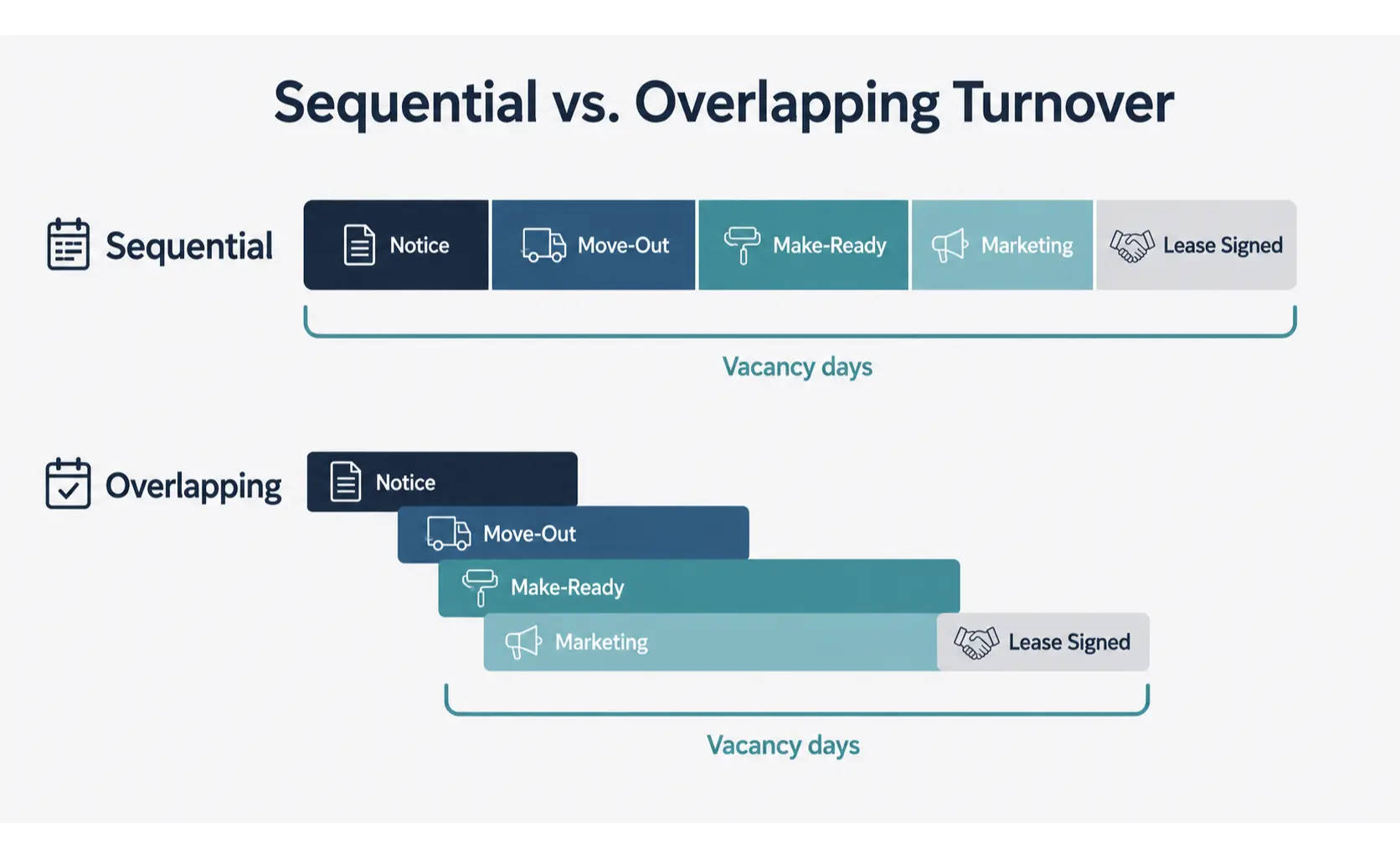
The operating rule that reduces vacancy is simple to state and difficult to execute without a system: no turnover task should wait for another task it does not physically depend on.
Pricing does not depend on paint. Photography of a well-maintained unit can often begin before the final touch-ups are complete. Screening does not depend on flooring. Vendor scheduling depends only on knowing the move-out date, which is known the day notice is received.
Under sequential management, a turnover requiring seven working days of actual labor routinely produces three to four weeks of vacancy. Under overlapping management, that same turnover produces vacancy roughly equal to the labor itself, plus a short leasing tail.
The difference is not effort or spend. It is whether the operation starts on the day notice arrives or the day the keys come back.
The Pre-Notice System: How to Reduce Vacancy Between Tenants
Reducing vacancy consistently across a portfolio requires the work to be defined before it is needed. Four components make that possible.
1. A Standing Vendor Bench
The single largest source of avoidable vacancy is vendor availability. A portfolio with an established relationship with painters, cleaners, flooring installers, and HVAC technicians gets scheduled within days. An owner sourcing vendors reactively for one unit competes for the same calendar slots with no leverage.
2. Condition Knowledge Before the Unit Is Empty
An owner who already knows the property’s condition can scope make-ready work from the notice date. This is where routine inspections and preventative maintenance pay for themselves twice: once by avoiding the failure, and again by removing the discovery delay at turnover. A unit maintained throughout the tenancy has a predictable, short make-ready. A unit with three years of deferred issues has an unpredictable one.
3. Pricing Decided in Advance
Rent should be set from current comparable data before the listing goes live, not adjusted downward after two weeks of silence. Overpricing costs vacancy days that the eventual higher rent rarely recovers; underpricing gives away income for the full lease term. Both errors come from deciding under time pressure.
4. Marketing That Launches Before the Unit Is Empty
Listings can go live during the notice period with a stated availability date. Qualified applicants tour, apply, and get screened while make-ready work proceeds. The objective is a signed lease that starts within days of the unit being ready.
Sequential Turnover vs. Overlapping Turnover
Sequential Turnover
- Notice period: No action taken; work begins after move-out
- Vendors: Sourced and scheduled after the walkthrough
- Pricing: Set when the listing goes up, adjusted if it stalls
- Marketing: Begins after make-ready is complete
- Screening: Begins after showings, which begin after marketing
- Typical result: Three to five weeks of vacancy for one week of actual work
Overlapping Turnover
- Notice period: Scope, pricing, vendor scheduling, and listing prep all completed
- Vendors: Pre-booked for the day after move-out
- Pricing: Set from comparable data before the listing goes live
- Marketing: Launched during the notice period with an availability date
- Screening: Underway while make-ready work is in progress
- Typical result: Vacancy approaching the length of the make-ready work itself
Why South Florida Changes the Math
Three regional realities make vacancy management here different from slower markets.
Seasonality is real and directional. Leasing activity in South Florida is not evenly distributed across the year. A turnover that lands in a slower window takes longer to fill and often at a softer rate. Lease end dates are a controllable variable — renewal terms can be structured to steer future turnovers toward stronger leasing months rather than leaving the timing to chance.
Vendor demand spikes with weather. After any significant storm event, roofers, restoration crews, and general contractors are fully committed. A make-ready that competes with regional storm repair work waits. Owners with standing vendor relationships and pre-scheduled work absorb far less of that delay.
Humidity does not pause for vacancy. An empty unit with cooling shut off to save on utilities is a mold risk in this climate. Vacant properties need dehumidification and cooling maintained at reasonable setpoints, which turns “let the unit sit” into an active carrying cost rather than a neutral one. Related reading for owners weighing the broader cost environment: what South Florida owners should know about insurance rates.
What This Looks Like Across a Portfolio
A single unit turning over sequentially instead of in parallel is an annoyance. A portfolio doing it is a structural drag.
Consider an owner with four units and an average tenancy of roughly two years. That is approximately two turnovers per year across the portfolio. The difference between a 12-day average vacancy and a 30-day average vacancy is more than a month of lost rent annually — every year, indefinitely, with no corresponding increase in property value or reduction in expenses.
This is why turnover speed belongs in the same category as the true cost of tenant turnover and residential asset protection: it is an operational discipline with a direct, measurable effect on return, not a customer service detail.
It is also the clearest example of why owner availability matters. Compressing a turnover requires someone to act on the notice date, coordinate vendors, price against live comparables, and manage showings — during business hours, on the ground, in the same week. For an out-of-state owner or a trustee administering an estate, that is not a matter of willingness. It is a matter of structural capacity.
Decrease Rental Vacancy Time with Beam
Beam Residential runs turnovers on an overlapping timeline: scope and pricing set during the notice period, vendors pre-scheduled, marketing live before the unit is empty, and lease start dates aligned to make-ready completion.
If your portfolio is growing but your time isn’t, and vacancy days between tenants are quietly costing you more than any single repair line item, we should talk about how your turnovers are actually sequenced.
Contact Beam Residential to review your current turnover timeline and where the recoverable vacancy days are.
FAQ
How long should a rental property be vacant between tenants in South Florida?
There is no universal benchmark, but the useful standard is the amount of make-ready work the unit actually requires plus a short leasing tail. When a unit needing about a week of work sits empty for three or four weeks, the delay is almost always sequencing and vendor availability rather than market demand.
Can I market a rental property before the current tenant moves out?
Yes, subject to the lease terms and reasonable notice requirements for showings. Listing during the notice period with a stated availability date is one of the most effective ways to reduce vacancy, because screening and lease signing happen while make-ready work is still underway rather than after it.
Does lowering rent reduce vacancy?
Sometimes, but it is usually the most expensive available lever. A rent reduction applies for the entire lease term, while the vacancy it solves lasts days or weeks. Pricing correctly from comparable data before listing avoids the situation where a reduction becomes the only remaining option.
What causes most of the delay in a turnover?
Waiting — for vendor availability, for a scope decision after the walkthrough, and for marketing that did not start until the unit was finished. Actual labor is rarely the constraint. That is why the fix is scheduling and sequencing rather than working faster.
Should utilities stay on in a vacant South Florida rental?
Yes. In this climate, cooling and dehumidification need to be maintained at reasonable setpoints in a vacant unit to prevent moisture and mold problems. Shutting everything off to save on a utility bill during vacancy risks a significantly more expensive remediation issue.
How does preventative maintenance affect vacancy?
Directly. A property maintained throughout the tenancy has a short, predictable make-ready scope that can be planned from the notice date. A property with accumulated deferred maintenance has an unpredictable scope that cannot be scheduled until the unit is empty and inspected, which pushes every downstream step later.
Can an out-of-state owner realistically manage turnover speed?
Not without local operational support. Compressing a turnover requires same-week vendor coordination, in-person showings, and decisions made against live market data. This is the specific gap professional operational oversight is designed to close for absentee owners and trustees.
Authority Outbound Links
- U.S. Census Bureau — Housing Vacancies and Homeownership (rental vacancy data) → https://www.census.gov/housing/hvs/
- U.S. Environmental Protection Agency — Mold and moisture control guidance → https://www.epa.gov/mold