
How to Protect a Rental Property Before a Hurricane
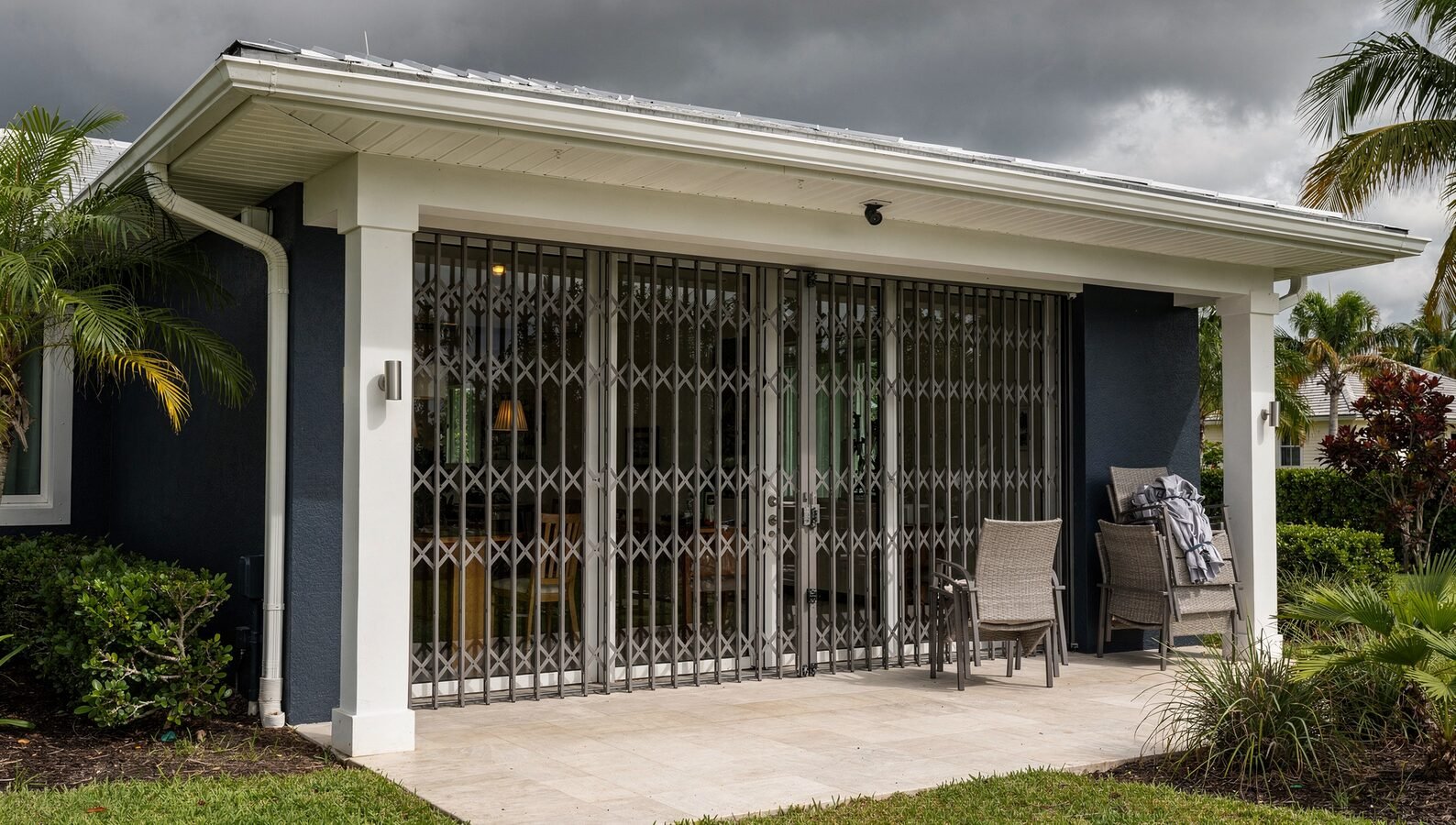
Most hurricane losses on South Florida rental properties are not caused by wind tearing a building apart. They are caused by water getting inside a building that was still standing. That is why how to protect a rental property before a hurricane is primarily a question about water paths.
The sequence is almost always the same. Wind finds a weakness — an unprotected window, a lifted roof edge, a compromised soffit, a failed door seal. Water follows the wind through that opening. In a warm, humid climate, wet drywall, insulation, and flooring become a mold problem within days. The structural repair is often modest. The interior restoration, the lost rent while the unit is uninhabitable, and the remediation are what make the loss large.
That means protection is not really about surviving the wind. It is about eliminating the paths water uses to get in, in a specific order, before the storm arrives.
The Four Water Paths
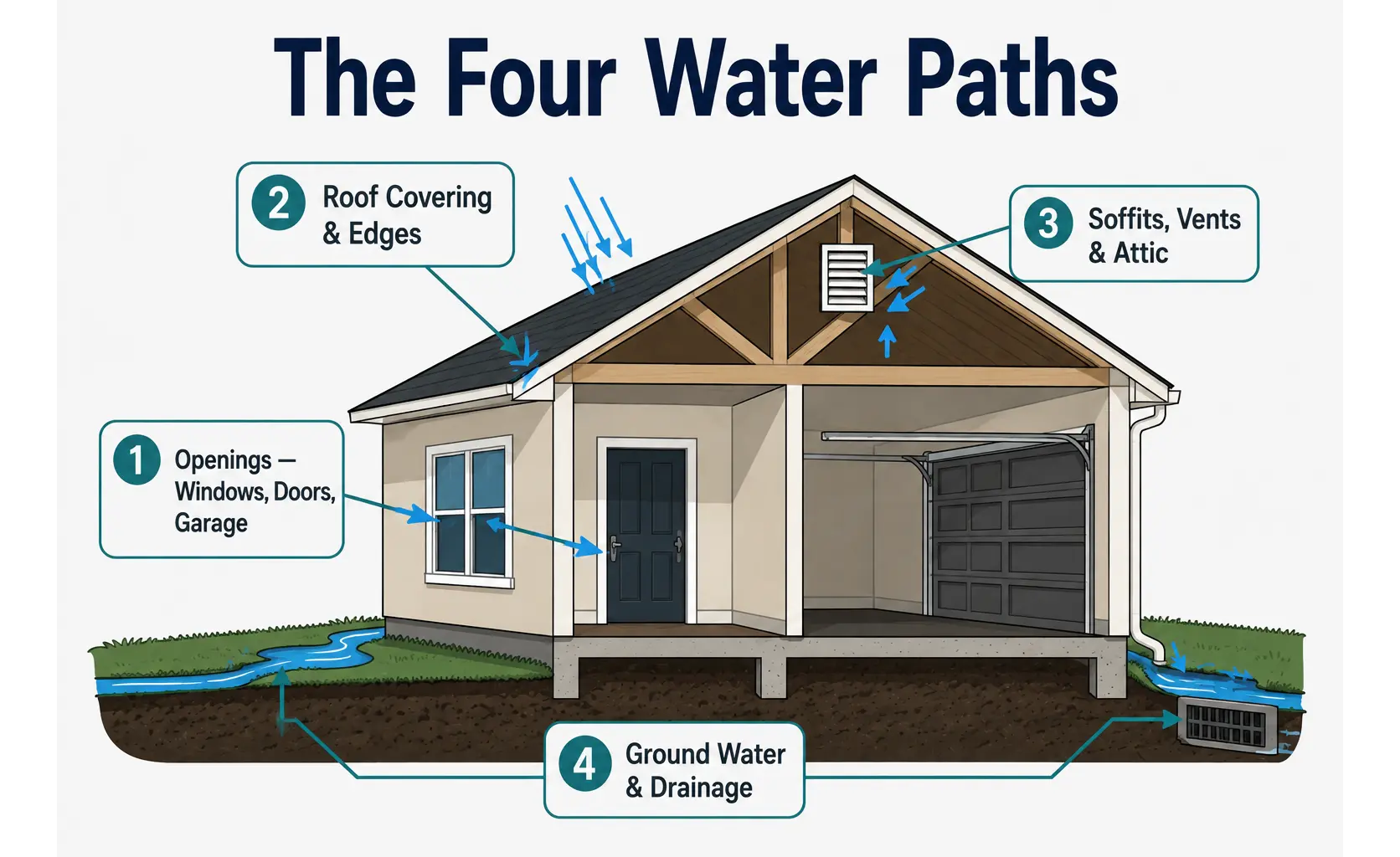
Every serious storm loss on a residential rental traces back to one of four entry points. Prioritizing work in this order produces more protection per dollar than any other approach.
1. Openings — Windows, Doors, and Garage Doors
An unprotected window that fails does two things: it lets water in, and it pressurizes the building interior, which increases uplift on the roof from inside. This is why opening protection is not cosmetic — a single failed opening can contribute to a roof failure.
The garage door is the largest opening on most single-family rentals and frequently the weakest. A garage door that fails under pressure often takes the framing and part of the roof structure with it.
Every window and door needs either impact-rated glazing or functioning shutters or panels. Partial protection is closer to no protection than to full protection, because water and pressure both find the one unprotected opening.
2. The Roof Covering and Its Edges
Roofs rarely fail in the middle. They fail at the perimeter, where wind pressure is highest and where the covering is most dependent on fasteners and flashing. Loose or lifted edge material, damaged flashing at penetrations, deteriorated sealant around vents and skylights, and any prior repair that was never properly finished are the specific vulnerabilities.
None of this can be corrected during a watch. It requires a professional inspection during the pre-season window and repair while roofers are available.
3. Soffits, Vents, and the Attic
Soffit panels are commonly underestimated. When wind removes a soffit, it creates a direct opening into the attic — and driven rain entering the attic saturates insulation and comes down through the ceiling across multiple rooms. Every soffit panel should be secure and properly fastened, and attic vents intact.
4. Ground Water and Drainage
Water that never enters through the envelope can still enter at the slab. Blocked gutters that discharge against the foundation, clogged area drains, grading that has settled toward the structure, and blocked swales all direct storm water toward the building. In a heavy-rain event without extreme wind, drainage is frequently the only cause of damage — and it is one of the least expensive things to correct.
What Can Be Done Now vs. What Requires Lead Time
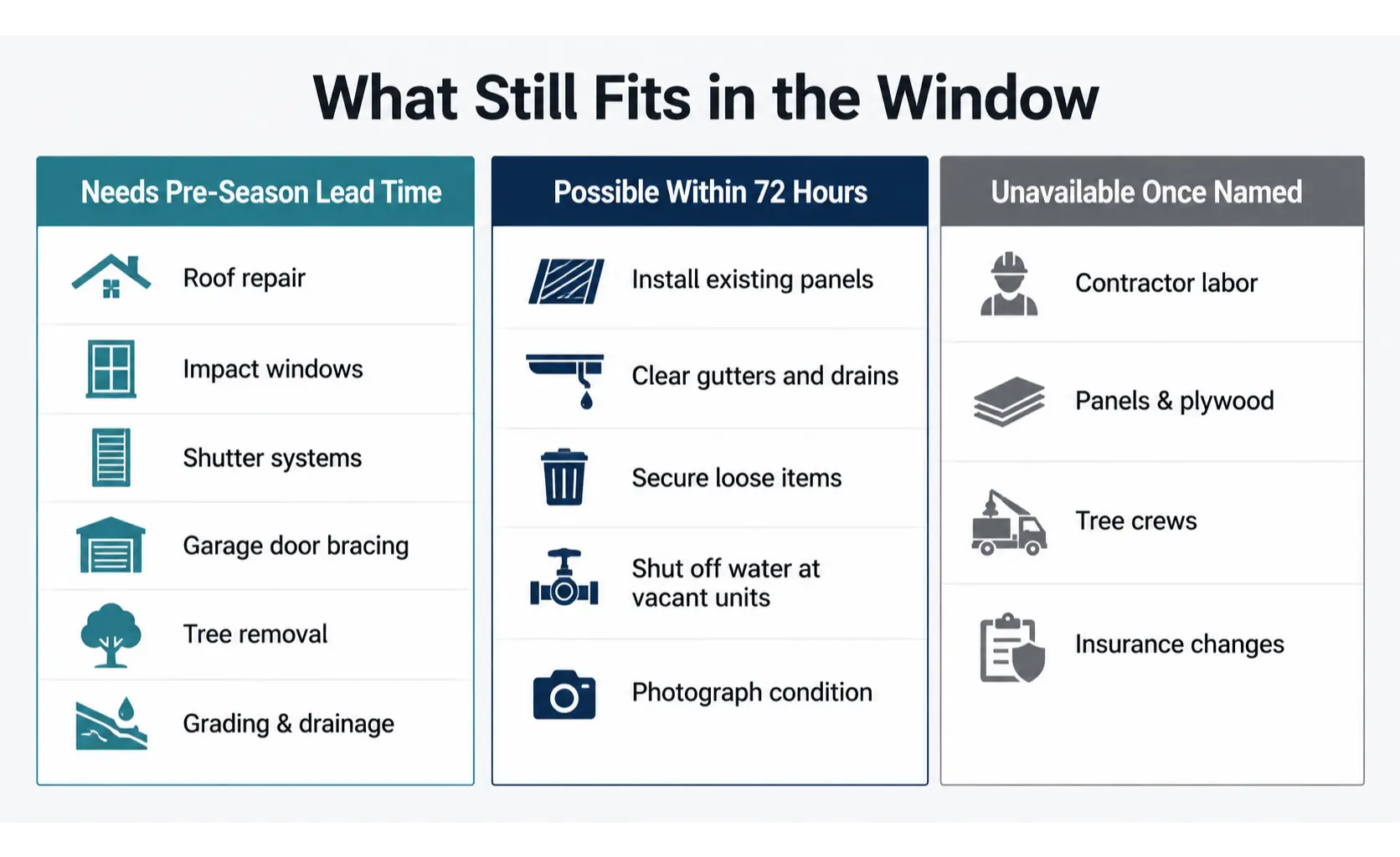
Owners consistently misjudge which items are still available once a storm is named.
Requires Pre-Season Lead Time
- Roof inspection and any repair
- Impact-rated window or door replacement
- Shutter or panel system installation or replacement of missing components
- Garage door bracing or replacement with a rated unit
- Soffit and fascia repair or refastening
- Tree removal and major canopy work
- Grading correction and drainage system repair
- Insurance policy review and any coverage change
Still Possible Inside 72 Hours
- Installing existing shutters or panels
- Clearing gutters, downspouts, and area drains
- Securing or removing exterior loose items
- Turning off water at the main for vacant units
- Photographic documentation of prepared condition
- Tenant communication and emergency contact confirmation
Effectively Unavailable Once a Storm Is Named
- Contractor labor of any kind, in most cases
- Panels, plywood, fasteners, sandbags, generators, and fuel
- Tree crews
- Insurance changes — carriers typically suspend binding new or increased coverage once a storm threatens the area
The practical implication is direct: everything in the first list has to be finished in the spring. What happens in the final 72 hours is execution, not improvement.
How to Protect a Rental Property Before a Hurricane: The Hardening Sequence
For an owner deciding where to spend, this order reflects consequence rather than cost.
First: the roof. A compromised roof is the highest-consequence failure on the property. It exposes the entire interior and generates the largest restoration cost and the longest displacement of rental income.
Second: opening protection, garage door included. Full coverage matters more than premium coverage on some openings and none on others.
Third: soffits and attic openings. Inexpensive relative to the ceiling and insulation damage they prevent.
Fourth: drainage and grading. Frequently the cheapest fix on this list and the cause of a disproportionate share of losses.
Fifth: vegetation. A tree does not need to fall on the structure to cause a loss. Limbs abrading a roof covering during a multi-hour wind event do real damage.
Sixth: interior and mechanical. Elevate anything stored on a slab in flood-prone locations, know where the water main and electrical shutoffs are, and confirm the HVAC condenser pad and mounting are sound.
This is the same asset-preservation logic described in residential asset protection, applied to a single, predictable seasonal risk. And most of it overlaps with work that should already be happening under a preventative maintenance program — storm hardening is largely just maintenance completed on a deadline.
Occupied vs. Vacant Units
The two situations require different decisions, and owners often apply one approach to both.
Occupied Units
- Coordinate opening protection with the tenant’s schedule and access needs
- Confirm in writing what the tenant is responsible for securing
- Provide evacuation zone information and emergency contacts
- Leave water and power configuration to the tenant’s plans; do not shut off utilities to an occupied unit
- Confirm whether the tenant intends to stay or evacuate, which affects post-storm inspection sequencing
Vacant Units
- Shut off water at the main to prevent an unattended supply failure
- Decide power configuration deliberately, balancing refrigeration and moisture control against electrical risk
- Remove or secure any staging or make-ready materials on-site
- Confirm the property is fully documented photographically, since no one is present to report damage
- Prioritize these units for post-storm inspection, because damage will otherwise go unnoticed
A vacant unit in a storm is the highest-risk configuration on a portfolio: no one is there to notice a leak, shut off a valve, or report a failure. This is one reason avoidable vacancy carries costs beyond lost rent, as covered in reducing vacancy between tenants in South Florida.
Documentation Is Part of the Protection
The photographs taken before a storm are what determine, later, whether damage is attributed to the storm or to pre-existing condition.
A useful pre-storm record includes the roof from multiple angles, every exterior elevation, all windows and doors with protection installed, the interior of every room, major mechanical systems, and any pre-existing damage visible at the time. Dated and stored off-site or in the cloud, because a record kept only at the property is a record that can be destroyed with the property.
Combined with maintenance history, this is what supports a claim under the coverage conditions most South Florida owners are already contending with — see what South Florida owners should know about insurance rates. The Florida Office of Insurance Regulation publishes consumer resources on residential property coverage worth reviewing before the season rather than during a claim.
What This Means for Owners Who Are Not Local
Every item that matters in the final 72 hours is physical: panels installed, drains cleared, exterior items secured, water shut off at vacant units, photographs taken. Multiply that by four or six properties, inside the same window, while the region competes for the same labor.
An out-of-state owner cannot execute that personally, and the tenant is not a substitute — tenants are preparing their own households and are not responsible for hardening the building. The gap is structural, which is why storm season is one of the clearest cases for local operational oversight, as covered in what absentee owners need from a property manager.
The seasonal program that sits behind all of this is laid out in the hurricane season prep checklist for South Florida rentals.
Premtive Protection of Your Properties with Beam
Beam Residential handles property-level storm protection as scheduled work: roof and envelope inspection before the season, opening protection verified and installed, drainage maintained, vacant units secured, and every property photographed before and after each event.
If you’ve inherited South Florida rental property, or you own here and live elsewhere, the 72 hours before landfall should not depend on your ability to fly in.
Contact Beam Residential to review how your properties would actually be protected this season.
FAQ
What causes the most hurricane damage to rental properties?
Water entering the building, usually through a failed opening, a compromised roof edge, a removed soffit, or drainage that directs storm water toward the structure. Full structural failure is comparatively rare; interior water damage, mold remediation, and lost rent during restoration account for most of the cost.
Do rental properties need hurricane shutters in South Florida?
Every opening needs either impact-rated glazing or functioning shutters or panels. Requirements depend on the building’s age, permitting history, and local code, but from a loss-prevention standpoint the important principle is completeness: one unprotected opening can admit both water and the interior pressure that contributes to roof failure.
How do I protect a garage door from hurricane winds?
Through a wind-rated door or an approved bracing system installed according to the manufacturer’s instructions. The garage door is typically the largest opening on a single-family rental, and its failure frequently damages framing and roof structure as well.
What should be done with a vacant rental property before a storm?
Shut off water at the main, decide power configuration deliberately, remove or secure any materials on-site, complete full photographic documentation, and schedule it as a priority for post-storm inspection. A vacant property has no one present to notice or report a developing problem.
Can I improve my insurance coverage when a hurricane is forecast?
Generally no. Carriers commonly suspend binding new or increased coverage once a storm threatens the area, and new policies often carry waiting periods. Coverage reviews belong in the pre-season window. Confirm specifics with your carrier or agent.
How long before a storm should shutters be installed?
Typically in the 72 to 48 hour window, once the track is reasonably clear, and before conditions make outdoor work unsafe. The prerequisite is having verified before the season that every panel and its hardware is present and fits, since missing components discovered during a watch usually cannot be replaced in time.
Is trimming trees before hurricane season worth the cost?
Generally yes, and it is one of the least expensive protective measures available. Overhanging limbs abrade roof coverings during extended wind events, and dead or weak limbs become projectiles. Tree services are also among the first to become fully booked once a storm is forecast.
Authority Outbound Links
- Florida Office of Insurance Regulation — residential property insurance consumer resources → https://www.floir.com/
- FEMA — protecting your property from high winds and flooding → https://www.ready.gov/hurricanes