
Annual Maintenance Schedule for South Florida Rental Properties

A maintenance request tells you what has already failed. An annual maintenance schedule tells you what must be inspected, serviced, documented, and budgeted before failure reaches the tenant, the income statement, or the property itself.
That distinction becomes more important with every additional address. A portfolio investor cannot run five properties from five unrelated reminder lists. A trustee or executor cannot demonstrate prudent care with a folder of invoices that only shows what was repaired after it broke. Both need a recurring operating calendar, a consistent condition standard, and a record that connects each finding to a completed action.
This is not another generic landlord checklist. It is a South Florida operating rhythm built around year-round cooling demand, moisture, heavy rain, hurricane exposure, occupied-property access, and the need to see risk across a portfolio rather than one work order at a time.
What This Schedule Is—and What It Is Not
The strategic case for planned maintenance is covered in preventative maintenance as an asset protection strategy. This article addresses the next question: what should the operating year look like?
A useful annual schedule does four things:
- Assigns each recurring task to a defined interval or seasonal window.
- Identifies who is responsible: the manager, tenant, licensed trade, association, or owner.
- Requires proof of completion, not just a calendar reminder.
- Converts findings into work orders, capital decisions, and the next service date.
It does not replace manufacturer instructions, lease obligations, local code, association responsibilities, or advice from licensed contractors. A coastal property, an older multifamily building, and a newer inland single-family home will not have identical service needs. The calendar provides the control structure; each property’s systems and exposure determine the exact scope.
Florida law also establishes a baseline rather than a complete maintenance plan. Florida Statute 83.51 addresses landlord obligations involving applicable codes and the condition of structural components and plumbing, with provisions that vary by property type and written agreement. Owners should have Florida counsel review obligations for their specific property and lease.
Build the Property Baseline Before You Build the Calendar
A schedule cannot manage information that has never been collected. Start with one asset record for every property containing:
- Roof type, approximate age, warranty information, and known repairs
- HVAC make, model, age, filter specification, service history, and condensate configuration
- Water heater type, age, location, and visible shutoff
- Plumbing supply and drain materials where known
- Electrical panel information and known upgrades
- Exterior coating, sealant, window, door, and opening-protection condition
- Drainage paths, gutters, downspouts, area drains, irrigation, and recurring ponding locations
- Smoke and carbon monoxide device locations and service dates, as applicable
- Pest or wood-destroying-organism history
- Appliance ages and warranties
- Insurance renewal date, required inspections, and current condition documentation
- Lease dates, access requirements, and tenant-assigned tasks
Then rank each major system by condition, consequence of failure, and expected planning horizon. An older water heater above finished living space deserves different oversight than a newer unit in a garage with a sound drain pan. The calendar should reflect that difference without abandoning the same portfolio-wide documentation standard.
The South Florida Annual Maintenance Cycle
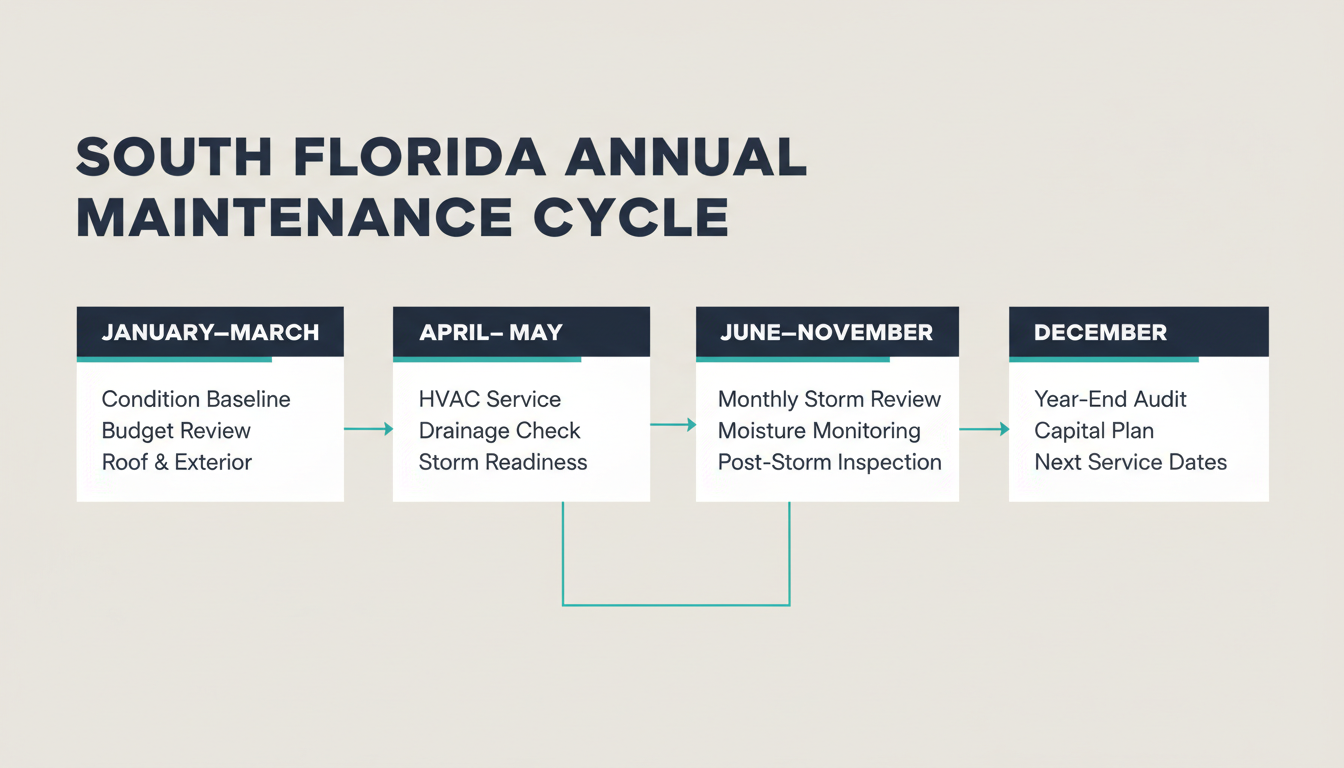
January–March: Establish Condition and Plan the Year
The beginning of the year is the control period. Hurricane activity is typically lower, contractor scheduling is more predictable, and there is time to complete capital work before the pre-storm rush.
Complete a documented condition review. Compare current photographs and findings with the prior inspection. Look for changes in ceilings, exterior walls, sealants, flooring, visible plumbing, drainage, vegetation, roof areas observable from a safe location, and mechanical equipment. Every exception should become a work order, a monitored item with a next review date, or a documented capital decision.
Audit open and recurring work orders. Repeated calls from the same property are often a system signal. A condensate line that clogs repeatedly, a bathroom with recurring staining, or an exterior door that continues to admit water should not remain a series of isolated tickets.
Review roofs, exteriors, and drainage early enough to act. The objective is to identify repairs while there is still time to scope work, obtain qualified proposals, and verify completion before heavy summer rain and storm demand compress contractor availability.
Inspect plumbing and water-heating risk. Review visible supply connections, shutoffs, fixture bases, under-sink areas, drain performance, water-heater condition, drain pans, and signs of prior leakage. Water events compound quickly when no one is looking behind a vanity or around an intermittently leaking connection.
Update the capital forecast. Record system age, current condition, repair history, likely replacement window, and preliminary budget range. Forecasting does not mean replacing equipment solely because of age. It means avoiding surprise when age, condition, and repair frequency point in the same direction.
For a trustee or executor, this first-quarter review also creates a dated annual baseline showing the condition inherited, the issues identified, and the plan approved to address them.
April–May: Complete Pre-Storm and Peak-Cooling Work
The Atlantic hurricane season runs from June 1 through November 30, according to the National Hurricane Center. Preparation belongs on the calendar before June, not after a storm is named.
Service cooling systems before peak load. Follow equipment-manufacturer requirements and use a qualified HVAC contractor for the appropriate inspection and service. At minimum, the operating plan should account for filters, coils, condensate drainage, outdoor-unit clearance, temperature performance, and signs of abnormal operation. The U.S. Department of Energy notes that annual maintenance can improve comfort and efficiency while prolonging equipment life, and that routine filter replacement or cleaning can reduce air-conditioner energy consumption by 5% to 15%.
Clear the property’s water paths. Inspect and clear gutters, downspouts, roof drains, area drains, swales, and discharge points. Confirm landscaping and irrigation are not directing water toward the structure. Drainage that works during light rain may still fail when debris and intense rainfall arrive together.
Close exterior-envelope exceptions. Address failed sealant, damaged screens, loose exterior components, compromised weather stripping, and roof or flashing issues identified in the first-quarter review. This is planned maintenance when completed in April and emergency work when discovered days before landfall.
Verify opening protection and storm assignments. Confirm that shutters or panels are present, labeled, accessible, serviceable, and matched to the correct openings. Record who is authorized to install them and how occupied properties will be accessed. Use the full hurricane season prep checklist for South Florida rentals for the storm program rather than trying to compress it into the annual calendar.
Capture pre-season condition. Date-stamped exterior and interior photographs create the comparison set needed after severe weather. For owners evaluating roof, opening, drainage, and water-entry exposure in detail, see how to protect a rental property before a hurricane.
June–November: Monitor Peak Load, Moisture, and Storm Exposure
Hurricane season is not six months of constant mobilization. It is six months in which readiness must remain current while cooling systems, drainage, vegetation, and the building envelope operate under sustained stress.
Review storm readiness monthly. Confirm contact lists, vendor availability, access instructions, vacant-unit status, and the location of protection materials. Resolve changes when they occur rather than rebuilding the plan under a warning.
Track HVAC and condensate performance. Filter condition and replacement frequency should follow equipment requirements and actual property conditions. Verify that condensate drains and pans are functioning and investigate repeated backups as a root-cause issue. A cooling system in South Florida also manages moisture; reduced performance can become a building-condition problem before it becomes a complete cooling failure.
Monitor interior humidity and moisture indicators. The U.S. Environmental Protection Agency recommends keeping indoor relative humidity below 60%, ideally between 30% and 50% where possible, and addressing condensation or moisture promptly. Watch for staining, musty odors, condensation, soft materials, slow plumbing leaks, and tenant reports that suggest abnormal humidity or water intrusion.
Inspect drainage and the exterior after significant weather. Look for displaced materials, blocked drains, standing water, fallen limbs, erosion, and new interior moisture. Not every thunderstorm requires a formal property inspection, but every reported or suspected event needs a defined decision rule.
Execute the post-storm protocol when triggered. Safety comes first; then document before cleanup, mitigate promptly, notify the carrier where appropriate, and maintain a dated claim file. The complete sequence is in Beam’s post-hurricane property inspection protocol.
Prioritize across the portfolio. Occupied properties with safety concerns come first, followed by vacant units where damage can develop unnoticed, properties in harder-hit locations, and assets with known vulnerabilities. Every property should eventually receive a recorded disposition—even when the result is “no damage found.”
December: Close the Record and Fund the Next Cycle
The year is not complete when the last repair invoice is paid. It is complete when the owner can see what changed, what remains open, and what the next operating year requires.
Reconcile scheduled work against completed work. A missed task needs a new date and owner, not a silent rollover. Confirm that invoices, photographs, reports, warranties, permits where applicable, and next-service dates are attached to the correct property record.
Close storm-season exceptions. Verify temporary measures have been converted into permanent repairs and that open insurance or vendor items have a documented status.
Update condition rankings and the capital plan. Compare repair frequency, emergency spend, inspection findings, and tenant disruption by asset. This turns maintenance history into a decision tool for hold, refinance, improvement, or disposition planning.
Coordinate with lease and turnover calendars. Work that is disruptive but not urgent may be best completed during a planned vacancy. Beam’s rent-ready system shows how property work, verification, documentation, and leasing can be sequenced without allowing the vacancy period to drift.
Set next year’s dates before the year ends. Recurring work should enter the calendar with assigned responsibility, expected documentation, and an escalation threshold. “Annual” is not a due date.
The Portfolio Maintenance Cadence
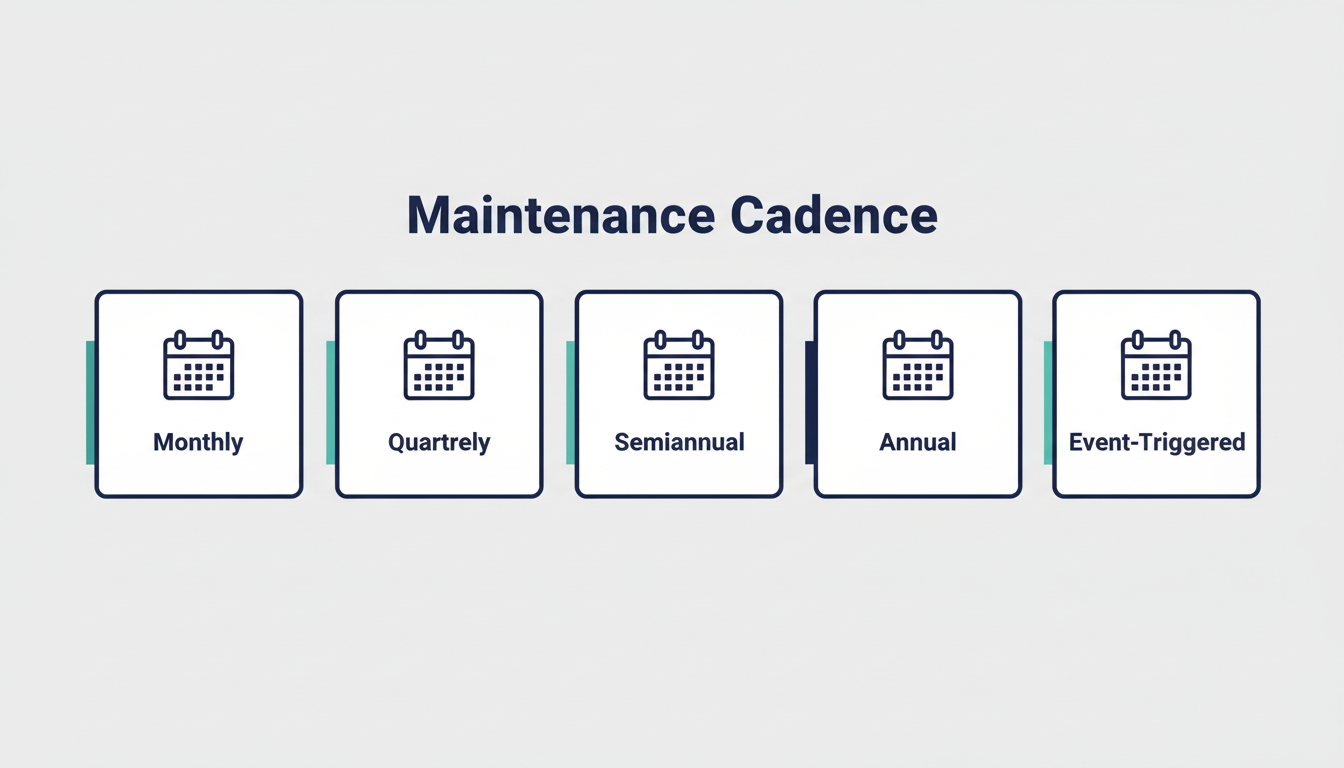
The annual cycle is supported by shorter recurring intervals. This baseline should be adjusted to each asset, equipment requirements, lease, and actual condition.
Monthly Operating Review
- Open work orders, aging items, repeat requests, and emergency response performance
- Vacant-property status and physical-check requirements
- Storm readiness during hurricane season
- Exceptions involving active leaks, abnormal humidity, cooling, safety, or access
This can be a portfolio-level desk review supported by field verification when an exception or scheduled visit requires it. It is not a reason to enter occupied units without proper notice or legal authority.
Quarterly Condition Review
- Compare current property condition with the prior record
- Review moisture indicators, visible leaks, drainage, and exterior exceptions
- Confirm recurring tenant or vendor responsibilities were completed
- Re-rank open issues by urgency, asset consequence, and tenant impact
Inspection frequency should reflect the lease, applicable law, the property, and documented risk. The important discipline is consistency: the same checklist, dated evidence, and a closed-loop response to findings.
Semiannual Service Window
- Qualified HVAC inspection and service at climate-appropriate times
- Safety-device and life-safety review as applicable to the property
- Pest or wood-destroying-organism review based on property type, exposure, and vendor recommendation
- Review of high-consequence systems showing age, repeated repair, or declining performance
Annual Asset Review
- Roof and exterior-envelope condition
- Plumbing and water-heating risk
- Electrical and safety exceptions visible within the appropriate inspection scope
- Drainage, vegetation, and site conditions
- Insurance documentation and renewal requirements
- System-age register, warranty record, and capital forecast
- Full-year maintenance performance by property
Event-Triggered Review
Some inspections belong to the event rather than the month:
- Tenant notice and move-out
- New occupancy and move-in condition documentation
- Severe weather or reported water entry
- Extended vacancy
- Insurance, refinance, acquisition, or disposition diligence
- Repeated failure of the same component or system
A calendar that ignores event-triggered work will look complete while missing the moments when condition changes fastest.
Make the Schedule Work Across Multiple Properties
A portfolio schedule should not be a larger version of a single-property checklist. It needs portfolio controls.
Use One Condition Standard
Inspect comparable components with the same questions and evidence requirements at every asset. Standardization makes differences visible. Without it, one property receives a detailed review while another receives “looks fine,” and the owner cannot rank risk reliably.
Group Work Without Hiding Exceptions
Route-based HVAC, pest, inspection, and exterior work can reduce scheduling friction. However, grouped service should never turn into identical scope regardless of condition. Standardize the process, then document property-specific findings.
Separate Routine Authority From Capital Decisions
Define what the management team may approve immediately, what requires owner authorization, and what qualifies as an emergency. Routine work should not wait through repeated approval cycles, while capital decisions should arrive with condition evidence, options, cost, consequence of deferral, and a recommended next step.
Measure Completion and Consequence
Useful portfolio reporting includes:
- Scheduled tasks completed on time
- Open work orders by age and urgency
- Repeat repairs by property and system
- Planned versus emergency work
- Condition changes since the prior review
- Upcoming capital items and decision dates
- Vacancy or tenant disruption connected to maintenance
This is the portfolio-level visibility described in portfolio management services for multi-property investors. The goal is not more reporting. It is earlier and better decisions.
The Maintenance Record Is Part of the Asset
For every completed task, retain:
- Property address and specific area or system
- Inspection or service date
- Finding and condition assessment
- Vendor and applicable license or qualification information
- Approved scope and cost
- Before-and-after photographs where useful
- Invoice, warranty, permit, or report where applicable
- Completion verification
- Next service or review date
- Owner decision and rationale when material work is deferred
That record supports more than maintenance. It helps an owner explain operating expenses, prepare an insurance claim, respond during diligence, evaluate recurring failures, and show a buyer or lender how the property was operated.
For a trustee or executor, the record also demonstrates a process: condition was assessed, material risk was identified, decisions were documented, and work was verified. Beam’s approach to property management for trustees and estate executors treats documentation as part of prudent administration, not administrative cleanup after the fact.
How Beam Runs the Annual Maintenance Schedule
Beam Management Group manages the calendar as an operating system across the owner’s properties:
- Build or verify the asset baseline for each address.
- Assign recurring and seasonal work by property, system, and responsible party.
- Coordinate access and qualified vendors without making the owner dispatch each visit.
- Document findings and convert exceptions into tracked work orders or capital decisions.
- Verify material work before closing the item.
- Maintain condition history, invoices, photographs, and next-due dates by property.
- Report portfolio-level exceptions so the owner can direct capital where it protects the most value.
That is the practical difference between a manager who responds to maintenance calls and an operational partner who helps prevent the calls that should never have become emergencies.
Grow your portfolio. Let Beam handle the annual maintenance.
If your portfolio is growing but your time is not, the annual maintenance calendar should keep running whether you are in South Florida or not. Beam can coordinate the inspections, vendors, documentation, and follow-through across every property so you can focus on portfolio decisions rather than reminder lists.
If you have inherited South Florida rental property, a documented annual schedule is one of the first ways to turn unfamiliar assets into a controlled operation—and to show beneficiaries and advisors that the properties are being preserved deliberately.
Beam is built for multi-property owners, inheritors, trustees, and executors who need local operational oversight, not a DIY maintenance checklist. Contact Beam Management Group to build a maintenance calendar around the actual condition and risk profile of your properties.
FAQ
What maintenance should be done annually on a South Florida rental property?
At minimum, the annual asset review should address roof and exterior-envelope condition, visible plumbing and water-heating risk, drainage and vegetation, HVAC service history, applicable safety systems, insurance documentation, recurring repair patterns, and the capital forecast. Exact tasks and frequency should follow the property’s condition, equipment-manufacturer guidance, lease, property type, local requirements, and qualified-contractor recommendations.
How often should HVAC equipment be serviced in a Florida rental property?
A practical South Florida operating calendar usually creates two service windows—before peak summer demand and after the heaviest cooling and storm period—while following the equipment manufacturer’s requirements and the HVAC contractor’s recommendation. Filter checks or replacement may be needed more frequently based on the system, occupancy, pets, construction activity, and actual filter condition.
When should hurricane maintenance be completed in South Florida?
Pre-season roof, drainage, vegetation, exterior-envelope, opening-protection, vendor, and documentation work should be completed before the Atlantic hurricane season begins on June 1. Storm-specific actions then follow the forecast and the property’s written protocol. Waiting until a storm is named reduces material availability and contractor capacity.
How often should a rental property be inspected?
There is no single inspection interval appropriate for every rental. Frequency should reflect applicable law, lease terms, occupied-property notice requirements, property condition, vacancy status, prior water or maintenance issues, insurance requirements, and the purpose of the inspection. Whatever interval is chosen should use a consistent checklist, dated photographs, written findings, and tracked follow-through.
Who should be responsible for tasks on the maintenance calendar?
Each task should name one responsible party: the manager, tenant where permitted and agreed, qualified vendor, association, or owner. Licensed or specialized work should be assigned to appropriately qualified professionals. The manager should also define who verifies completion, because scheduling a task and proving it was completed to scope are different controls.
What maintenance records should a trustee or executor keep?
Keep dated condition reports, photographs, work orders, vendor information, scopes, approvals, invoices, completion verification, warranties or permits where applicable, next-service dates, and written reasoning for material deferrals. Organize the record by property so it supports estate accounting and demonstrates how the asset was preserved during administration.
How does a maintenance schedule reduce vacancy and protect NOI?
It moves high-consequence work into planned windows, surfaces property-condition problems before move-out, reduces emergency tenant disruption, and allows disruptive non-urgent work to be coordinated with turnover. Across multiple properties, it also exposes repeated repairs and upcoming capital needs before they affect several units at once.
Is this schedule a substitute for legal, insurance, or contractor advice?
No. It is an operational framework. Owners should follow applicable law, lease and association obligations, insurance requirements, manufacturer instructions, and advice from Florida counsel and appropriately licensed contractors for each property’s specific circumstances.
Authority Outbound Links
- Florida Legislature — Florida Statute 83.51, landlord’s obligation to maintain premises → https://www.leg.state.fl.us/statutes/index.cfm?app_mode=display_statute&url=0000-0099%2F0083%2Fsections%2F0083.51.html
- National Hurricane Center — Atlantic hurricane season climatology → https://www.nhc.noaa.gov/climo/
- U.S. Environmental Protection Agency — mold, moisture, and indoor humidity guidance → https://www.epa.gov/mold/brief-guide-mold-moisture-and-your-home
- U.S. Department of Energy — air-conditioner maintenance guidance → https://www.energy.gov/sites/prod/files/HomeCooling101-final.pdf