
Portfolio Management Services for Multi-Property Investors
Most investors do not hit a financing wall. They hit an operations wall.
The properties are performing, the financing is available, and the next acquisition makes sense on paper. What does not scale is the owner: five sets of vendor relationships, five maintenance histories held partly in memory, five renewal dates arriving without analysis, and five separate mental models of what each property will need in the next 24 months.
Managing five properties one at a time is not portfolio management. It is the same job performed five times, with no shared system and no consolidated view — which is precisely the gap portfolio management services for multi-property investors exist to close. The distinction matters because the problems that limit portfolio growth — unpredictable capital events, staggered vacancies, uneven condition, unclear operating data — are portfolio-level problems that cannot be solved one property at a time.
Where Per-Property Management Breaks Down
The failure is rarely dramatic. It accumulates.
No consolidated condition picture. The owner knows the property with the recent problem. The other four are assumed to be fine until one of them proves otherwise. There is no ranked view of which asset carries the most near-term risk.
Capital events arrive as surprises. Three water heaters purchased in the same year reach end of life in the same year. Without tracked system ages, that is three unbudgeted emergencies instead of one planned replacement sequence.
Turnovers collide. Two units going vacant in the same month strains vendor availability and owner attention simultaneously. Lease end dates are controllable through renewal terms, but only if someone is managing them as a portfolio calendar rather than as five independent leases.
Vendor pricing stays retail. Five properties represent real volume. Handled as five separate relationships, that leverage is never applied.
Reporting cannot answer portfolio questions. Which property has the highest operating cost per unit? Which has the weakest rent-to-market position? Which should be sold or refinanced first? A stack of per-property statements does not answer any of these without manual reconstruction.
Rent roll drifts. Without a renewal analysis per unit per year, below-market leases persist quietly — and a rent roll below market suppresses both current income and eventual valuation.
What Portfolio Management Services for Multi-Property Investors Provide
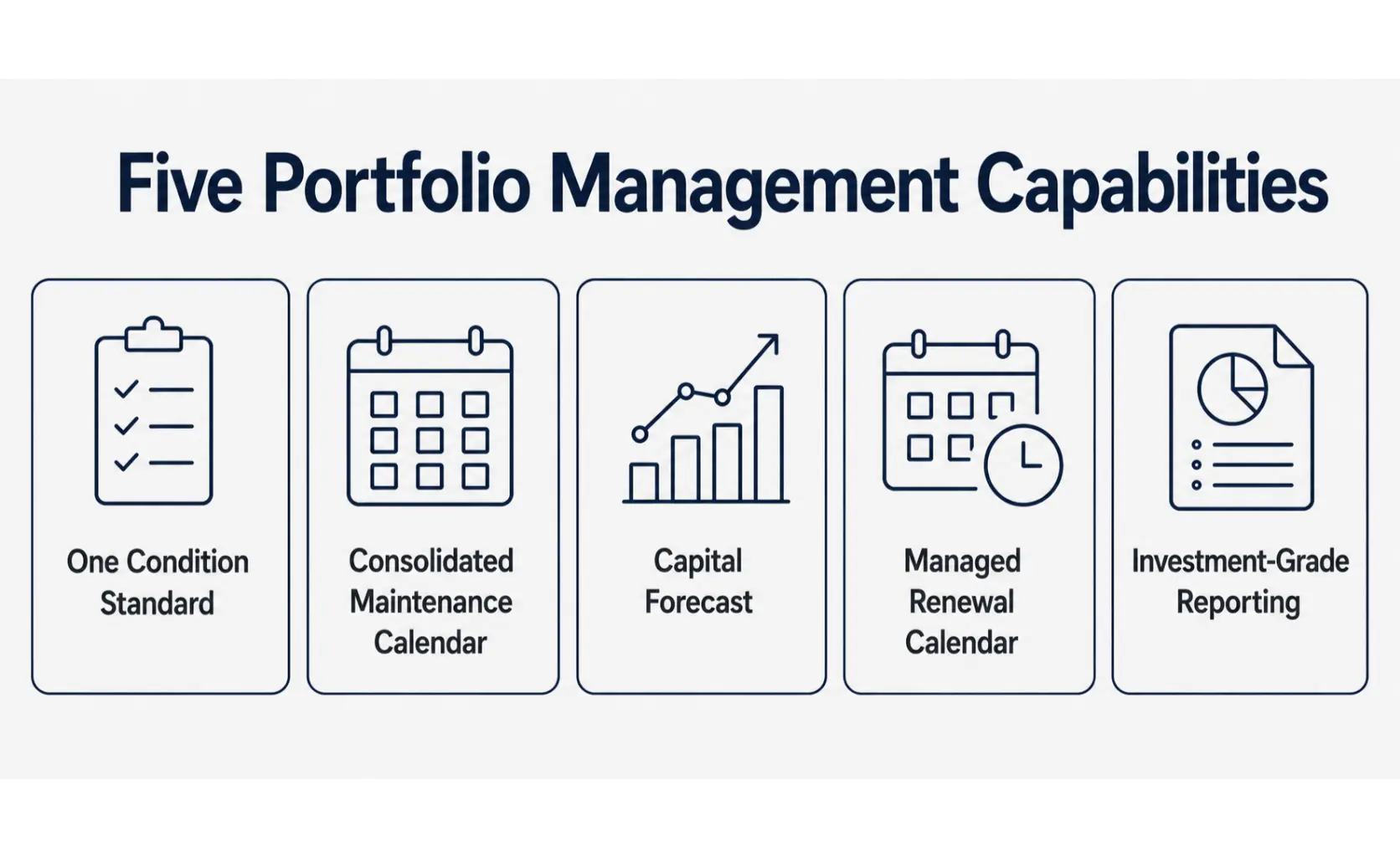
Portfolio management is not a larger version of single-property management. It adds five capabilities that only exist at the portfolio level.
1. One Condition Standard Across Every Asset
Every property is inspected on the same schedule, to the same standard, with the same documentation. This produces something an owner cannot get from per-property management: comparability. When every unit is assessed identically, the portfolio can be ranked by risk and capital need rather than by whichever property complained most recently.
2. A Consolidated Maintenance Calendar
HVAC service, roof inspections, drainage checks, water heater assessments, and pest and moisture management scheduled across the portfolio rather than per property. This smooths spend across the year, prevents clustering, and captures scheduling efficiency when multiple properties are serviced in sequence.
3. A Capital Forecast Instead of Capital Surprises
Tracking the age and condition of major systems across every property converts replacement from an emergency into a planned sequence. An owner who knows three roofs are five to seven years from replacement can plan, phase, and finance those decisions. An owner who does not will handle them as three unplanned events at whatever price the market offers that week.
4. A Managed Renewal and Lease Calendar
Renewals reviewed against current comparables, with lease terms structured to distribute expiration dates across stronger leasing months rather than clustering them. This directly reduces exposure to seasonal vacancy risk and keeps the rent roll tracking market rather than drifting below it.
5. Reporting Built for Investment Decisions
Operating cost per property and per unit, maintenance spend split between planned and reactive, vacancy days by property, renewal rates, rent-to-market position, and upcoming capital needs. This is the data required to decide what to refinance, what to sell, and what to acquire next.
Per-Property Management vs. Portfolio Management
Per-Property Management
- Condition view: One property at a time, on request
- Maintenance: Scheduled or reacted to per property independently
- Capital planning: None; replacements surface as failures
- Lease calendar: Five independent renewal dates
- Vendors: Separate relationships, retail pricing
- Reporting: A statement per property
- Growth constraint: Owner attention
Portfolio Management
- Condition view: Every asset inspected to one standard, ranked by risk
- Maintenance: One consolidated calendar across all properties
- Capital planning: System ages tracked, replacements forecast and phased
- Lease calendar: Expirations managed and distributed deliberately
- Vendors: Standing bench with portfolio volume applied
- Reporting: Consolidated operating, condition, and capital data
- Growth constraint: Capital and deal flow, not operations
The Portfolio Operating Review
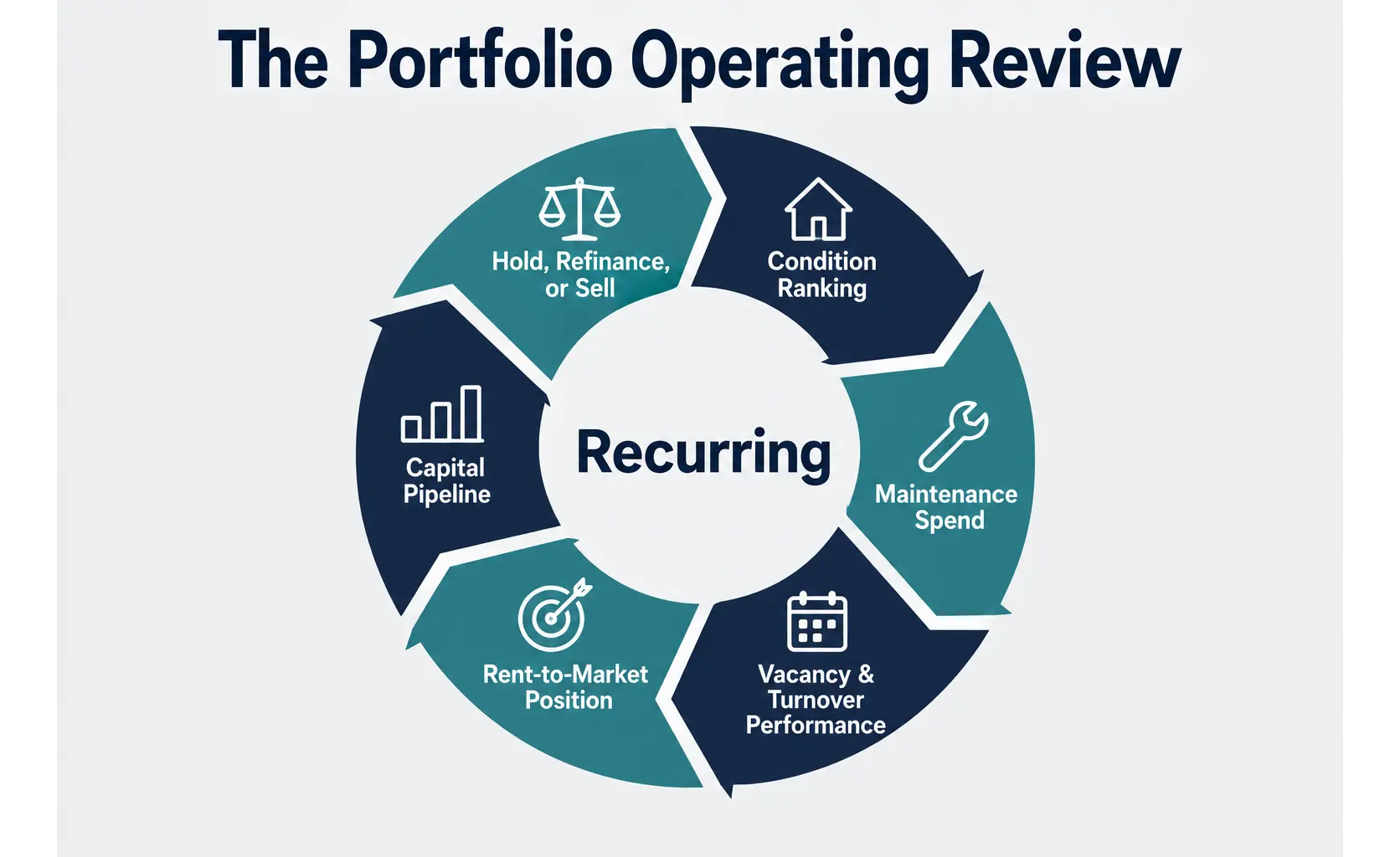
The mechanism that keeps a portfolio from drifting is a recurring structured review — the operational equivalent of reading financial statements rather than checking a bank balance. Each cycle should cover six items.
Condition ranking. Which properties have deteriorated relative to their last inspection, and what is the cost of addressing it now versus later.
Maintenance spend analysis. What share of spend was planned versus emergency. A rising emergency share is the clearest early indicator of deferred maintenance accumulating somewhere in the portfolio.
Vacancy and turnover performance. Average vacancy days per turnover by property, with any outlier examined for cause. The mechanics of reducing this number are covered in reducing vacancy between tenants in South Florida.
Rent-to-market position. Each unit’s current rent against current comparables, with a renewal recommendation attached.
Capital pipeline. Systems approaching end of life, with estimated cost and recommended sequencing.
Hold, refinance, or sell. Each asset’s performance and capital requirement evaluated against alternatives — the point at which operating data becomes investment strategy.
Why South Florida Portfolios Need This More
Regional conditions increase both the variance and the consequence of operational drift.
Correlated risk. A single storm event affects every property in the portfolio simultaneously. Preparation, inspection, and documentation must happen across all assets in a compressed window — a portfolio-level operation by definition, not a per-property one.
Climate-driven capital intensity. Roofing, HVAC, and exterior envelope components carry shorter effective lives here than in milder markets. Without tracked system ages across the portfolio, replacement clustering is close to inevitable.
Insurance requires documentation across every asset. Coverage and claim outcomes depend on condition records. Owners navigating the environment described in what South Florida owners should know about insurance rates benefit from a consistent, portfolio-wide documentation standard rather than uneven per-property records.
Vendor capacity is the binding constraint after storms. Portfolio volume and standing relationships determine scheduling priority when regional demand spikes.
For investors continuing to grow — including those using DSCR financing to scale in Florida — lender diligence is also easier with consolidated operating data than with reconstructed per-property records. The same discipline underlies scaling a South Florida rental portfolio with precision.
What Changes for the Owner
The practical difference is what the owner spends attention on.
Under per-property management, the owner is the integration layer. Every vendor decision, condition question, and renewal choice routes through them, and the portfolio’s operating knowledge lives in their head.
Under portfolio management, the owner reviews consolidated data and makes capital and strategy decisions. Routine operations proceed against defined thresholds and standards. That is the actual mechanism by which an investor scales: not by working harder across more properties, but by removing themselves from the operational path while gaining better visibility than they had before.
This is the same principle as residential asset protection, applied across a set of assets rather than one: value is preserved through documented, systematic operations, and it compounds with portfolio size.
Grow your multi-property portfolios with Beam
Beam Residential operates multi-property portfolios as a single operating system: one condition standard, one maintenance calendar, tracked system ages, a managed renewal calendar, and consolidated reporting built for hold, refinance, and acquisition decisions.
If your portfolio is growing but your time isn’t, Beam can run the operations so you can focus on the next deal.
Contact Beam Residential to review your portfolio’s condition, capital pipeline, and rent-to-market position.
FAQ
What are portfolio management services for rental properties?
They are management services organized around the portfolio rather than the individual property: one inspection and condition standard across every asset, a consolidated maintenance calendar, tracked system ages for capital forecasting, a managed lease and renewal calendar, and reporting that compares properties against each other.
How many properties do I need before portfolio management makes sense?
There is no fixed threshold, but the practical trigger is when the owner can no longer hold each property’s condition, maintenance history, and renewal timing in their own head and act on all of it in the same week. For most owners that occurs between two and four properties, and immediately if they live out of state.
How is portfolio management different from managing several properties separately?
Separate management produces separate outcomes: independent vendor relationships, uneven condition, clustered lease expirations, and no comparability between assets. Portfolio management applies one standard and one calendar across all of them, which is what makes ranking risk, forecasting capital, and distributing lease expirations possible.
What reporting should a multi-property owner expect?
Operating cost per property and per unit, maintenance spend separated into planned and emergency, vacancy days per turnover by property, renewal rates, each unit’s rent against current market comparables, and a forward capital pipeline with estimated costs and timing.
How does capital planning work across a rental portfolio?
By tracking the age and observed condition of major systems — roofing, HVAC, water heaters, and exterior components — in every property, then sequencing replacements before failure. This converts unbudgeted emergencies into planned, phased capital decisions that can be financed deliberately.
Can lease expiration dates really be managed?
Yes, within lease law and tenant willingness. Renewal terms can be structured in months rather than fixed 12-month increments, which allows expirations to be steered toward stronger leasing periods and away from clustering. Across a portfolio this measurably reduces seasonal vacancy exposure.
Does portfolio management help with refinancing or selling?
Substantially. Lenders and buyers price uncertainty, and consolidated operating data — clean financials, documented maintenance history, market-rate leases, and a known capital pipeline — reduces it. Reconstructing that record during diligence is slower and generally produces worse terms.
Authority Outbound Links
- U.S. Census Bureau — Rental Housing Finance Survey (multi-property ownership data) → https://www.census.gov/programs-surveys/rhfs.html
- National Association of Residential Property Managers — professional standards → https://www.narpm.org/