
Property Value Protection Strategies for Passive Investors
A South Florida owner who has collected rent on time for six straight years can still lose a meaningful percentage of their asset value in a single afternoon. It happens when a buyer’s inspector comes out of the attic, when an appraiser marks the condition rating a grade lower than the owner assumed, or when a carrier declines to renew because the roof is past the age their underwriting will accept. Nothing broke that afternoon. The loss had been accumulating for years. That afternoon was just when it got priced.
This is the structural risk in passive ownership, and it is different from the risk of a bad tenant or a vacancy. Income problems announce themselves. Condition and insurability problems do not. They compound quietly through a hold period and then settle up in one transaction, which is why an owner can be satisfied with every monthly statement and still be surprised at exit.
Deliberate non-involvement is a legitimate position. Portfolio investors have better uses for their attention, and trustees are often explicitly not supposed to be running buildings. The question is not whether to be passive. It is whether the property is merely being occupied or is actually being preserved, because those two states look identical on a rent roll and diverge sharply on a settlement statement.
This article is written for owners of multiple South Florida residential rentals and for fiduciaries administering them. It is not written for single-unit self-managers or for short-term rental operators, whose asset wear, insurance profile, and revenue mechanics do not resemble long-term residential holdings.
Occupied Is Not the Same as Preserved
An occupied property produces rent. A preserved property produces rent and holds its position in the market. The distinction is almost entirely about what happens to the building between lease signings.
A property is being occupied when a tenant is in place, payments arrive, and someone responds when something breaks. That is the baseline most passive owners believe they have bought. It is also fully compatible with a roof entering its final years unremarked, sealant failing along a west-facing wall, an air handler running well past its rated life, and a rent that has fallen behind the submarket because nobody has priced the unit against current comparables in three renewal cycles.
A property is being preserved when condition is measured on a schedule, capital items are forecast before they fail, work is documented as it happens, insurability is actively managed, and the rent roll is repriced against real market data at each renewal. The tenant experience may be identical. The asset is on a different trajectory.
The practical implication is that the service you buy determines which state you are in. A vendor whose scope ends at rent collection and emergency response is delivering occupancy. Preservation requires someone accountable for the condition trajectory, which is a different job with a different deliverable, as covered in operational oversight vs. rent collection.
Condition Trajectory Is the Real Variable
Value is not a snapshot. It is a slope. Two identical properties with identical rents can be years apart in effective age depending on whether their short-lived components were maintained, replaced on schedule, or run to failure.
Appraisers formalize this. Fannie Mae’s Selling Guide requires appraisers to assign a standardized condition rating, and the rating definitions turn on deferred maintenance and physical deterioration rather than on age alone. A property with “no deferred maintenance” and one with “obvious deferred maintenance” sit in different rating bands under the same guide, and the guide directs the appraiser to rate the property on its own merits rather than relative to the neighborhood. The full definitions are published in Fannie Mae Selling Guide B4-1.3-06.
Condition rating is not something an owner can improve at the closing table. It reflects years of accumulated decisions, and it influences appraised value, financing terms, and the buyer pool at exit.
The trajectory is also asymmetric. Correcting condition on schedule is a predictable operating expense. Recovering condition after years of drift is a capital project, usually undertaken under time pressure, in the least favorable pricing environment, with the buyer or the lender setting the deadline.
The Six Value-Eroding Patterns a Passive Owner Cannot See
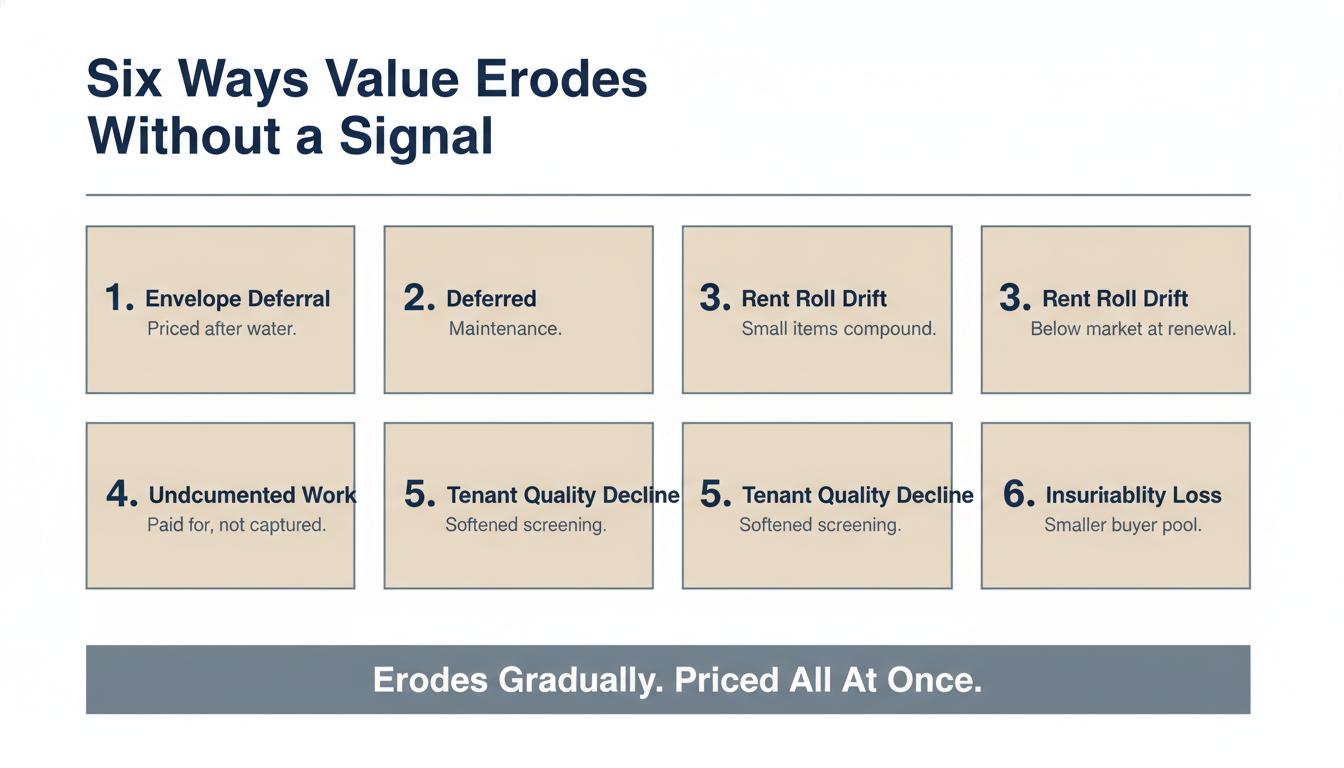
Each of these erodes value without generating a single alarming phone call. That is precisely why they persist under passive ownership.
1. Deferred Envelope Work
Roof, flashing, sealants, stucco, soffits, and coatings do not produce tenant complaints until they produce water. By then the cost is no longer an envelope cost. It is an envelope cost plus interior repair plus a moisture history that will be disclosed. Envelope condition is also the single item carriers scrutinize most closely at renewal in this market. The year-round mechanics are covered in roof and exterior maintenance in a tropical climate.
2. Accumulating Deferred Maintenance
Individually trivial items compound: a slow drain, a sticking window, a failing water heater anode, a corroded shutoff, a stained ceiling tile nobody investigated. None justifies an owner call. Collectively they become the punch list a buyer’s inspector produces, and that list is what gets priced.
3. Below-Market Rent Roll Drift
Renewals handled administratively rather than analytically produce rents that trail the market. Because income drives value on an income-producing asset, drift in the rent roll is drift in value. A property renewing at convenience rather than at market can carry a rent gap that a buyer capitalizes downward at sale, and a lender sees as reduced coverage on a refinance.
4. Undocumented Capital Work
This is the pattern owners find hardest to accept. Work that was actually performed, and performed well, contributes almost nothing at diligence if there is no dated record, no permit where one was required, no vendor license information, and no invoice. A new roof with no documentation is treated by a cautious buyer as a roof of unknown age. Value that was paid for was not captured.
5. Tenant Quality Decline
Screening standards that soften over time to fill units faster produce a rent roll that is nominally intact and operationally weaker: later payments, more wear, shorter tenancies, more turnover cost. The cumulative expense of that drift is significant on its own, as detailed in the true cost of tenant turnover, and it also degrades the quality of the income stream a buyer is underwriting.
6. Insurability Deterioration
Coverage does not usually disappear at once. It narrows: a higher deductible here, a roof exclusion there, a nonrenewal that pushes the property into a more expensive placement. Each step raises the carrying cost and shrinks the set of buyers who can finance the property, and it happens without any visible change to the building.
Capital Reserve Discipline: Forecast the Replacement, Do Not React to the Failure
The financial difference between a forecast replacement and a reactive one is not primarily the price of the equipment. It is everything around it.
A forecast replacement is scoped in advance, competitively bid, scheduled during a vacancy or at a convenient point in the lease, funded from reserves that were built deliberately, and completed with permits and documentation intact. A reactive replacement happens after a failure, often during a heat wave or a storm week when trade availability is worst, with the tenant displaced or uncomfortable, at whatever price is available, frequently with secondary damage attached.
Reserve discipline for a passive owner requires three things and none of them are complicated:
- A component inventory by property. Roof, HVAC equipment, water heaters, major appliances, exterior coatings, windows and openings, service panels, water supply lines and drain lines, with installation dates and observed condition. Age is an estimate; observed condition is the correction to that estimate.
- A funded reserve target that is reviewed, not assumed. Reserve levels should be set against the actual component inventory and its remaining life, not against a rule of thumb inherited from a different building in a different climate. Any percentage figure used should be treated as illustrative until it is tested against the inventory.
- A rolling multi-year capital sequence. Which item is expected in which year, what it is expected to cost, and how it is sequenced across the portfolio so that two roofs and a chiller do not land in the same twelve months.
There is a Florida-specific reason to plan capital work rather than absorb it after damage. Under National Flood Insurance Program rules, if the cost of restoring a structure to its pre-damage condition equals or exceeds fifty percent of the structure’s pre-damage market value, the structure is considered substantially damaged and must be brought into compliance with current floodplain management standards, as explained by FEMA’s guidance on substantial improvement and substantial damage. Improvement work is subject to a parallel threshold. Owners in Special Flood Hazard Areas should confirm local thresholds with their municipality, because some communities adopt stricter standards. The operating point stands regardless: deferring envelope and structural work in a coastal floodplain raises the probability that the next event triggers a compliance obligation instead of a repair.
The strategic case for this posture is developed in preventative maintenance as an asset protection strategy, and the operating year that produces the data sits in the annual maintenance schedule for South Florida rental properties.
Documentation Is a Component of Value, Not Paperwork
Treat this as an underwriting fact rather than an administrative preference: a buyer, a lender, an appraiser, an adjuster, and a beneficiary all price uncertainty, and documentation is how uncertainty is removed.
The record that protects value is organized by property and contains dated condition reports with photographs, work orders with scope and approval, licensed vendor information, invoices, completion verification, permits and closeouts where applicable, warranty documentation, lease and renewal history, insurance policies and claim history, and written reasoning for anything deliberately deferred.
Two of those deserve emphasis for passive owners.
Permits and closeouts. Open or missing permits on work that was completed years ago surface at the worst possible moment and are far harder to resolve retroactively than to obtain correctly at the time.
Written deferral reasoning. A deferral with a documented finding, cost, alternatives, and rationale is a decision. A deferral with no record is indistinguishable from neglect, and for a trustee it is the difference between demonstrating prudent administration and being unable to explain a five-year gap.
Documentation also has a tax dimension, which is why the record needs to be built as work happens. The distinction between a currently deductible repair and a capital improvement that must be capitalized is governed by the IRS tangible property final regulations, and the analysis depends on documented facts about scope. This is not tax advice; owners should work with a CPA on their specific position. Operationally, the requirement is the same either way: capture scope, date, and cost contemporaneously.
Insurability as a Value Input
In the current South Florida market, insurability is not a line item on the operating statement. It is a condition of sale.
A property that is difficult or expensive to insure has a smaller buyer pool, because financed buyers must place coverage to close and coverage cost feeds directly into their debt service coverage. A smaller buyer pool produces a worse price. That chain is the reason insurability belongs in a discussion of value rather than a discussion of expenses.
What underwriting actually looks at is largely condition and history: roof age, covering type and documented replacement date, opening protection, plumbing and electrical age and materials, water heater age and location, and prior claim history. Policy forms and eligibility differ meaningfully by structure type and age, which the Florida Office of Insurance Regulation summarizes in its homeowners insurance overview. Owners should confirm specifics with a licensed Florida agent, because eligibility and pricing are carrier-specific and change.
The passive owner’s exposure here is that insurability declines on the carrier’s schedule, not the owner’s. A roof does not become uninsurable when it leaks; it becomes uninsurable when it crosses an age threshold in someone’s underwriting guidelines. The only way to manage that as a non-involved owner is to have documented roof and envelope condition available before renewal rather than after a nonrenewal notice. Additional context on the market is in what South Florida owners should know about insurance rates.
Rent Roll Quality Is a Valuation Input
Buyers of income property do not buy the rent number. They buy the reliability of the rent number, and they discount everything they cannot verify.
A high-quality rent roll has current written leases with consistent terms, documented screening on each tenancy, payment history that supports the stated income, staggered expirations rather than clustered ones, rents that sit at or near market, security deposits handled and accounted for correctly, and renewal history showing retention rather than churn.
A weak rent roll can carry the same gross income and still price lower: expired leases operating month to month, undocumented screening, deposits with unclear handling, three units expiring in the same month, and rents that appear at market only because a concession was applied off the books. Each of those becomes a diligence question, and diligence questions become negotiation items. The systems that produce a defensible rent roll across several properties are covered in portfolio management services for multi-property investors.
The Deferred-Maintenance Discount
When condition is unknown, buyers do not assume the average case. They underwrite the worst case, because they are the party absorbing the risk.
That is the mechanism behind the deferred-maintenance discount. It has three parts, and only the first is what most owners expect:
- The repair estimate itself, typically drawn from an inspection report and often quoted at retail emergency pricing rather than scheduled pricing.
- A contingency for what the inspection could not see, which grows in direct proportion to how thin the maintenance record is.
- A risk premium on the whole transaction, expressed as a lower price, a larger holdback, a longer diligence period, or a renegotiation after inspection.
A documented history compresses parts two and three. Condition reports, dated invoices, permits, and warranty records replace the buyer’s imagination with facts, which is the entire point of maintaining the record during the hold rather than assembling it at listing. How this plays out in the transaction itself is the subject of how strong property management affects resale value.
The same asymmetry applies to appraisals and refinances. An appraiser working without documentation is not permitted to assume favorable unobserved conditions, and a lender pricing an uncertain asset prices it conservatively.
Passive and Unmanaged vs. Passive and Managed
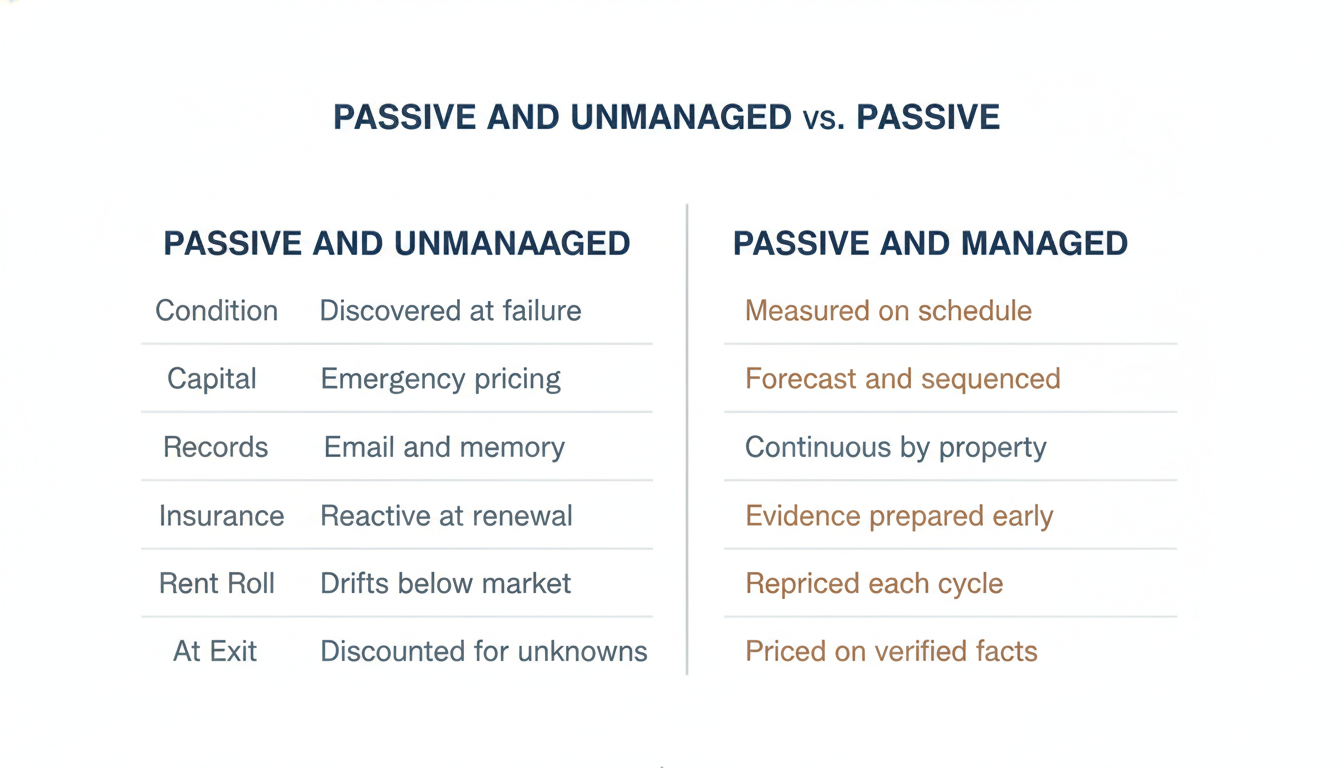
Both columns describe an owner who is deliberately uninvolved. The difference is whether the operating layer holds condition, capital, documentation, and insurability, or whether nobody does.
| Dimension | Passive and unmanaged | Passive and managed |
|---|---|---|
| Condition knowledge | Discovered at failure or at sale | Measured on a schedule with dated evidence |
| Envelope and roof | Addressed after water intrusion | Tracked against remaining life and carrier requirements |
| Capital spend | Emergency pricing, unplanned timing | Forecast, bid, and sequenced across the portfolio |
| Reserves | Estimated or absent | Set against a component inventory and reviewed |
| Documentation | Email history and memory | Continuous record retrievable by property |
| Insurability | Managed reactively at renewal | Condition evidence prepared before renewal |
| Rent roll | Renewed administratively, drifts below market | Repriced against comparables each cycle |
| Tenant quality | Standards soften to fill vacancies | Screening standard held constant |
| Diligence at exit | Buyer’s inspector defines the narrative | Seller’s record defines the narrative |
| Price outcome | Discounted for unknowns and worst-case assumptions | Priced on verified condition and verified income |
Over a multi-year hold, the two columns can produce similar monthly statements. They rarely produce similar closing statements.
What the Passive Owner Should Still Require
Being uninvolved in operations does not mean being uninformed about the asset. Four deliverables are the minimum for a passive holder who intends to protect value:
- A condition baseline and a scheduled reassessment, so the trajectory is a known quantity rather than an assumption.
- A rolling capital plan with a funded reserve, reviewed annually against the component inventory.
- A continuous documentation record by property, complete enough that an insurer, lender, appraiser, or beneficiary question can be answered from the file.
- An annual insurability and rent-position review, because both drift on external schedules.
The operating machinery that produces these without routing work back to the owner is the subject of stress-free ownership: what it actually takes operationally, and the broader framework sits in residential asset protection.
Value preservation under passive ownership is not vigilance. Vigilance does not scale and cannot be delegated to an absent owner. It is a set of standing systems that run whether the owner is paying attention or not, which is the only version that survives a ten-year hold.
Build a Property Value Protection Plan
If you own multiple South Florida rentals and intend to keep owning them without operating them, the variable that will determine your outcome is not this year’s rent. It is the condition trajectory, the reserve discipline, the documentation record, and the insurability position accumulating underneath the income. Those either have an owner inside your operation or they do not.
Beam Management Group is built for that requirement. We establish a condition baseline for each property, maintain a component inventory and rolling capital plan, keep a continuous documented record of condition and work performed, prepare condition evidence before insurance renewals, and reprice the rent roll against current market data at each renewal cycle. You receive exception-based reporting and make capital decisions with real information. You do not receive work orders.
For trustees, executors, and inheritors, the same systems produce the evidence the role requires: a demonstrable record that the asset was assessed, maintained, and administered on stated criteria rather than left to run. We work with multi-property owners and fiduciaries and are not a fit for single-unit self-managers or short-term rental operators. Contact Beam Management Group to establish a condition baseline and capital plan for your properties.
FAQ
How does a property lose value while it is fully occupied and paying rent?
Income and condition are independent variables. A tenant paying on time has no bearing on roof age, envelope integrity, equipment life, permit status, or insurability. Those decline on their own schedule, and because the decline produces no monthly signal, it accumulates through the hold and gets priced at the first event that requires third-party verification: a sale, an appraisal, a refinance, or an insurance renewal.
What is the deferred-maintenance discount and why is it larger than the repair cost?
It is the price reduction a buyer applies when condition is uncertain. It includes the estimated repairs, a contingency for what the inspection could not observe, and a risk premium on the transaction as a whole. Buyers underwrite the worst case on unknowns because they carry the outcome. A documented maintenance and capital history compresses the contingency and the risk premium, which is usually the larger portion.
How much should a passive owner hold in capital reserves?
There is no defensible universal figure, and any percentage quoted without reference to the building should be treated as illustrative only. The reserve target should be built from a component inventory for each property, listing roof, HVAC, water heaters, coatings, openings, panels, and supply and drain lines with installation dates and observed condition, then funded against remaining useful life and sequenced across the portfolio so major items do not cluster in the same year.
Why does documentation affect value if the work was actually completed?
Because buyers, lenders, appraisers, and adjusters can only credit what can be verified. Undocumented work is treated as unknown, and unknowns are underwritten conservatively. A roof replaced five years ago with no invoice, permit, or dated photographs is functionally a roof of unknown age at diligence. The value was paid for and never captured. Records have to be produced as work happens; they cannot be assembled retroactively with the same credibility.
How does insurability affect the price of a rental property?
Financed buyers must place coverage to close, and premium cost feeds directly into their debt service coverage. A property that is expensive or difficult to insure therefore has a smaller pool of buyers who can transact, and a smaller pool produces a lower price. Underwriting decisions turn largely on documented condition, particularly roof age and covering, opening protection, and plumbing and electrical age, so condition management and insurability management are the same activity.
Does a below-market rent roll really reduce value on an income property?
Yes, on two paths. Current income is capitalized into value directly, so a rent gap is a value gap. Separately, clustered expirations, expired leases running month to month, undocumented screening, and unclear deposit handling each become diligence questions, and diligence questions become negotiation items. A rent roll can show acceptable gross income and still price poorly because its quality cannot be verified.
Can a trustee or executor stay uninvolved and still protect estate asset value?
Yes, provided the operation generates evidence rather than requiring personal involvement. Scheduled condition assessments, a documented capital plan, licensed vendors, verified completion, and written reasoning for any deferral demonstrate that the asset was administered on stated criteria. Fiduciaries should confirm their specific duties and any trust-instrument or court constraints with Florida counsel, and coordinate basis and expense records with a CPA.
When should value protection systems be put in place if a sale is likely in a few years?
Immediately, and earlier is materially better. Condition ratings, permit status, claim history, and rent-roll quality reflect years of accumulated decisions and cannot be repaired in a listing window. Work completed under sale pressure is priced at emergency rates and still lacks history. A property entering diligence with two or three years of continuous documentation negotiates from a different position than one entering with an inspection report and an explanation.