
Rent-Ready Systems: How We Prepare Properties Between Tenants

Ask three different people to get a rental unit “rent-ready” and you will get three different properties back. One will clean it. One will clean it and paint. One will replace the flooring, service the HVAC, re-key the locks, and photograph every room.
All three will send an invoice describing the work as a turnover. Only one of them produced a unit that will lease quickly, at market rent, to a tenant who will not submit six repair requests in the first month.
That variance is the actual problem that rent-ready systems exist to solve. It is not that the work is expensive — it is that without a defined standard, cost and quality are both unpredictable, every turnover starts from scratch, and no two units in the same portfolio end up in the same condition. A rent-ready system replaces judgment calls with a scope that is decided once and applied every time.
What “Rent-Ready” Should Actually Mean
A unit is rent-ready when it meets a written condition standard, not when someone decides it looks acceptable. That standard should cover five dimensions.
Habitability and safety. Working smoke and carbon monoxide detectors, functioning locks, no electrical hazards, no active leaks, no visible mold, hot water, and a working cooling system. This is the floor, not the goal.
Systems verified, not assumed. HVAC serviced and tested, plumbing fixtures run and checked for leaks, water heater inspected, drainage confirmed, appliances tested under load rather than just switched on.
Presentation. Clean to a leasing standard rather than a residential one: paint touched up or refreshed, floors cleaned or replaced, fixtures and hardware intact, exterior and landscaping presentable.
Documentation. Dated photographs of every room and system, a written condition record, and a move-in inspection form the incoming tenant signs. This is what prevents deposit disputes and gives the owner an unambiguous baseline.
Leasing readiness. Marketing photography complete, listing live, keys and access controlled, and the unit ready to show.
A unit that is clean but has an unserviced HVAC system entering a South Florida August is not rent-ready. It is a maintenance call scheduled for three weeks from now.
The Five-Stage Rent-Ready Sequence
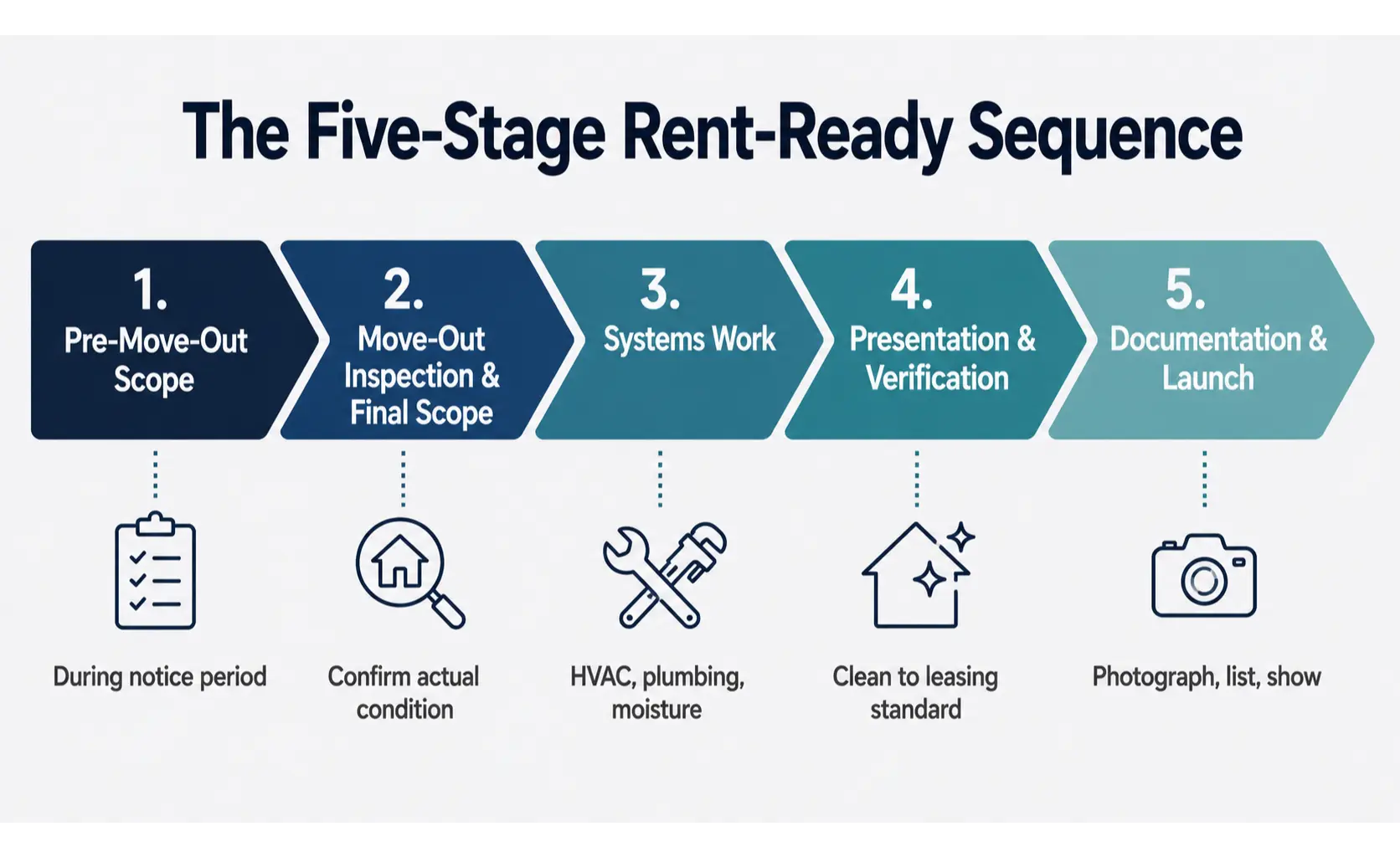
The sequence matters as much as the checklist, because each stage exists to prevent rework in the next one.
Stage 1: Pre-Move-Out Scope (During the Notice Period)
Inspect while the unit is still occupied. Identify what will need paint, flooring, appliance work, or system service. Book vendors now, for the day after move-out. Set target rent from current comparables. This stage costs zero vacancy days and eliminates most of the delay that normally follows a move-out.
Stage 2: Move-Out Inspection and Final Scope
Photograph every room within 24 hours of the keys coming back. Compare against the move-in record to separate normal wear from tenant damage — that distinction drives deposit accounting and needs to rest on documentation, not memory. Finalize the scope of work in writing.
Stage 3: Systems First, Cosmetics Second
Mechanical and moisture work goes before finish work, every time. Fixing a supply-line leak after new flooring is installed means paying for the flooring twice. In this climate, moisture and HVAC issues are the two categories that reliably create expensive rework when they are addressed out of order.
Stage 4: Presentation and Verification
Paint, deep clean, and detail work, followed by an independent walkthrough against the written standard. The person who verifies should not be the person who performed the work. Payment is released after verification, not before.
Stage 5: Documentation and Launch
Final photographs, updated condition record, marketing assets refreshed if the unit’s condition changed materially, and the move-in inspection form prepared for the incoming tenant.
The Fixed Scope vs. Judgment Call Problem
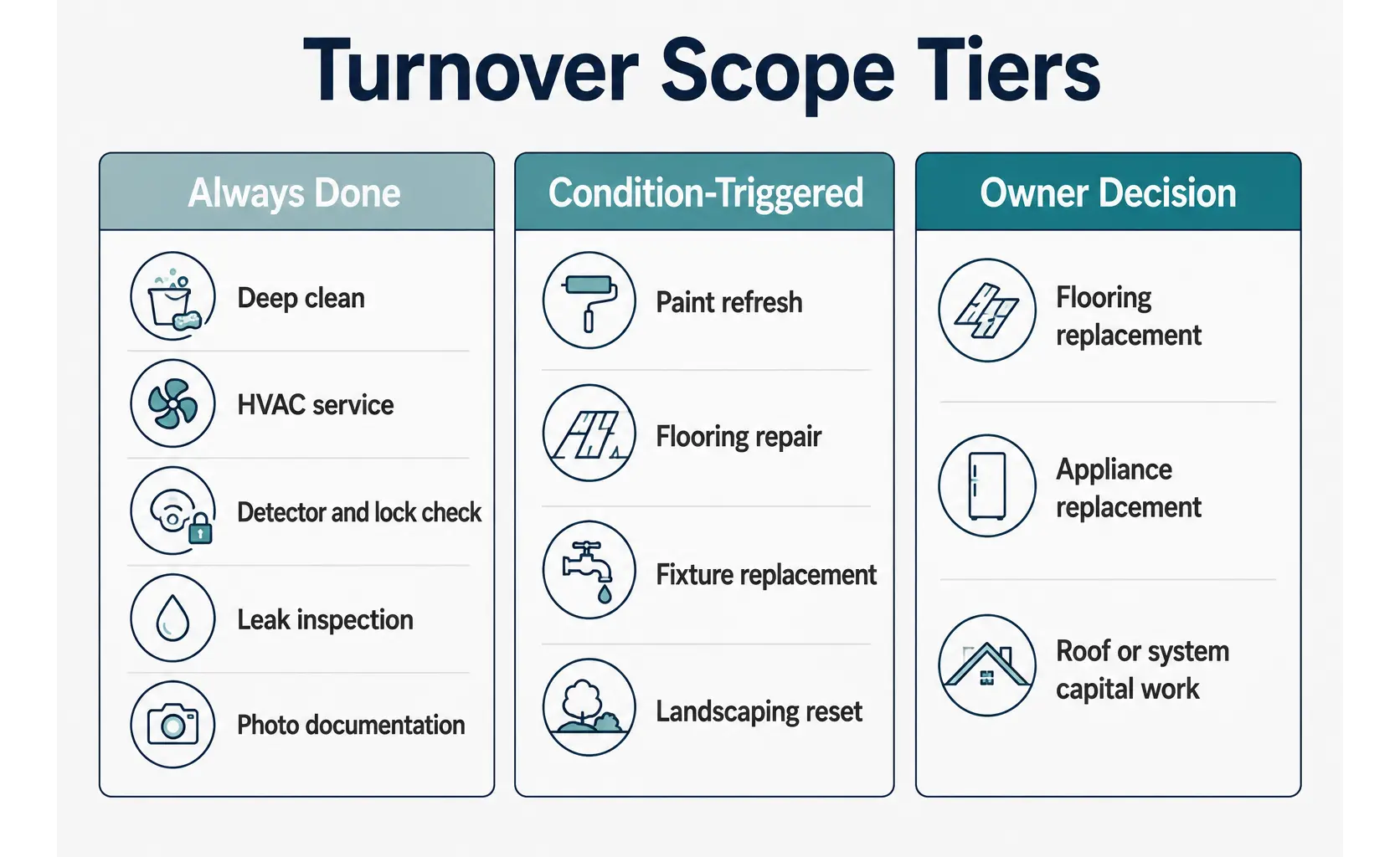
Most make-ready cost overruns come from treating every item as a decision. A rent-ready system sorts work into three fixed categories, which removes most of the deliberation.
Always Done (Every Turnover)
- Re-key or reprogram locks
- HVAC service, filter replacement, and operational test
- Smoke and CO detector test and battery replacement
- Deep clean including appliances, bathrooms, and interior windows
- All plumbing fixtures run and checked for leaks
- Full photographic condition record
Condition-Triggered (Done When the Standard Is Not Met)
- Paint: full or touch-up depending on wall condition and tenancy length
- Flooring: cleaning, repair, or replacement based on documented wear
- Appliance repair or replacement based on age and function
- Landscaping restoration
- Caulking, grout, and seal replacement where moisture risk exists
Capital Decision (Escalated to the Owner)
- Roof work
- HVAC replacement rather than service
- Water heater replacement
- Flooring replacement across the full unit
- Kitchen or bathroom upgrades intended to reposition the rent
The value of this structure is that categories one and two proceed without waiting for approval, so vacancy days are not spent on email threads. Only genuine capital decisions reach the owner, and they arrive with condition photos, cost, and expected effect on rent.
South Florida-Specific Requirements
Rent-ready standards written for a temperate market miss the items that matter most here.
HVAC is the highest-consequence system in the unit. Cooling equipment in South Florida runs close to year-round under high humidity load. A turnover is the only moment the unit is empty and accessible for real service. Skipping it converts a scheduled maintenance item into an emergency call during the hottest month of the year, with a tenant in place.
Moisture is a standing condition, not an event. Check under sinks, around water heaters, at window seals, at exterior door thresholds, and at any point where prior staining suggests intrusion. The EPA’s guidance on mold and moisture control is direct on the underlying principle: control the moisture source and the mold problem does not develop. A turnover is the cheapest opportunity to find and correct those sources.
Vacant units still need conditioning. Cutting cooling entirely in an empty unit to save on utilities invites humidity damage. Maintaining reasonable setpoints during vacancy is part of the scope, not an optional expense.
Storm readiness is part of readiness. During hurricane season, verify shutter or panel hardware, confirm drainage is clear, and check that exterior items are secured. A unit that is rent-ready in August should also be storm-ready in August.
Insurance-relevant condition should be documented. Photographs of roof, exterior, and systems at turnover create the condition record that supports future claims — relevant for any owner tracking the current market, discussed further in what South Florida owners should know about insurance rates.
Why Rent-Ready Systems Beat a Checklist
A checklist tells someone what to do. A system determines who does it, when it is scheduled, what standard it must meet, and who verifies it before payment.
The difference shows up across a portfolio. With a system:
- Turnover cost becomes predictable enough to budget, because the always-done items are known and the condition-triggered items are documented
- Every unit reaches the same condition standard, so the portfolio does not develop a two-tier quality problem
- Vendor performance becomes comparable, because they are all working to the same written scope
- Vacancy shortens, since scheduling and scope decisions happen during the notice period rather than after move-out — the mechanics of which are covered in reducing vacancy between tenants in South Florida
- Deposit accounting is defensible, because move-in and move-out condition are both documented
It also directly reduces the largest hidden turnover cost. A unit prepared to a real standard tends to attract better applicants, lease closer to asking rent, and generate fewer early maintenance calls — which is one of the more controllable inputs to the true cost of tenant turnover.
And the single largest determinant of how much make-ready work a unit needs is not the outgoing tenant. It is how well the property was maintained during the tenancy, which is the entire argument for preventative maintenance as an asset protection strategy.
Get Rent-Ready with Beam
Beam Residential runs make-ready work to a written standard: scope set during the notice period, systems before cosmetics, vendors verified before payment, and a photographic condition record on every unit.
If your portfolio is growing but your time isn’t, and every turnover currently requires you to re-decide what “rent-ready” means, that is the problem worth fixing first.
Contact Beam Residential to review your current turnover scope and where it is producing unpredictable cost.
FAQ
What does rent-ready mean for a rental property?
It means the unit meets a written condition standard covering safety and habitability, verified mechanical systems, presentation to a leasing standard, a documented photographic condition record, and leasing readiness. Without a written standard, “rent-ready” varies by whoever performed the work.
How long should a make-ready take?
It depends on scope, but most standard turnovers involve roughly a week of actual work. When a turnover takes three or four weeks, the constraint is almost always vendor scheduling and delayed scope decisions rather than the labor itself.
What should always be done between tenants?
Re-key or reprogram locks, service the HVAC and replace filters, test smoke and CO detectors, deep clean including appliances, run every plumbing fixture and check for leaks, and complete a dated photographic condition record. These items are inexpensive relative to what they prevent.
Should flooring be replaced at every turnover?
No. Flooring is a condition-triggered item, evaluated against documented wear and tenancy length. Replacing on a fixed schedule wastes capital; deferring replacement past the point where it affects leasing costs vacancy days and rent. Both errors are avoided by evaluating against a standard rather than a calendar.
Why should HVAC service happen during turnover?
Because it is the only time the unit is empty and fully accessible, and because in South Florida cooling equipment carries near year-round load. Servicing during turnover is scheduled, inexpensive, and non-disruptive. The alternative is an emergency call during peak heat with a tenant in place.
How does documentation at turnover protect the owner?
Dated move-in and move-out photographs establish the difference between normal wear and tenant damage, which is what makes deposit accounting defensible. The same record supports insurance claims, refinance diligence, and — for trustees and executors — evidence that the asset was maintained during their administration.
Who should verify that make-ready work was completed properly?
Someone other than the party that performed the work, walking the unit against the written standard before payment is released. Self-reported completion is not verification, and for an owner who is not local it is the only check that exists.
Authority Outbound Links
- U.S. Environmental Protection Agency — Mold and moisture control guidance → https://www.epa.gov/mold
- U.S. Department of Energy — HVAC maintenance and efficiency guidance → https://www.energy.gov/energysaver/maintaining-your-air-conditioner