
How to Evaluate a Property Management Company in South Florida

Every management company will tell you they are responsive, thorough, and investor-focused. None of that is verifiable, which is why most owners end up deciding on fee and instinct. Knowing how to evaluate a property management company means replacing both with evidence.
There is a better approach, and it does not require you to know the industry. It requires asking for artifacts rather than assurances — the actual inspection report, the actual maintenance log, the actual renewal analysis. A firm that operates systematically can produce these in an afternoon. A firm that does not will explain why they cannot.
That single distinction separates operational partners from rent collectors more reliably than any list of promises.
Start With What Is Publicly Verifiable
Before any conversation, confirm the basics independently.
Licensing. In Florida, property management activity that includes renting or leasing property for others generally requires a real estate license, and firms are typically licensed through a broker. License status is publicly searchable through the Florida Department of Business and Professional Regulation. Confirm the license is active and check the disciplinary history. Requirements depend on the specific services provided, so verify how the firm is licensed for the work you need.
Entity and standing. Confirm the business entity is active and registered with the state, and that the name on the management agreement matches the licensed entity.
Insurance. Ask for proof of general liability coverage and errors and omissions coverage. A firm making decisions about your asset should carry both.
Trust account handling. Ask directly how tenant security deposits and owner funds are held, and confirm they are kept separate from the company’s operating funds. Florida imposes specific requirements on how security deposits are held and disclosed to tenants; a firm that cannot explain their process clearly is a meaningful concern.
Professional affiliation. Membership in an organization such as the National Association of Residential Property Managers is not a guarantee of quality, but it does indicate a firm operating against a published code of ethics and standards.
The Ten Questions That Reveal How a Firm Operates
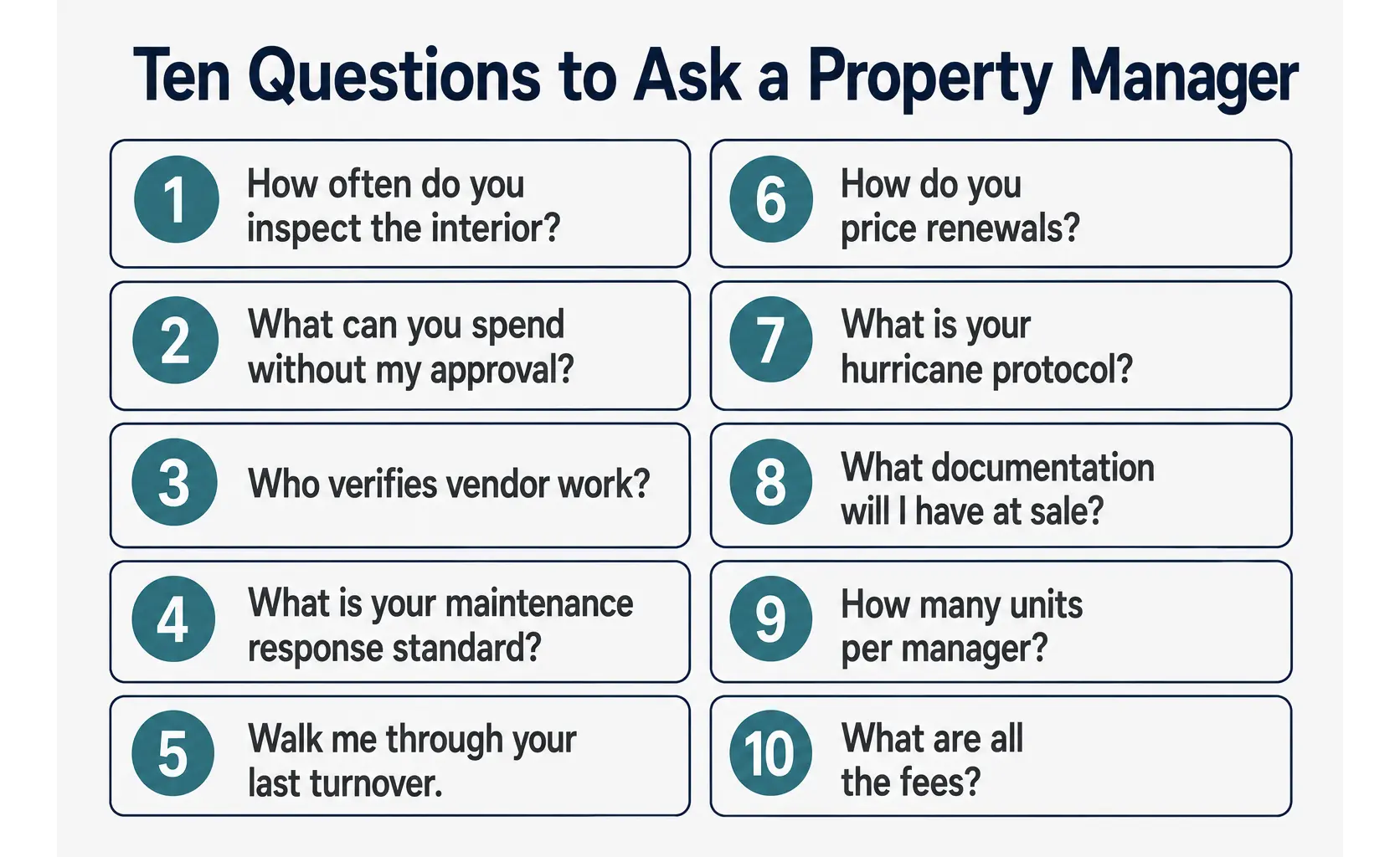
Ask these in order. The pattern of answers is more informative than any single response.
1. How often do you physically inspect the interior, and what do I receive?
Look for a defined schedule and a written report with dated photographs. “As needed” means when a problem is already visible.
2. What can you spend without contacting me, and what is the escalation path above it?
A defined threshold means routine repairs proceed immediately instead of waiting on approval cycles. No threshold means either constant interruptions or unauthorized decisions.
3. Who selects vendors, and who verifies the work before payment?
The key word is verifies. If the vendor’s invoice is the only evidence the work was done to standard, quality is self-reported.
4. What is your maintenance response standard, and how do you measure it?
Look for a stated timeframe by urgency level and some form of tracking. Maintenance response time is one of the most consistent drivers of tenant retention.
5. Walk me through your last turnover on a comparable property.
Ask for the specifics: notice date, move-out date, work completed, lease signed, rent start. This single question surfaces whether the firm sequences turnovers in parallel or waits for the unit to empty before starting, as described in reducing vacancy between tenants in South Florida.
6. How do you price renewals?
A market analysis per unit is a different operation from a flat annual increase or no increase at all. Renewal pricing determines whether the rent roll tracks the market or drifts below it.
7. What is your hurricane protocol?
Specifically: what happens in the 72 hours before landfall and the 48 hours after. A South Florida firm without a documented answer here has not thought seriously about the region they operate in.
8. What documentation would I have if I sold or refinanced in three years?
Maintenance history, inspection reports with photographs, capital records, and lease history all affect diligence and pricing. A firm that keeps records only for its own convenience will not have this.
9. How many units does each property manager handle?
There is no universal correct number, but the answer tells you how much attention your property will realistically receive. A vague answer usually means a high one.
10. What are all the fees, including the ones that are not the management fee?
Leasing, renewal, maintenance coordination markups, inspection fees, vacancy fees, and early termination charges. Total annual cost matters, not the headline percentage — the fuller argument is in operational oversight vs. rent collection.
How to Evaluate a Property Management Company: Ask for Artifacts
The most efficient evaluation step: request four documents, with client details redacted.
A recent inspection report. Does it include dated photographs, written findings, and a comparison to prior condition, or is it a one-page checklist?
A twelve-month maintenance history for one property. What share of the work was planned versus emergency? A history that is almost entirely reactive tells you how the firm operates regardless of what they said.
A monthly owner statement. Is it categorized and usable for tax preparation and analysis, or a bare list of deposits and withdrawals?
A renewal analysis. Does one exist at all? This is where firms most often reveal that renewals are handled administratively rather than analytically.
A firm with systems produces these readily. A firm without them will explain that every client’s situation is different — which is true, and not a reason to be unable to show one example.
Contract Terms That Deserve Scrutiny
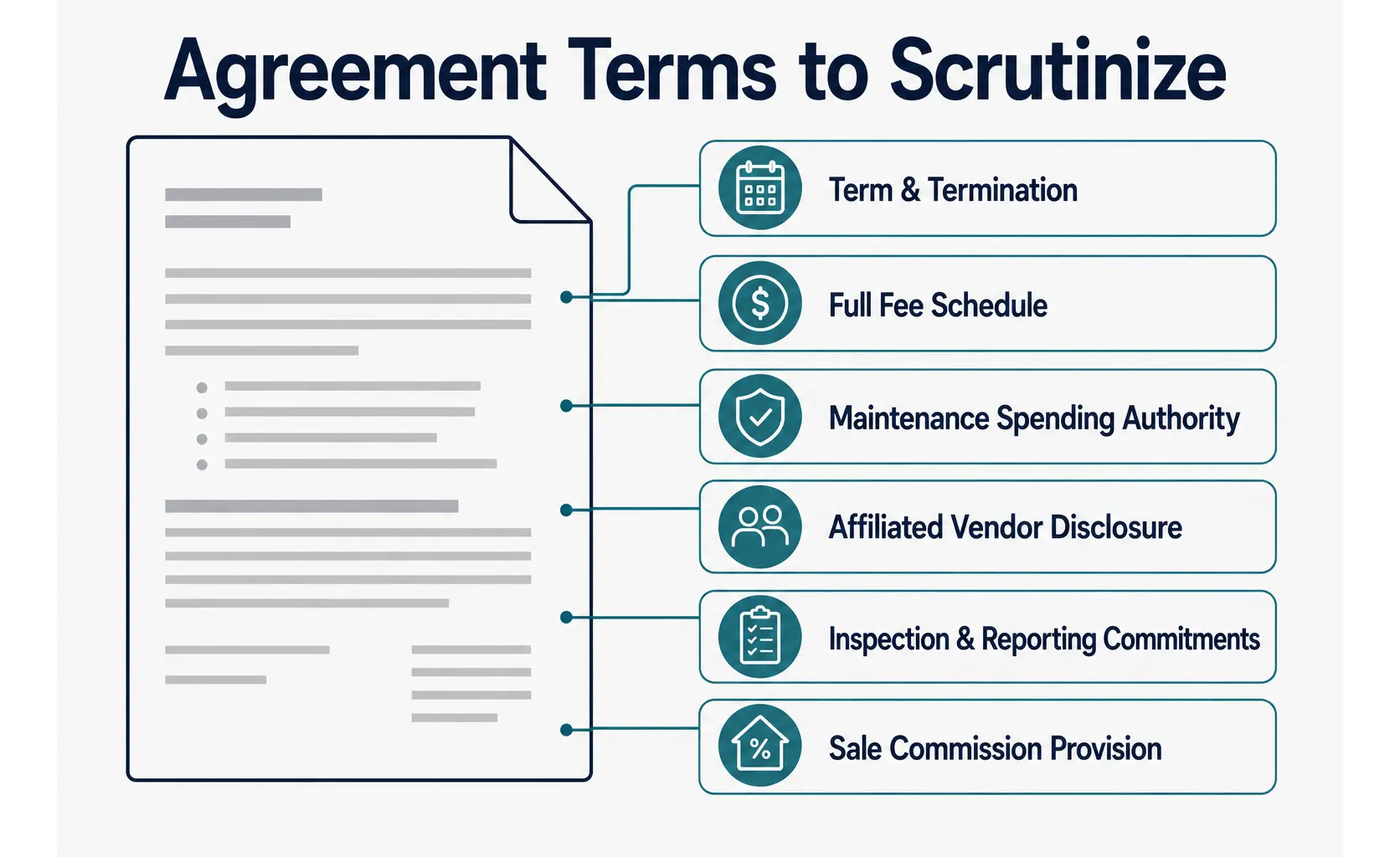
Read the management agreement with these specific items in mind.
- Term and termination. How long is the initial term, what notice is required to terminate, and is there a termination fee? A short notice period signals confidence.
- Fee schedule in full. Every fee, when it applies, and how maintenance coordination is charged. Confirm whether vendor invoices are passed through at cost or marked up.
- Maintenance authority. The spending threshold and escalation process should be written into the agreement, not left to practice.
- Vendor relationships. Disclose whether the firm owns or has a financial interest in any maintenance company it hires. This is not automatically disqualifying, but it must be disclosed.
- Reporting commitments. Inspection frequency and reporting deliverables should appear in the contract. Verbal commitments are unenforceable.
- Owner approval rights. Which decisions require your consent — lease terms below a threshold rent, capital work above a limit, tenant selection criteria.
- Indemnification and liability. Understand what the firm is responsible for and what it disclaims.
- Sale provisions. Some agreements claim a commission if the owner sells during the term, including to the tenant. Know whether yours does.
For a trustee or executor, one additional item matters: the agreement should support the documentation obligations of fiduciary administration, since inspection reports and maintenance records become part of the estate’s evidence of prudent care. That standard is covered in property management for trustees and estate executors.
Red Flags
- Cannot produce a single redacted inspection report
- No defined maintenance spending threshold
- No answer on hurricane protocol
- Renewals handled as a flat increase with no market analysis
- Vendor work not independently verified before payment
- Fee schedule that arrives only after you request the contract
- Reluctance to provide owner references with comparable portfolios
- Pressure to sign quickly, or a long initial term with a high termination fee
- Marketing that emphasizes the lowest fee as the primary differentiator
What Matters Most for South Florida Owners
Three regional capabilities should carry disproportionate weight here.
Storm operations. Pre-storm preparation, post-storm inspection, and photographic documentation for insurance purposes happen on a schedule set by the weather. A firm without a written protocol will improvise, and improvisation during a regional emergency produces poor results.
Climate-driven preventative maintenance. Heat, humidity, and salt air make HVAC, roofing, moisture control, and drainage the highest-consequence systems. A firm without a calendared approach to these will be reactive by default, which is the pattern examined in preventative maintenance as an asset protection strategy.
Insurance-aware documentation. Given current market conditions — see what South Florida owners should know about insurance rates — condition records directly affect underwriting and claims. Documentation should be routine rather than requested.
Grow Your Assets
Beam Residential is built for owners who evaluate managers on operations rather than fee: scheduled photographed inspections, written maintenance thresholds, verified vendor work, market-based renewal pricing, a defined hurricane protocol, and reporting that holds up in a refinance, a sale, or an estate accounting.
Whether you have inherited South Florida rental property or you are replacing a manager who only collects rent, ask us the ten questions above and ask to see the artifacts.
Contact Beam Residential to start that conversation.
FAQ
Do property managers need a license in Florida?
Property management activity that includes renting or leasing property for others generally requires a real estate license in Florida, with firms typically licensed through a broker. Requirements depend on the specific services performed, so verify license status and how the firm is licensed through the Florida Department of Business and Professional Regulation before signing.
What questions should I ask a property management company?
Ask about inspection frequency and what reporting you receive, the spending threshold they can act on without approval, who verifies vendor work before payment, their maintenance response standard, a walkthrough of their most recent turnover, how renewals are priced, their hurricane protocol, what documentation you would have at sale or refinance, units handled per manager, and the complete fee schedule.
What documents should I request before signing a management agreement?
A redacted recent inspection report, a twelve-month maintenance history for one property, a sample monthly owner statement, and a sample renewal analysis. These four artifacts reveal how a firm actually operates more reliably than any interview.
What are typical property management fees in South Florida?
Management fees are commonly a single-digit percentage of collected rent, often with separate leasing and renewal fees. The more important number is total annual cost including all ancillary fees, evaluated alongside the operational outcomes it produces — vacancy days, maintenance spend, and renewal rates.
How do I know if a property manager is actually inspecting my property?
Require inspection reports with dated photographs and written findings, and confirm the reporting cadence is written into the management agreement. Photographs with visible dates and comparison to prior condition are the practical evidence; a checklist without images is not.
What contract terms should I negotiate?
Termination notice and any termination fee, the full fee schedule including maintenance markups, the written maintenance spending threshold, inspection and reporting commitments, disclosure of any affiliated vendor relationships, owner approval rights on leases and capital work, and any provision claiming a sale commission.
Should I choose the manager with the lowest fee?
Rarely. Across a portfolio, vacancy duration, maintenance timing, renewal rates, and vendor pricing move considerably more money than the difference between two fee structures. The right comparison is total cost of ownership, not the headline percentage.