
How Beam Handles Property Management for Trustees and Estate Executors

A trustee’s obligation on a rental property is not to maximize its income. It is to preserve it prudently and to be able to demonstrate that they did.
That distinction is why property management for trustees and estate executors is a different problem than investor-held rental property. An investor who defers a roof repair makes a judgment call about their own money. A trustee who defers the same repair makes a decision affecting beneficiaries who did not consent to it, in a role where the standard is prudent administration and the evidence is the record.
Most trustees and executors do not arrive in this position by choice. They inherit a set of South Florida rental properties with unfamiliar leases, undocumented maintenance history, tenants they have never met, vendors they cannot evaluate, and insurance policies they did not select — often while living in another state and administering the rest of the estate at the same time.
What the Role Actually Requires
Fiduciary standards vary by instrument and jurisdiction, and nothing here is legal advice. But across trusts and probate estates, the recurring operational expectations are consistent enough to plan around.
Preserve and protect the property. The asset should not lose value through neglect during administration. In South Florida, where humidity, storm exposure, and HVAC strain accelerate deterioration, “no action” is not neutral — it is a decision with a predictable cost.
Keep income-producing property productive. Occupied units should be leased on defensible market terms, with rent collected and accounted for. An avoidable extended vacancy is a real loss to the estate.
Maintain separate, accurate records. Rental income and property expenses must be tracked distinctly from other estate assets, with documentation that supports accounting to beneficiaries and, where required, to a court.
Act impartially among beneficiaries. Where beneficiaries disagree — one wants to sell, another wants to hold — decisions need to rest on documented condition and financial reality rather than on whichever party is most insistent.
Maintain adequate insurance. Coverage on inherited property is frequently stale, incorrectly titled, or inadequate for current replacement cost. Owners feeling the market pressure directly should read what South Florida owners should know about insurance rates.
Every one of these obligations produces the same practical requirement: a documented record of what was done, when, and why.
The Documentation Standard
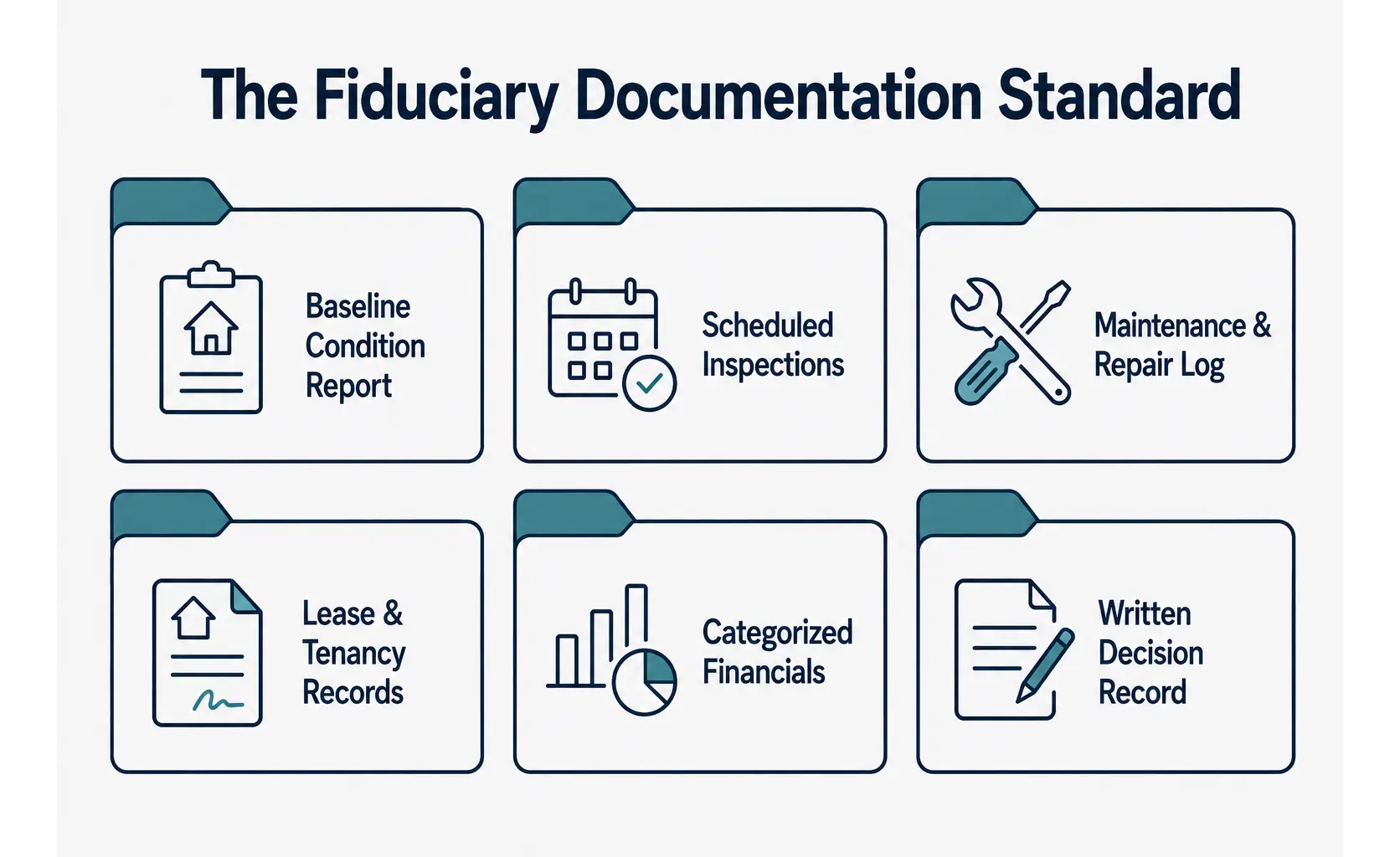
For a fiduciary, undocumented work has limited defensive value. The useful question is not “was the property maintained?” but “can it be shown, item by item, with dates?”
A defensible record on an estate-held rental property includes:
A dated baseline condition report. Photographs and a written assessment of each property at the start of administration. This establishes what the fiduciary inherited versus what occurred on their watch — the single most valuable document in the entire file, and the one most often skipped.
Scheduled inspection reports. Periodic interior and exterior inspections with photographs and written findings, so condition trends are visible rather than inferred.
A complete maintenance and repair log. Every work order, vendor, scope, cost, and completion date. This is what converts “we took care of the property” into an auditable record.
Lease and tenancy records. Current leases, rent roll, payment history, deposit accounting, notices, and renewal terms — including for inherited tenants whose paperwork may be incomplete.
Categorized operating financials. Income and expense by property, in a format that supports estate accounting and tax preparation rather than requiring reconstruction from bank statements.
A written record of significant decisions. When a capital repair is approved, deferred, or a property is held rather than sold, the reasoning and supporting data should be captured at the time. Reconstructing rationale months later, under beneficiary scrutiny, is a materially weaker position.
The First 90 Days of Administration
The early period sets the trajectory of the entire administration. Five actions matter most.
1. Establish the Baseline
Inspect and photograph every property before anything changes. Document deferred maintenance that predates the fiduciary’s authority. This protects the fiduciary and gives beneficiaries an honest starting point.
2. Verify the Tenancies
Confirm who occupies each unit, under what written terms, at what rent, with what deposit held and where. Inherited tenancies frequently include verbal arrangements, expired leases operating month-to-month, or below-market rents that need a documented plan rather than an abrupt change.
3. Confirm Insurance and Titling
Verify that coverage is active, adequate, and correctly reflects the current ownership entity. A claim denied because the named insured no longer matches the titleholder is a preventable and expensive failure.
4. Triage Safety and Structural Risk
Address items that create liability or accelerating damage first: water intrusion, electrical hazards, roof compromise, drainage problems, non-functioning smoke or CO detectors. These are not discretionary improvements; they are preservation.
5. Stabilize Operations Before Making Strategic Decisions
Whether to sell, hold, or distribute should be decided from stable operations and real data, not during a period when condition is unknown and records are incomplete. Selling a property with undocumented deferred maintenance predictably yields a lower price and a rougher diligence process.
Where Fiduciaries Get Exposed
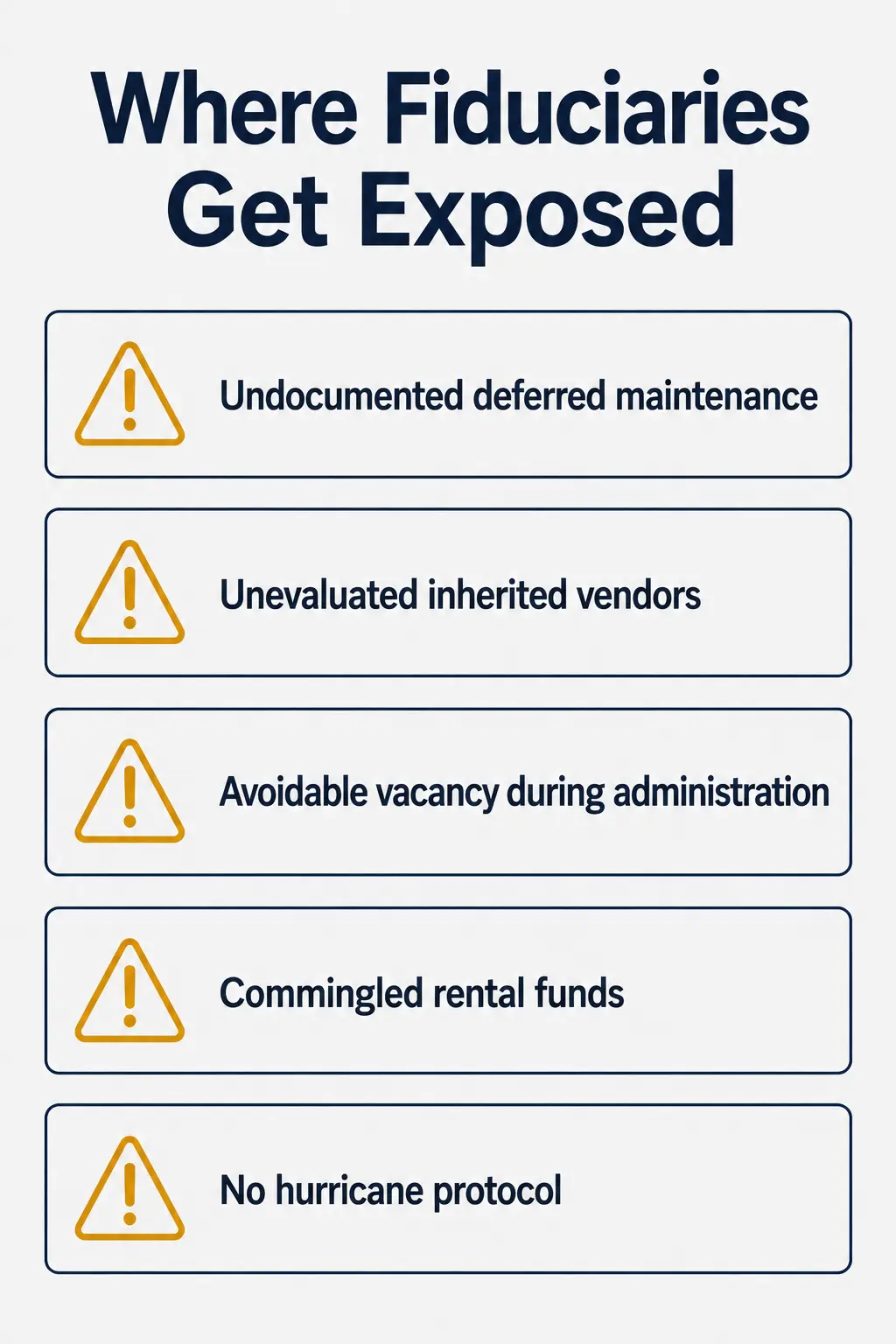
The recurring failure patterns are operational, not legal.
Deferring maintenance to preserve estate cash. Understandable, and often reasonable in the short term — but undocumented deferral looks identical to neglect when a beneficiary reviews it later. Deferral decisions should be recorded with their reasoning and the estimated consequence.
Relying on the previous owner’s vendors without evaluation. Longstanding relationships may be excellent or may reflect decades of unexamined billing. A fiduciary should verify scope and pricing rather than inherit both.
Allowing avoidable vacancy. An empty unit during administration is a direct reduction in estate income. The mechanics of compressing that gap are covered in reducing vacancy between tenants in South Florida — the same operational discipline applies, with a higher standard of accountability attached.
Commingling funds. Rental income deposited into personal or general accounts creates accounting problems that are difficult to unwind and easy for a beneficiary to question.
No hurricane protocol. In South Florida, storm preparation is a preservation obligation. A fiduciary who cannot show what was done before landfall and what was documented afterward is in a weak position on both the insurance claim and the beneficiary conversation.
Investor Management vs. Fiduciary Management
Investor-Oriented Management
- Primary objective: Maximize net operating income and long-term value
- Decision standard: Owner’s risk tolerance and return targets
- Documentation: As needed for taxes, financing, and eventual sale
- Accountability: To the owner
- Time horizon: Multi-year hold, owner-defined
Fiduciary-Oriented Management
- Primary objective: Preserve the asset and demonstrate prudent administration
- Decision standard: Prudence, impartiality among beneficiaries, and defensibility
- Documentation: Continuous, dated, and audit-ready by default
- Accountability: To beneficiaries, co-fiduciaries, counsel, and potentially a court
- Time horizon: Duration of administration, with a defined transition or disposition
Both need competent operations. Only one needs every decision to be reconstructible three years later.
Property Management for Trustees and Estate Executors: How Beam Operates
Beam Residential treats estate-held and trust-held property as an asset under obligation, not just a unit under lease.
Baseline condition documentation at the start of the engagement, with dated photographs of every property.
Scheduled inspections with written findings and photographs, structured so condition changes are visible over time rather than discovered at move-out.
Preventative maintenance on a calendar, targeting the systems that fail most expensively in this climate — HVAC, roofing, plumbing, drainage — following the approach in preventative maintenance as asset protection.
Vendor selection, scheduling, and post-work verification, with work inspected before payment is released.
Documented decision thresholds, so routine repairs proceed immediately while material capital decisions are escalated to the fiduciary with supporting condition data and cost detail.
Reporting built for accounting, not just for reassurance: categorized income and expense by property, maintenance history, rent roll, and renewal calendar.
A defined hurricane protocol covering pre-storm preparation and post-storm inspection with photographic documentation for insurance purposes.
This is the same operational discipline described in residential asset protection, applied where the record matters as much as the result.
Grow Your Asset with Beam
If you are administering a trust or estate that includes South Florida rental property, the operational question is not only whether the asset is being maintained. It is whether you can demonstrate it — to beneficiaries, to counsel, and if necessary to a court.
Beam Residential manages inherited residential property with the documentation standard fiduciary administration requires: dated baselines, scheduled inspections, complete maintenance logs, and reporting that supports estate accounting.
If you’ve inherited South Florida rental property and need a management partner who treats the asset with the same care it took to build it, contact Beam Residential to discuss the properties under your administration.
FAQ
What are a trustee’s responsibilities for rental property held in a trust?
Duties depend on the trust instrument and applicable state law, but they generally include preserving the property, keeping income-producing assets productive, maintaining accurate and separate records, acting impartially among beneficiaries, and maintaining adequate insurance. Practically, all of these require documented condition, maintenance, and financial records. Consult the trust’s counsel for the obligations specific to your instrument.
Can an executor hire a property manager for estate property?
Executors and personal representatives commonly retain professionals — including property managers — to administer estate assets, and reasonable management costs are typically treated as an expense of administration. Authority and approval requirements vary by jurisdiction and by the terms of the will, so confirm with the estate’s attorney before engaging.
What records should a fiduciary keep on an inherited rental property?
A dated baseline condition report with photographs, periodic inspection reports, a complete maintenance and repair log with vendors and costs, current leases and rent roll, deposit accounting, categorized operating financials by property, and a written record of significant decisions including deferrals and the reasoning behind them.
Should an inherited rental property be sold or kept?
That decision belongs to the fiduciary, the beneficiaries, and their advisors — but it should be made from stable operations and documented condition rather than during a period of unknowns. A property with a clear maintenance record and clean financials generally sells more smoothly and prices better than one requiring buyers to underwrite unknown deferred maintenance.
What happens to existing tenants when a property owner dies?
Existing leases generally survive a change in ownership, and the new ownership entity steps into the landlord’s position. The practical work is verifying each tenancy: current written terms, rent, payment history, and where security deposits are held. Inherited tenancies often involve incomplete paperwork or informal arrangements that need to be documented properly. Confirm the specifics with counsel.
How does deferred maintenance affect a fiduciary’s exposure?
Deferral itself is not necessarily improper — fiduciaries routinely make cash-flow judgments. The exposure comes from undocumented deferral, which is indistinguishable from neglect in hindsight. Recording what was deferred, why, and the expected consequence converts a judgment call into a defensible decision.
Why does South Florida require special attention for estate-held rentals?
Climate and storm exposure compress the timeline on everything. Humidity accelerates moisture and mold issues, HVAC systems carry unusual load, and hurricane season imposes time-critical preparation and post-storm documentation requirements. A property left unattended for a season here deteriorates measurably faster than in most other markets.
Authority Outbound Links
- Florida Courts — probate self-help and estate administration resources → https://www.flcourts.gov/Resources-Services/Court-Improvement/Family-Courts/Self-Help-Information
- Florida Office of Insurance Regulation — residential property insurance information → https://www.floir.com/